Field notes
A woodlander's glossary
When new volunteers start working in the wood on a regular basis it becomes clear that established workers appear to be using an alternative language, which poses a dilemma. We do not want to indulge in unnecessary jargon, which tends to be exclusive, but equally we want to use the traditional language of the coppicing and woodland craft industries. In some ways it is as important to keep the language alive as it is to maintain the crafts themselves. With this in mind it was agreed that a glossary of woodland terms would be prepared.
To suggest a word or phrase for the glossary, contact us. The small numbers after an entry link to its sources in the references at the bottom of the page.
Bavin
Pronounced bah’vn. ¹ “A bundle of brushwood or light underwood, such as is used in bakers’ ovens, differing from a faggot in being bound with only one withe or band instead of two.” ³ A statute of 1542 stipulated the dimensions of bavins: 3 feet long and 24 inches in circumference. ⁴
Bavins were also produced for the navy. These were generally cut from furze for the graving of wooden hulls. This involved burning a quick, hot fire under the hull to melt the tar before scraping the bottom and retarring.
Baviner
Beadle, beetle, bittle
A roughly formed mallet, often crafted from thorn tree or knotty ash, both of which are resistant to splitting. ¹ ²
Beanpole
An eight-foot long, straight rod used in the cultivation of climbing plants, especially runner beans. Traditionally cut from coppiced hazel.
Bender
A shelter formed by placing vertical rods around the circumference and bending them overhead to provide an enclosed structure, which is then covered with waterproof material. Mike Abbott had one built of sufficient size to accommodate his wedding reception! ⁵
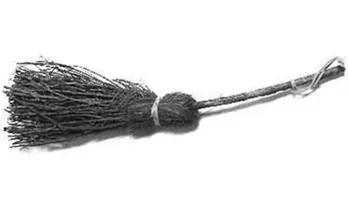
Besom
Traditional broom made from birch twigs and an ash handle. This is the type of broom witches are often depicted flying on! The broom should be used in a sideways swishing motion. ⁸
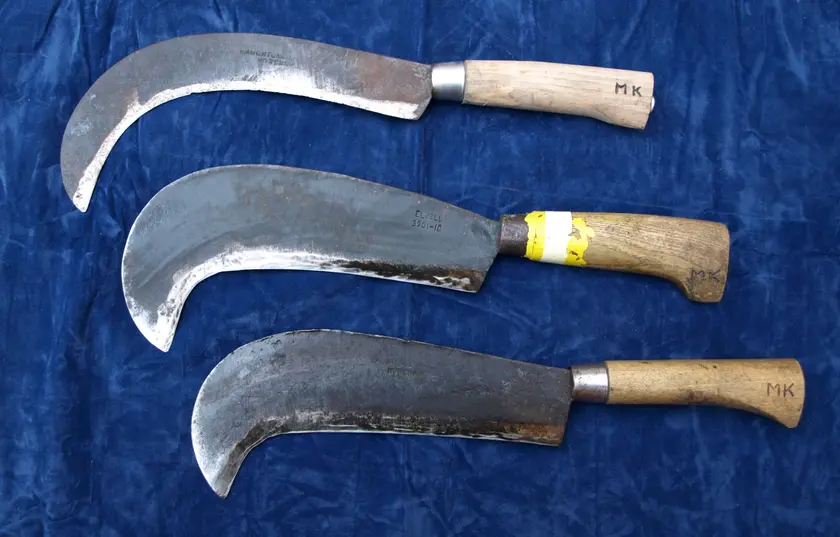
Billhook
The traditional tool for cutting coppice. The basic design is a long straight blade with a hooked end. However, there are many regional variations, and some have a secondary blade on the top edge. A long hook is particularly useful when riving hazel rods for hurdle making. ² ⁶
Binders
See etherings.
Bodger
A largely romanticised word for people who traditionally made turned chair parts in a woodland setting from green wood. ⁷ At the beginning of the twentieth century “a bodger received only 5s (25p) for each gross (144) of legs plus the appropriate number of stretchers (108). To earn a decent living wage of 12s. 6d. (62p) per week meant they had to make a total of 756 turned parts” (Hill, 1994). The bodger would make the turned parts of the chair and sell them on to a dealer, but rarely finish the manufacture of the chair. This may be the origin of the modern use of the word, meaning someone who never finishes a task properly.
Brake
A structure or device. See cleaving brake and saving brake.
Brash
The twiggy tops and offcuts left after a stem has been trimmed.
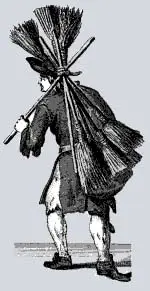
Broom clisher, broom dasher, broom squire
A person who makes or sells brooms, faggots and so on. ¹
Broom horse
A three-legged device used for tying bundles of birch tops together in the process of making besom brooms. ⁸
Brusher
A person who lays hedges. ¹
Cant, coup
Working woods are divided up for management purposes. Each plot is a cant or coup. Cants are usually defined by rides or cant ditches. In Tottington Wood North the cants are recognised by an alphabetical code, which makes management planning and surveying much easier. ²
Cant ditches
Ditches which divide cants within a piece of woodland. These ditches are not necessarily part of the drainage system within the wood. ²
Cleave
The controlled splitting or riving of wood along its length using principles of leverage and wedging; cutting tools are hardly needed in this process. ²
Cleaver
Cleaving brake (break)
A device for holding wood while it is being cleft. A range of styles exist, but the general principle is of two parallel bars, one acting as a fulcrum and the other as a restraining piece. ⁸
Coppicing
An ancient form of woodland management dating back to Neolithic times (4000 BC), and used continuously since then. It consists of cutting trees back to ground level and allowing them to regrow. The resulting rods have a wide variety of uses. The cyclical cutting of the stool does not harm the tree; on the contrary, it prolongs its life, often well beyond the species’ natural span. ⁹
Cord
A measure of cut wood. A cord is a stack of wood 4 ft (1.2 m) high by 4 ft (1.2 m) deep and 8 ft (2.4 m) wide, making a total of 128 cu ft (3.6 m³). ²
Cuckoo gate
One of the Sussex names for a kissing gate. ¹
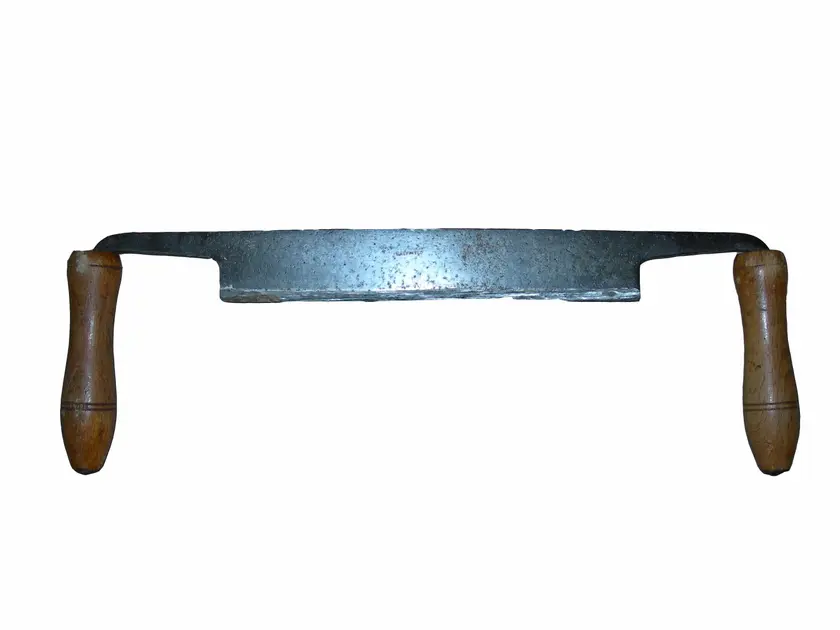
Drawknife
Cutting tool with a blade supported between two handles, often associated with the shaving horse. The drawknife is used to shave small quantities of wood in a motion that pulls the blade towards the operator’s midriff; although this sounds extremely dangerous, in practice it is not so alarming. ²
Etherings
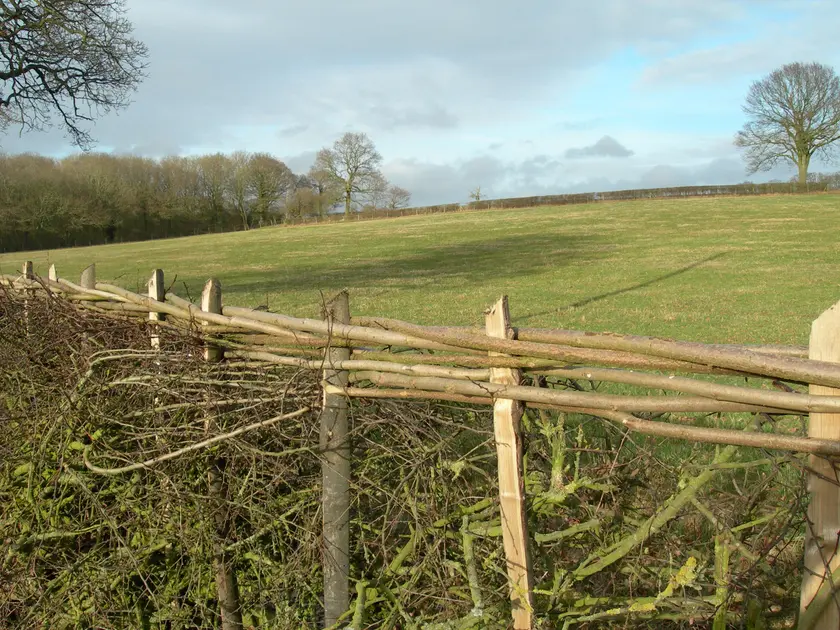
Long rods of hazel used to bind the tops of the stakes in a length of laid hedge. Sometimes called heathers. ²
Faggot
A superior form of bavin, generally bound with two ties and traditionally used as a fuel in ovens and so on. ²
Fammard
Fascine, facine
A bundle of sticks much like a very long faggot, usually 8 to 10 feet long and tied in three places. Fascines are regularly used in river defences, and fascines were cut from Tottington Wood to build the levee along the River Adur. Fascines were also used to stabilise military earthworks and to enable armies to cross ditches with relative ease. ² ¹⁰
Frith
Young underwood. From the Saxon fyrth, meaning grove. ¹ ¹¹
Froe, frow
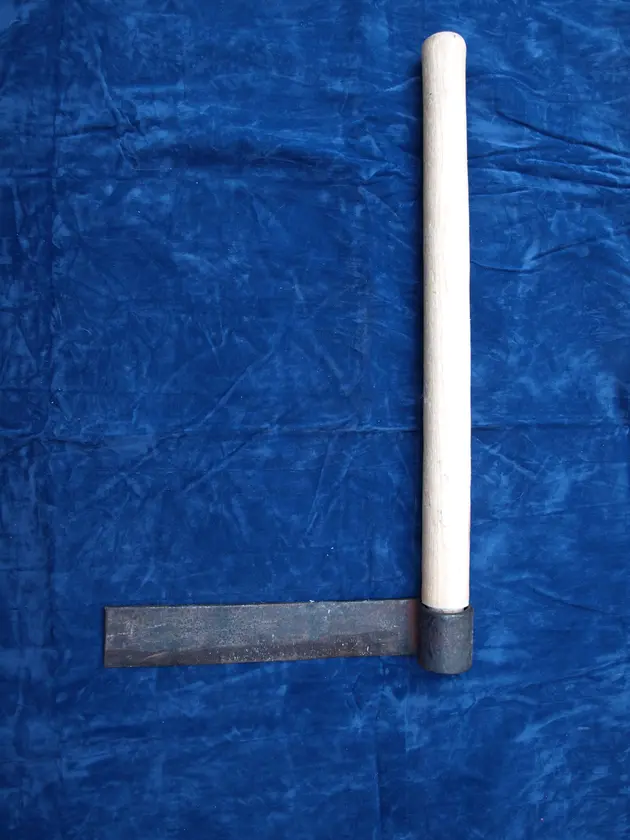
A cleaving tool formed by a long blade and a long handle set at right angles. The tool is used in the cleaving of wood. The sharp edge is at the bottom of the blade, and it is introduced into the wood by a sharp wallop from the beadle. ¹ ² ⁶
Gad
The lengths of round wood from which sparrers are cleft. ²
Glut
Wooden wedges, used for splitting large logs lengthways. ⁶
Green wood
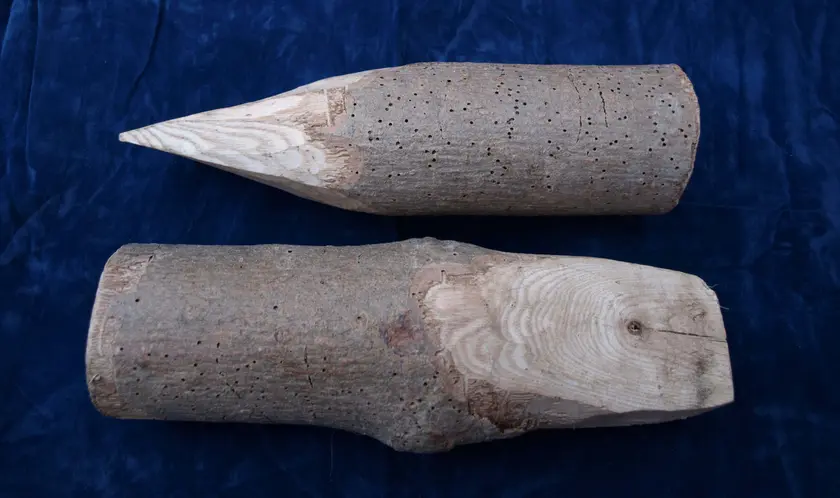
Unseasoned wood: freshly cut, and soft enough to work with hand tools.
Handbill
A similar tool to a billhook. ¹
Heathers
Hedge laying
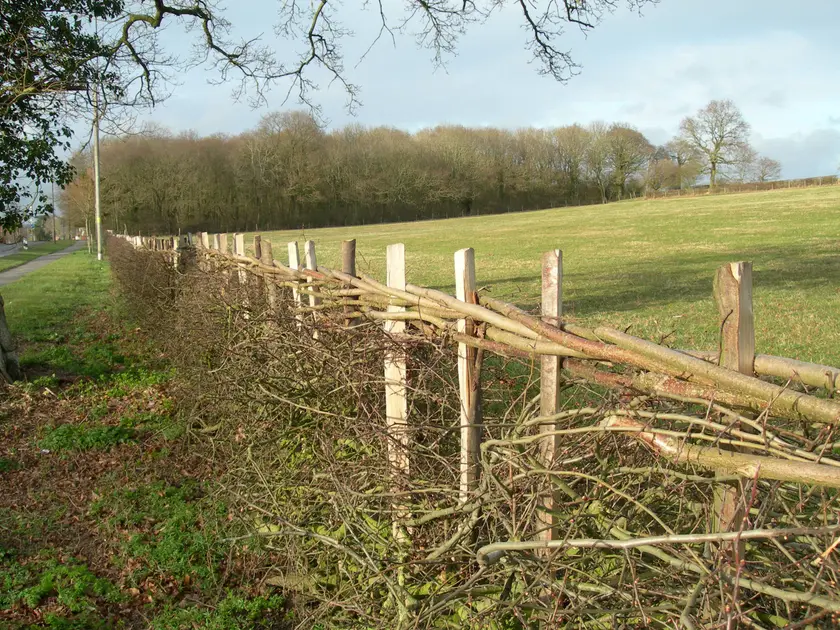
“The main upright stems (known as pleachers) are cut almost through near the ground on the opposite side of the face to the direction of lay and pushed over at an angle of approximately 35 degrees in the direction of the rising slope. Stakes of hazel or ash are driven into the hedge line every 40cm (16in) and the pleachers woven between. Binders or heathers of coppiced hazel, sweet chestnut or willow are then twisted around the top of the stakes to secure the pleachers. The cut stubs of the pleachers are trimmed to keep the stools from rotting. The gap at the end of a laid hedge is usually filled with unwanted pleachers cut from the hedge.” ¹² ¹³
Hurdle
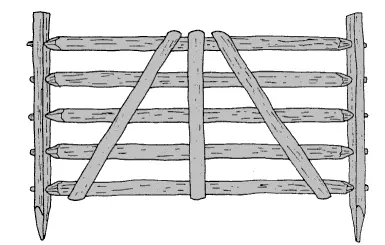
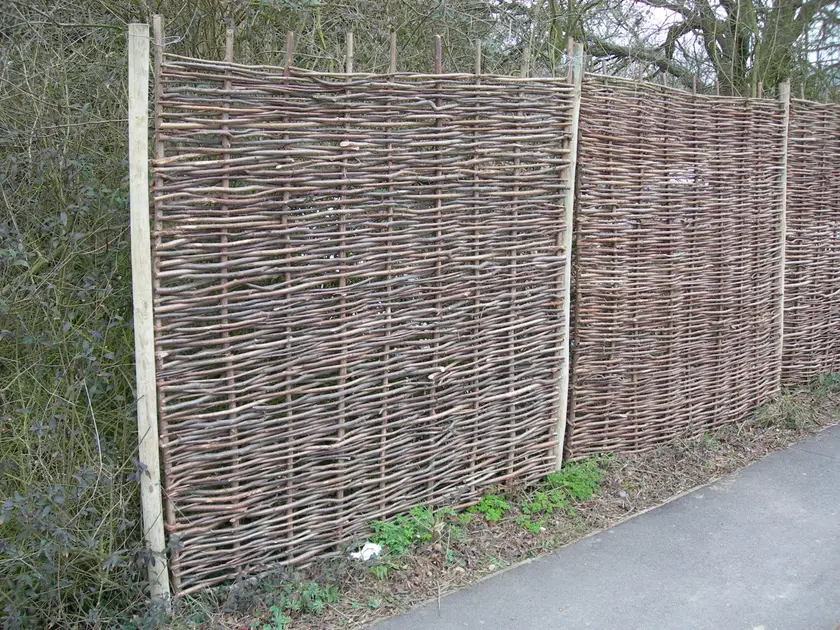
Devices designed to provide portable temporary enclosure. In particular they were used in the folding of sheep. There are two main types of hurdle, the gate hurdle and the wattle hurdle. The former is a mortised structure rather like a five-bar gate in appearance. Wattle hurdles, as the name suggests, are formed from hazel wattle, and have a more closed structure than a gate hurdle. ²
Kiln
A metal drum used for the making of charcoal. Tottington Woodlanders have one located in the south-east corner of the wood.
Kissing gate
Gate which swings between two fixed points, allowing only one person to pass at a time. There is one at the Sands Lane entrance to Tottington Wood.
Layering
A technique for propagating trees. It involves cutting a stem part way through near the base, and then bending the stem down to lie on the ground. The stem is then pegged down and possibly earthed over. Eventually new trees will grow from the old stem. When the new tree is established the old stem can be cut away from the parent plant.
Lordings
Maul
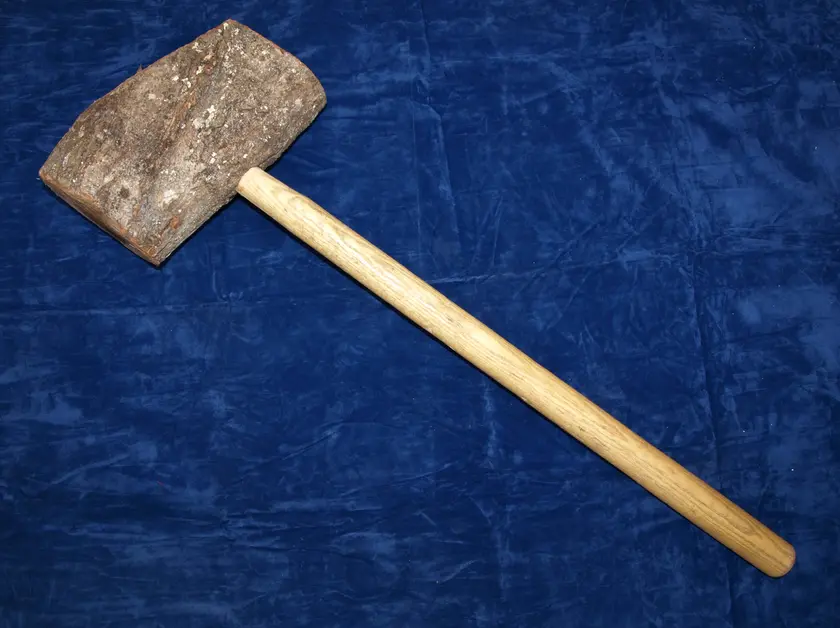
A large wooden hammer, similar in appearance to a sledgehammer. Used for driving in wedges, stakes and pegs. It can also be used for hitting a cleaving axe, and is less likely to damage metal tools than a sledgehammer. ⁶
Mould
A heavy log, six feet in length, with ten holes drilled in it, used in the production of wattle hurdles. The upright stakes or sails are placed into the holes before the wattle is woven. ⁸
Pea bough
A fan-shaped piece of top growth of hazel. Traditionally used to support peas.
Pleachers
The main upright stems in a hedgerow, which are the parts bent over in a laid hedge. ¹³
Pole lathe
A traditional treadle lathe powered by a long springy pole. Tottington Woodlanders demonstrate them at many shows. Mike Abbott’s book Green Woodwork is an ideal introductory text. ⁶
Pollard
A tree cut like a coppice stool but at head height, out of the reach of grazing animals.
Prog
A Y-shaped stick used for supporting and guiding in a variety of situations. Progs are particularly useful for supporting the pole of the pole lathe. ²
Raker
A particular configuration of teeth on a saw blade, which makes it especially suitable for green woodworking. The teeth appear to have large arch-shaped gaps at intervals along their length. These gaps allow the wood to be removed more efficiently.
Riving
Rod
A coppiced stem.
Sails or zales
The upright stakes of a wattle hurdle. ² ⁸
Saving brake (break)
Any structure designed to store cut wood, usually out of contact with the ground.
Shaving horse
A clamping device, which is straddled and operated with the feet. ⁶
Side axe
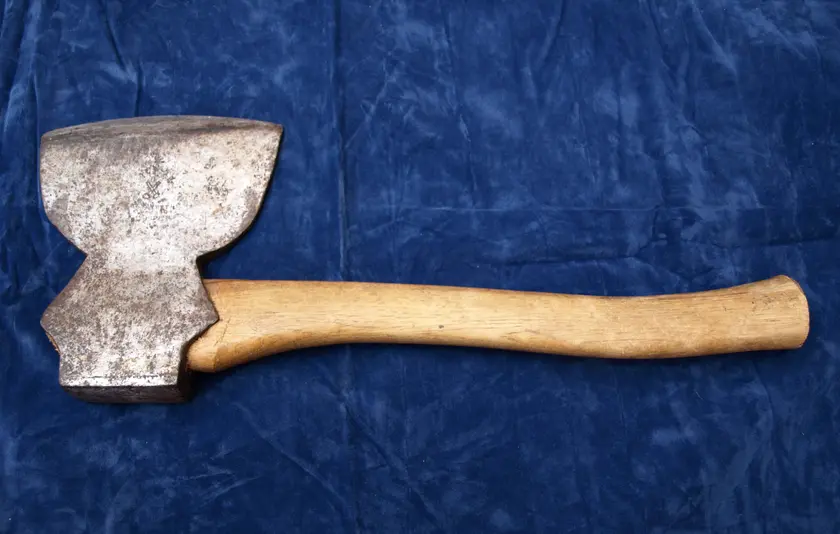
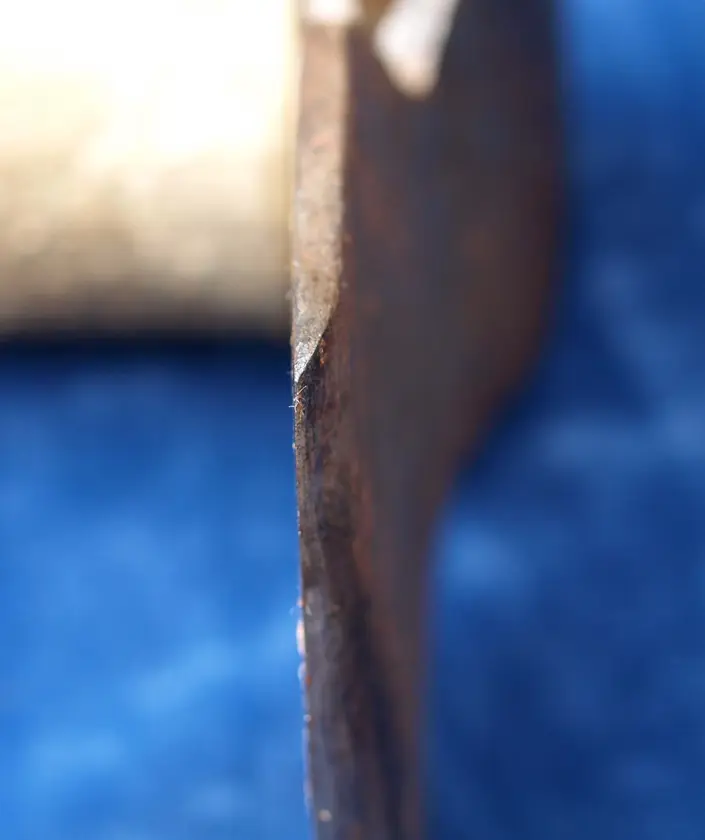
A shaping axe with only one bevelled edge, the other side being completely flat. It operates on the same principle as a chisel, and is very effective at removing wood. This is the tool of choice when pointing stakes. ²
Sparrer or sparrow
This is the old Sussex name for the bent lengths of hazel used to hold thatch on a roof. They are rived from gads. In other parts of the country these pins are known by other names: spar in Dorset, broches in Suffolk, and stakes or spits in Wiltshire. ¹
Standard
A tree such as oak left to grow tall above the coppice, giving timber as well as underwood.
Stool
The multiple shoots from a single rootstock as a result of coppicing a deciduous tree. Some stools in English woods are many centuries old. ¹⁰
To-she-and-fro-she gate
A kissing gate. ¹
Twibill
A mortising knife, used in the manufacture of gate hurdles. Also known as twobill, twivile, dader and tomyhawk. ¹ ⁸
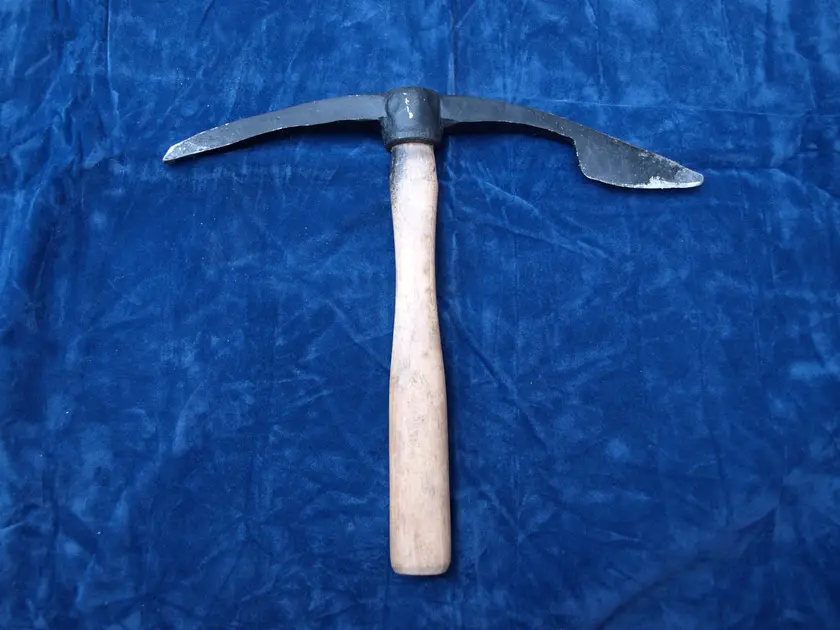
Underwood
The coppiced layer of a wood, as opposed to the timber trees above it.
Wassail
A midwinter blessing of the trees, with songs, noise and something warm to drink. We hold one for members each year.
Whip
A young, slender tree for planting out.
Withe
A thin wand of coppiced wood used as a tie or bond in a variety of situations. ¹
Wood collier or collyer
Individuals engaged in charcoal production. Charcoal was generally referred to as “small coals” to distinguish it from house coal, which was known as “sea coal”.
References
- Parish, W. D. (1981 edition, first published 1875) A Dictionary of the Sussex Dialect and Collection of Provincialisms in Use in the County of Sussex. Gardener’s, Bexhill.
- Tabor, R. (1994) Traditional Woodland Crafts. Batsford.
- Oxford English Dictionary, as quoted on the MARHST-L maritime history mailing list at Queen’s University, Canada (no longer online).
- soagarch.org.uk/firewood.html (no longer online).
- Abbott, M. (2002) Living Wood: From Buying a Woodland to Making a Chair. Living Wood Books.
- Abbott, M. (1991) Green Woodwork: Working with Wood the Natural Way. Guild of Master Craftsman Publications.
- Hill, J. (1994) Jack Hill’s Country Chair Making. David & Charles.
- Jenkins, J. Geraint (1965) Traditional Country Craftsmen. Routledge & Kegan Paul.
- forts.org glossary (archived copy; the original is no longer online).
- Brooks, A. (1994) Woodlands: A Practical Handbook. British Trust for Conservation Volunteers.
- workingwoodlands.info/woodnames.htm (no longer online).
- Arnold, J. (1968) The Shell Book of Country Crafts. John Baker.
- Royal Horticultural Society, hedge laying advice, rhs.org.uk/advice/profiles0203/hedge_laying.asp (no longer online).
- Howkins, C. (1994) Trees, Herbs and Charcoal Burners. Unwin Brothers.
Spend a Sunday in the wood
No experience needed and no commitment expected. Bring a mug and wear old clothes. We supply the tea, the tools and the good company.