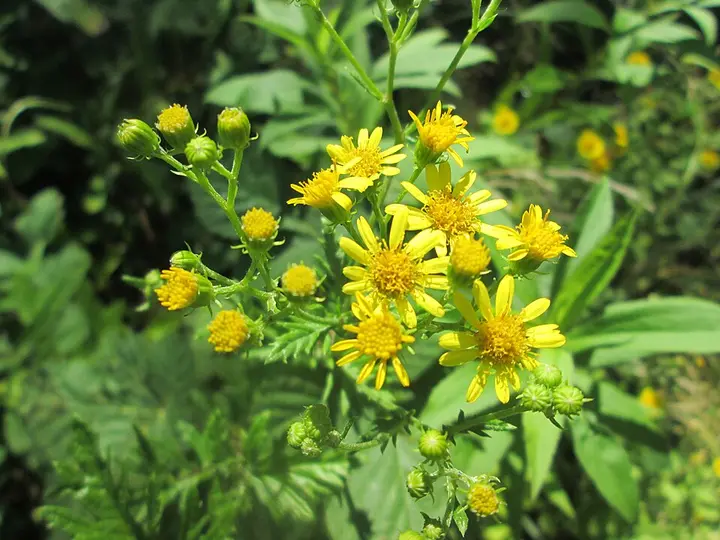
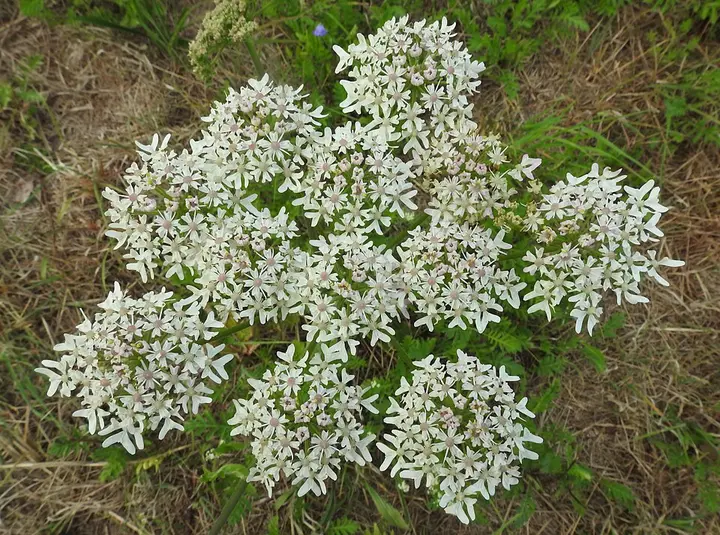
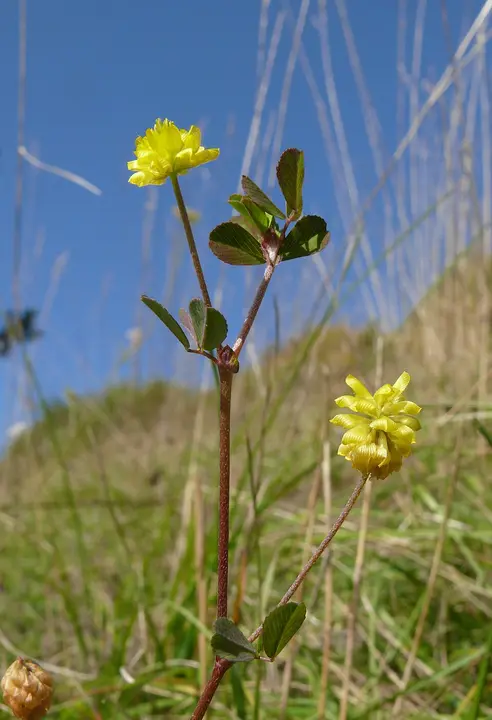
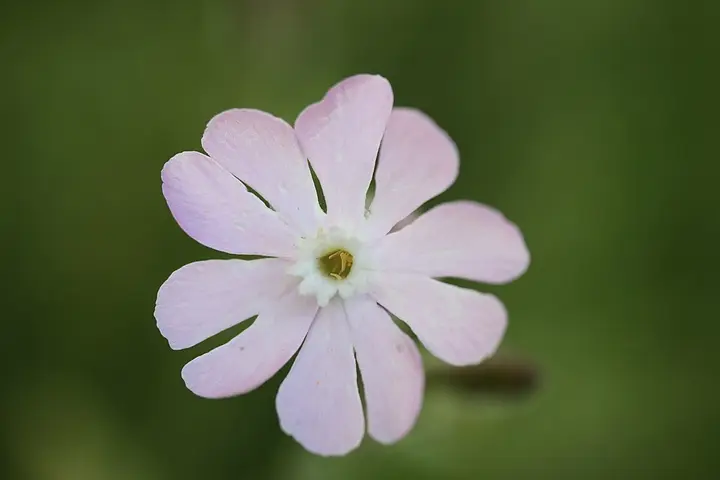
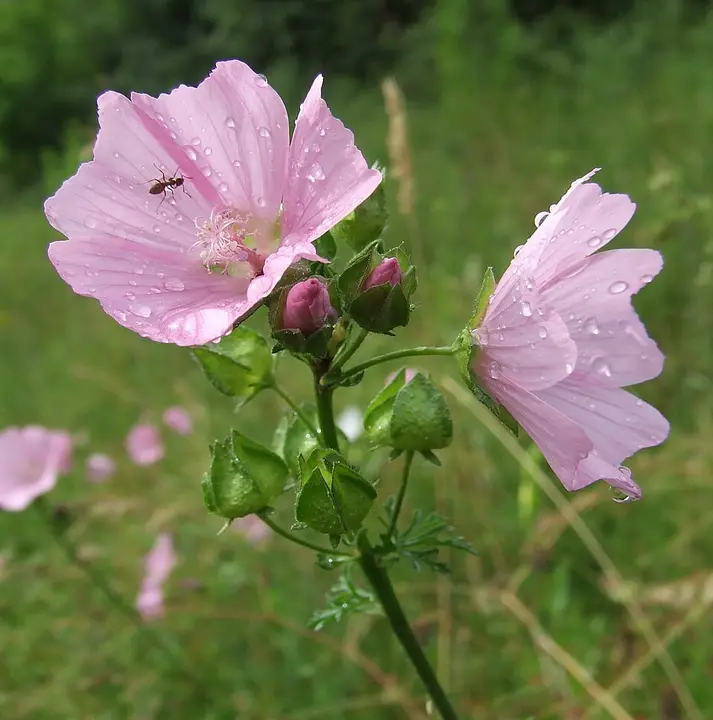
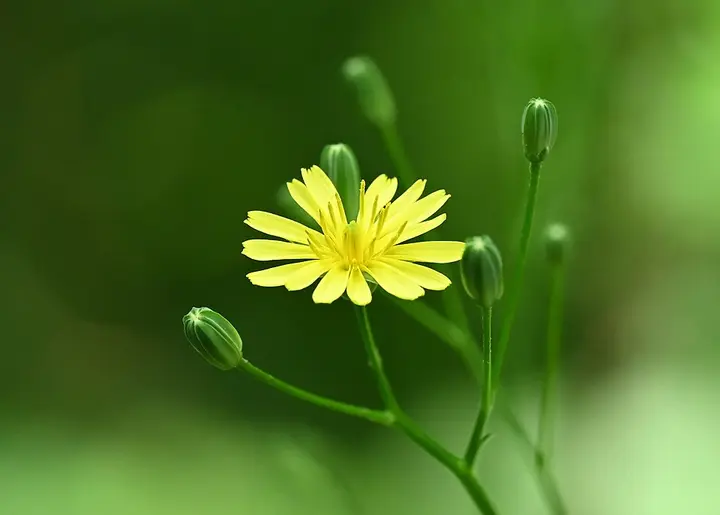
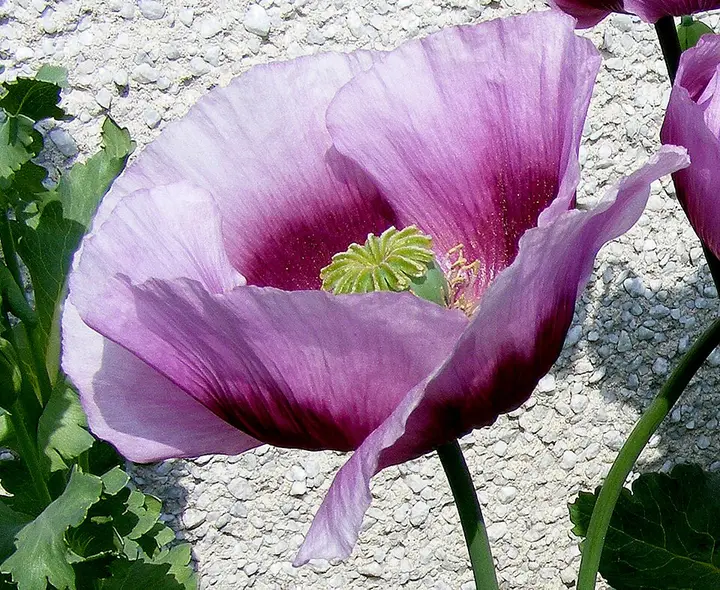
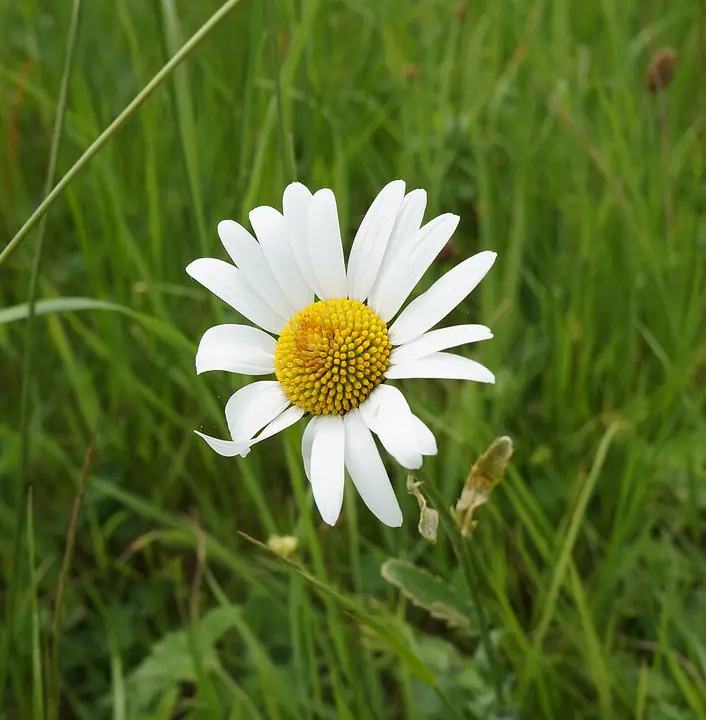
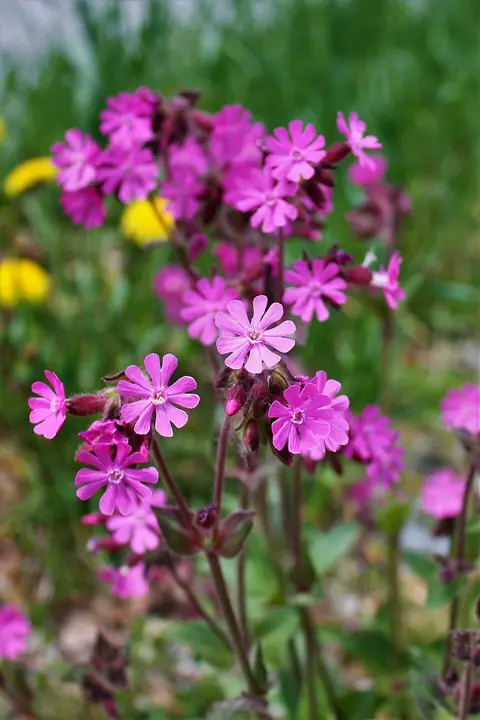
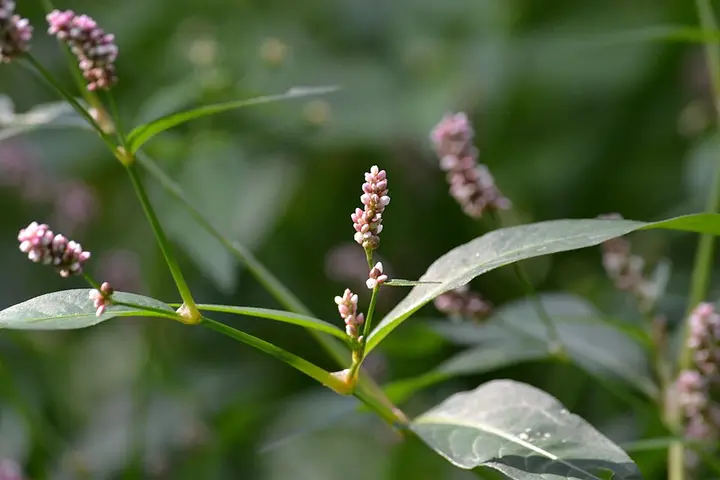
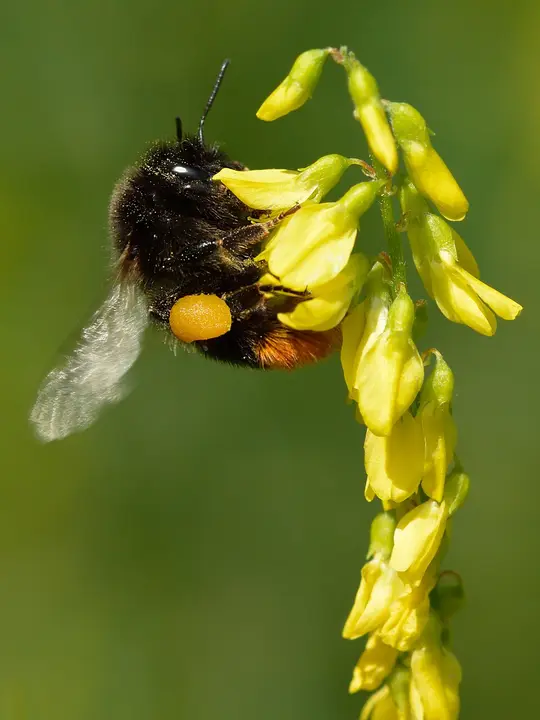
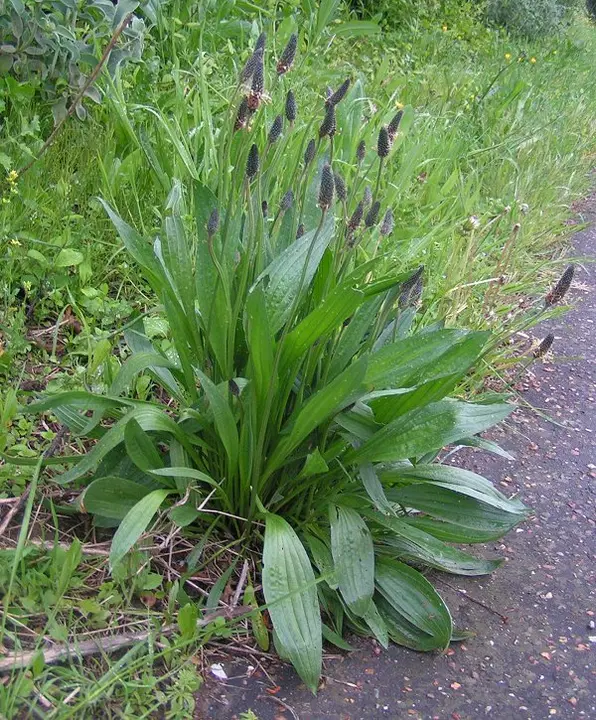
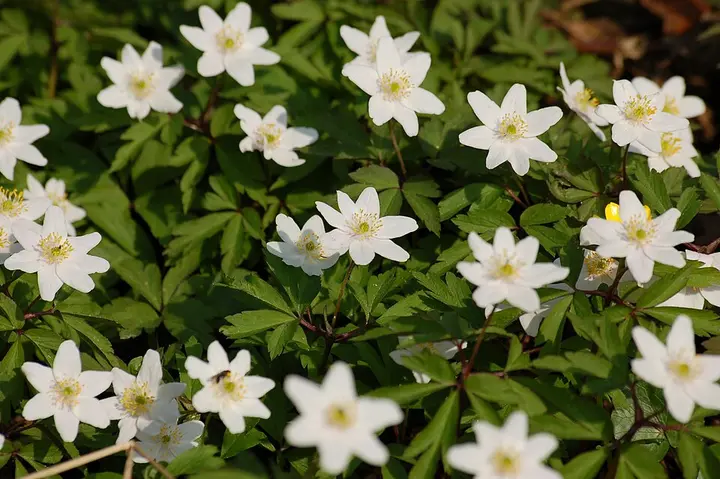
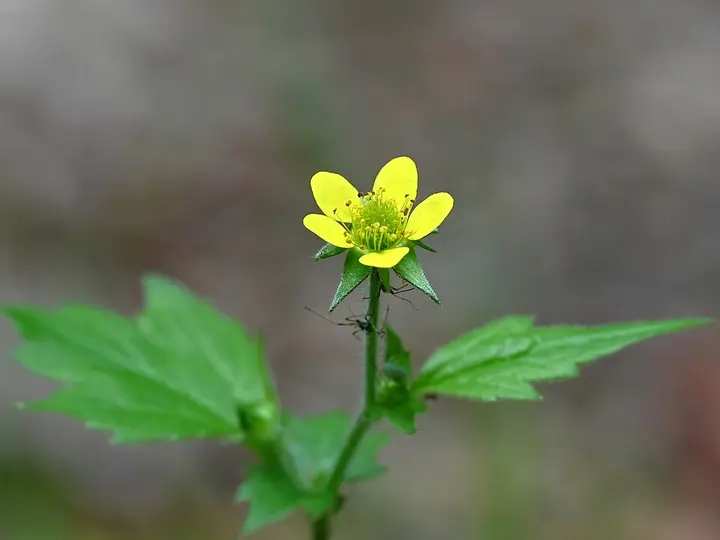
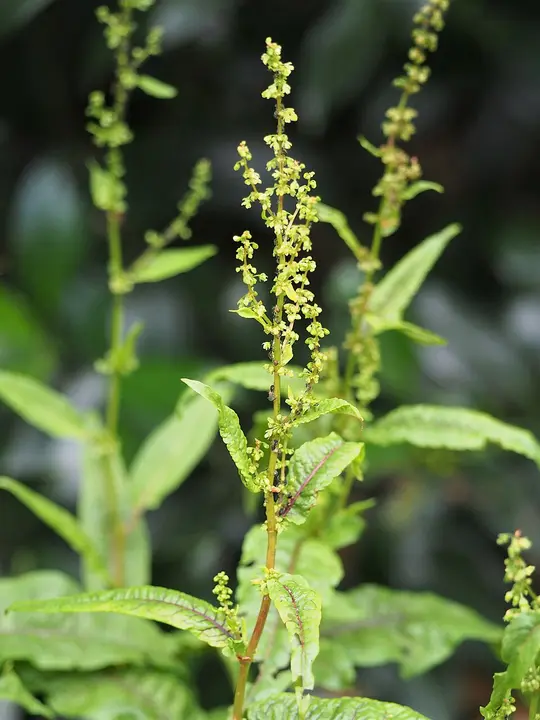
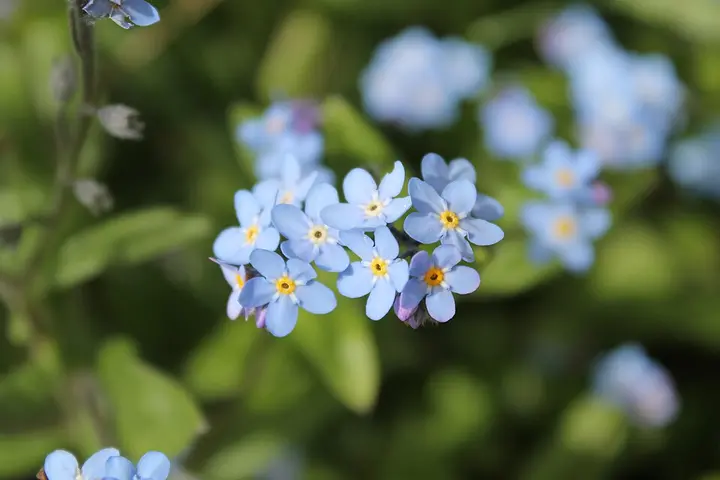
45 plants usually in flower in October

Usual flowering months in Britain, not records from this wood. Ferns and 2 other plants have no flowering months listed; find them under Browse by type.

Trees and shrubs

1

Including pedunculate oak, hazel, holly and wild cherry.

Back to contents

Wild flowers and other plants

43

Including bluebell, wood anemone, primrose and early-purple orchid.

Back to contents

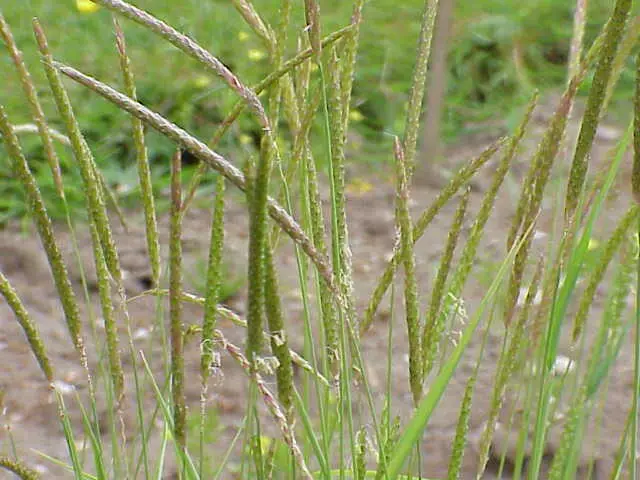
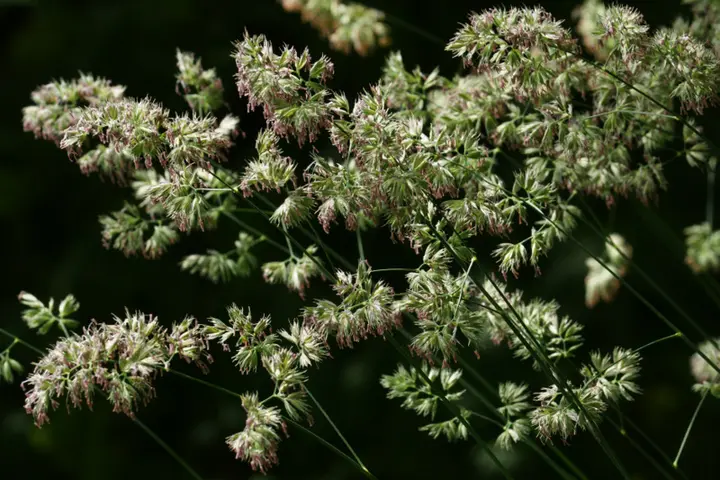
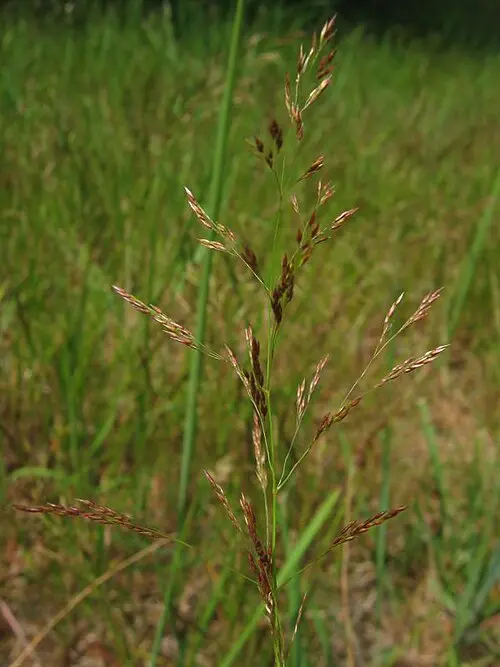
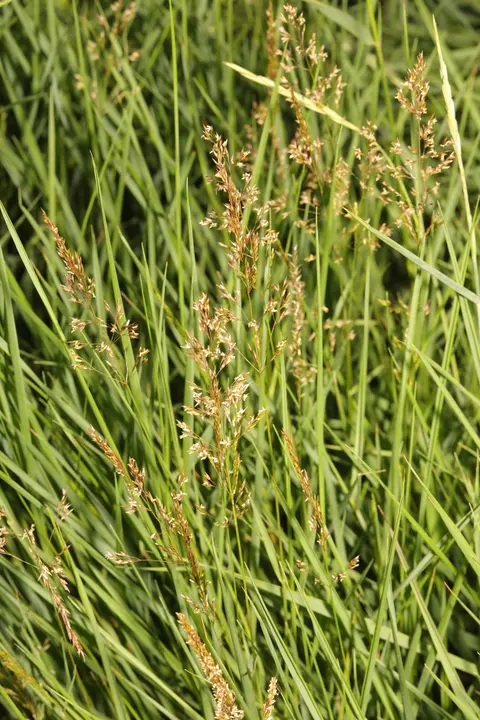
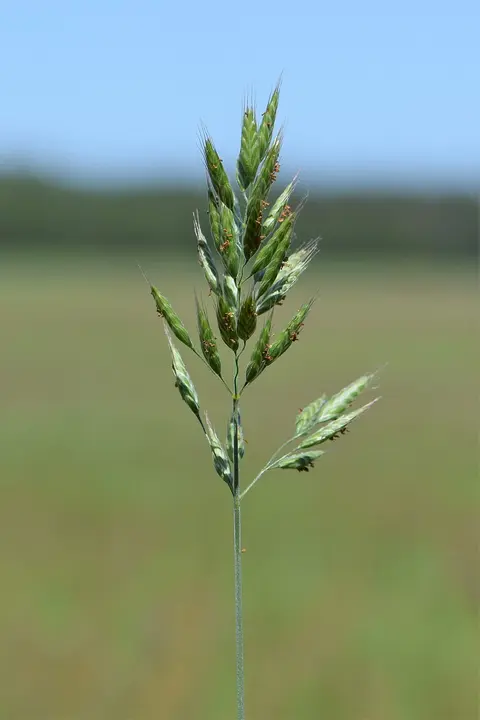
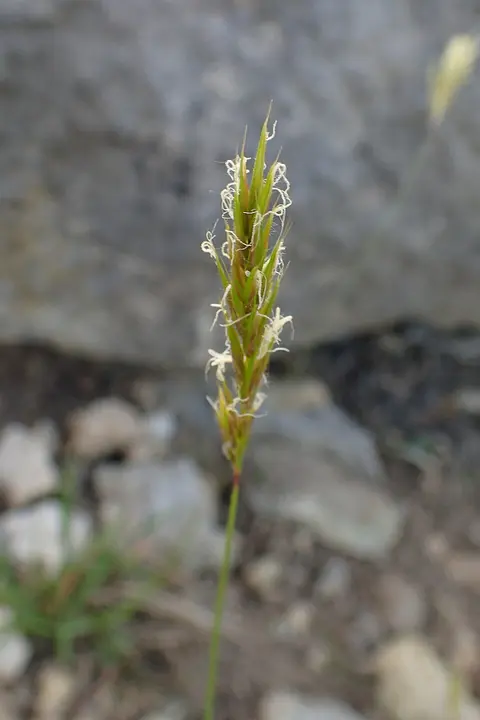
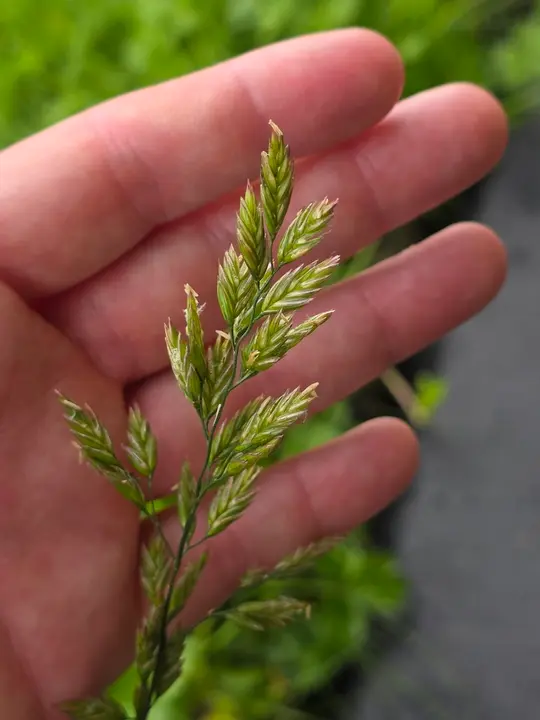
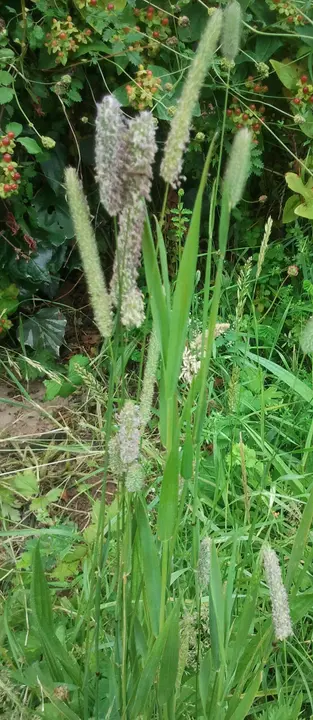
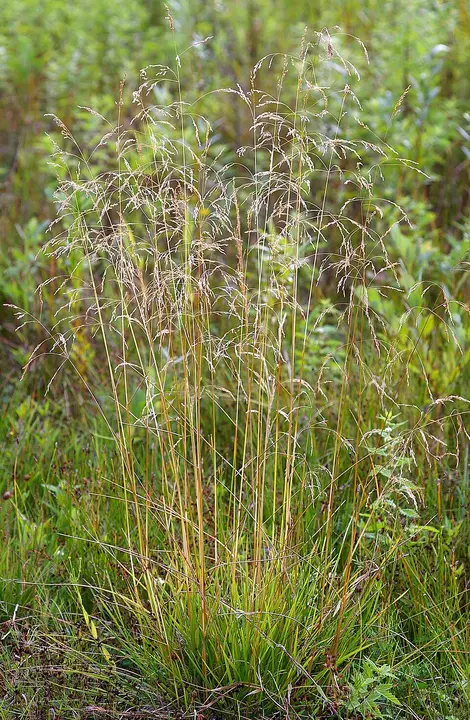
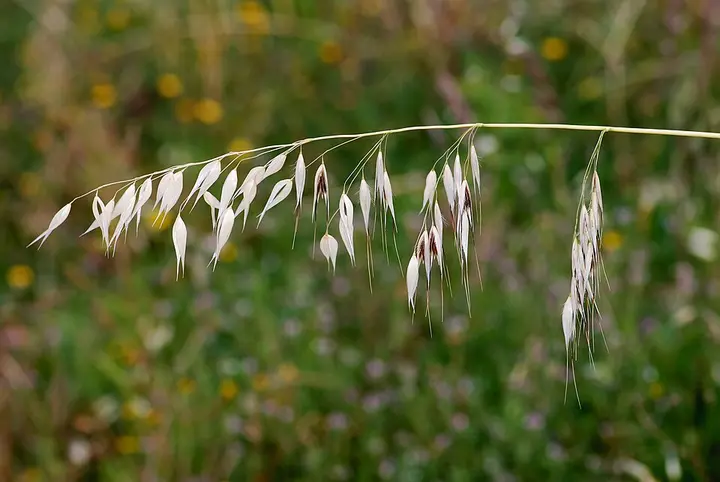
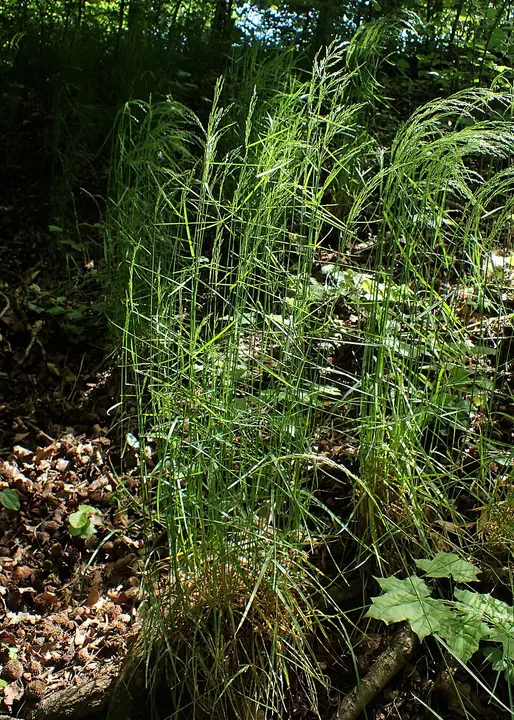
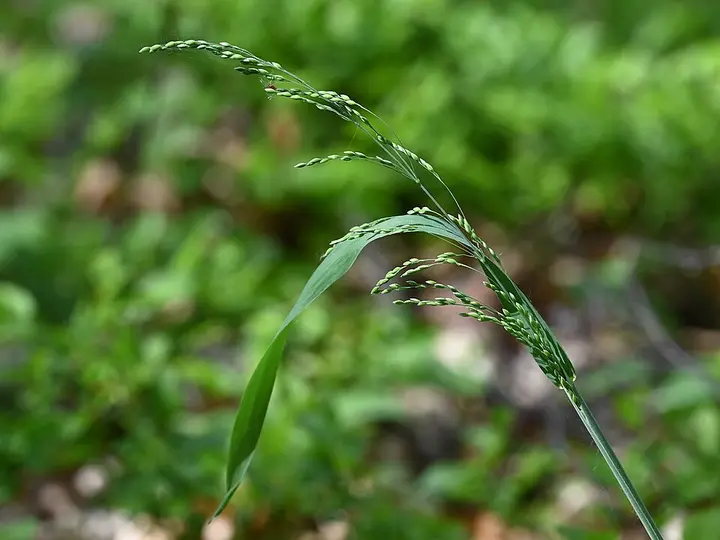
Grasses

1

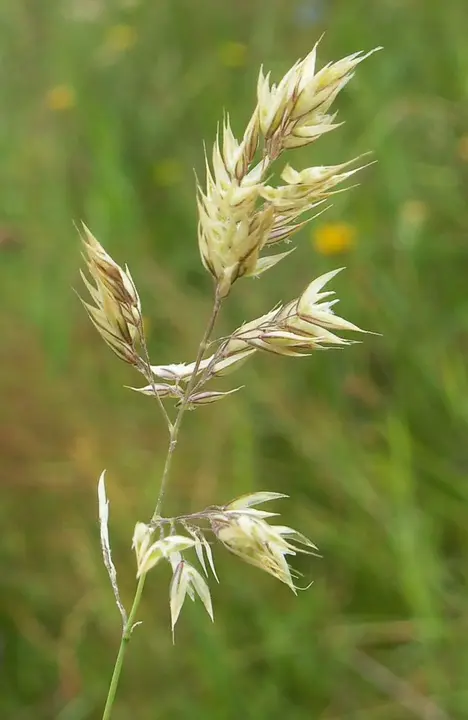
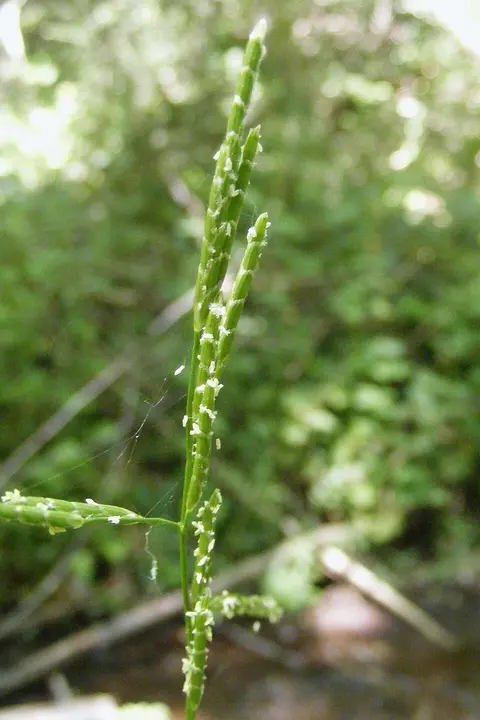
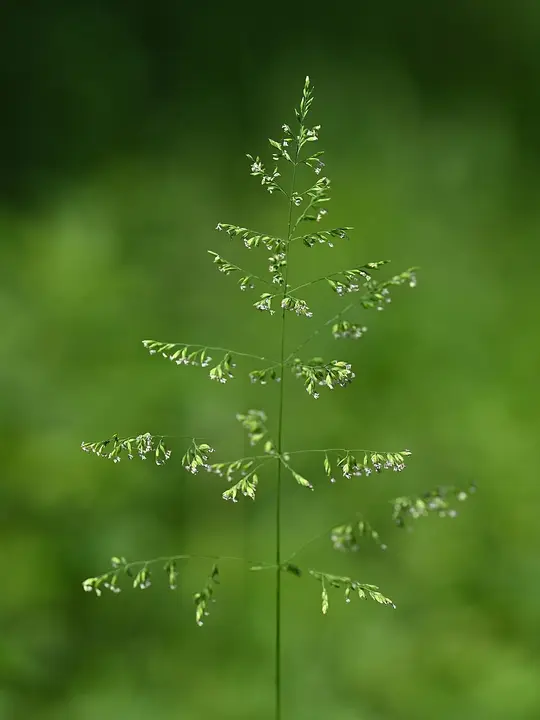
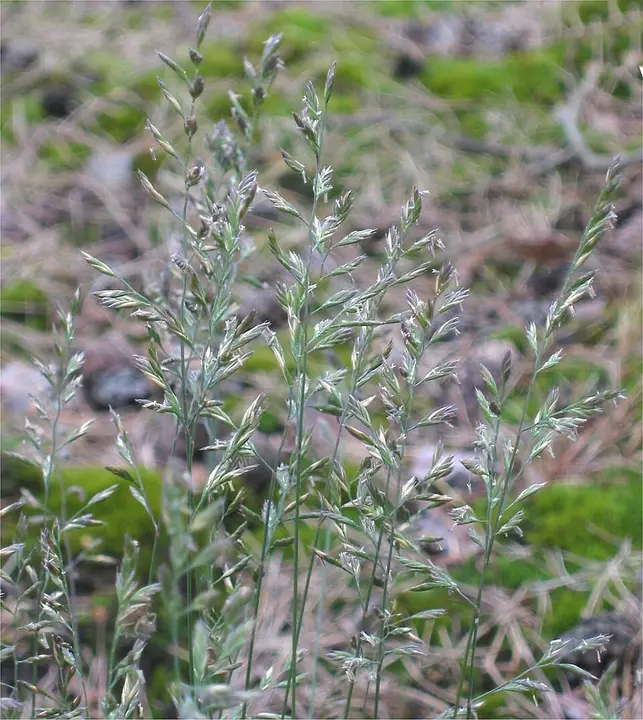
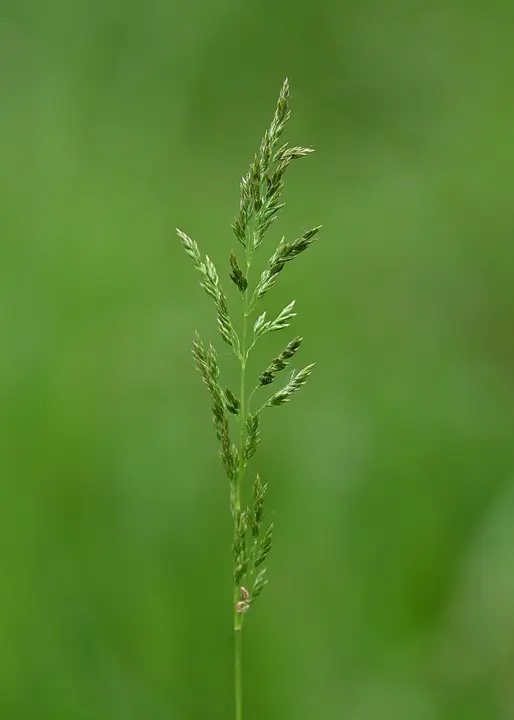
Including Yorkshire-fog, cock's-foot and wood millet.

Back to contents
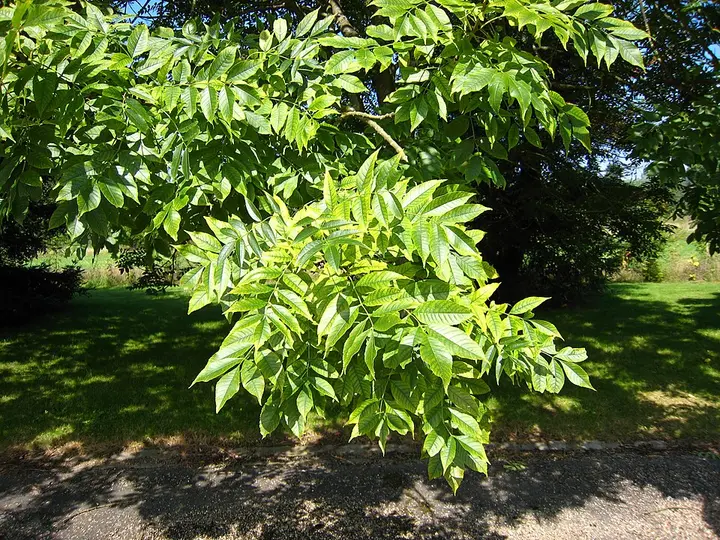
Ash, Fraxinus excelsior

Tree or shrub

Ash

Fraxinus excelsior

A large tree with pale brown to grey bark, black buds in opposite pairs, and leaves made up of several pairs of leaflets with one at the tip. Bunches of winged seeds, called keys, often stay on the tree into winter. It grows in woods, scrub and hedgerows, and many ash trees are being killed by ash dieback, a fungal disease.

When it flowers

April to May

Also called
common ash

Sources: Woodland Trust, NatureSpot

Photo: Matthieu Sontag, CC BY-SA 3.0, via Wikimedia Commons

Close

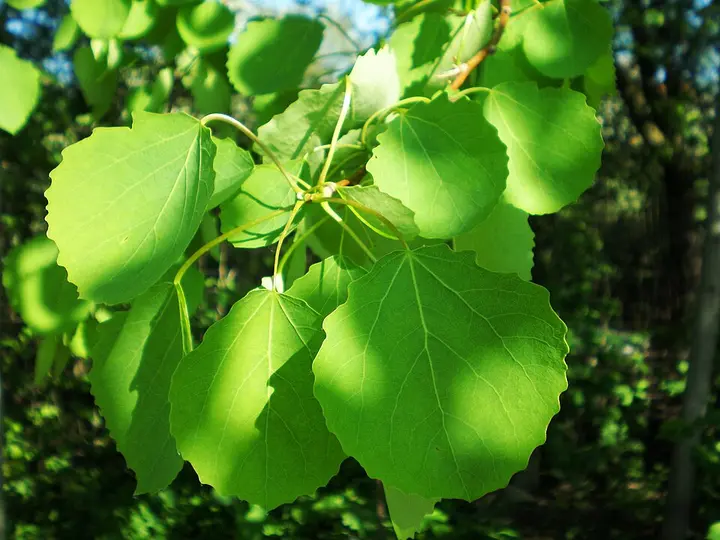
Aspen, Populus tremula

Tree or shrubAncient woodland

Aspen

Populus tremula

A tree with grey bark and rounded leaves with large, blunt teeth. The leaves hang on long, flattened stalks, so they flutter in the slightest breeze. It spreads by suckers from its roots to form clumps of trees that are all one clone, and grows in woods, hedgerows and beside streams.

When it flowers

March to April

Sources: Woodland Trust, NatureSpot

Photo: Šarūnas Šimkus, CC BY-SA 3.0, via Wikimedia Commons

Close

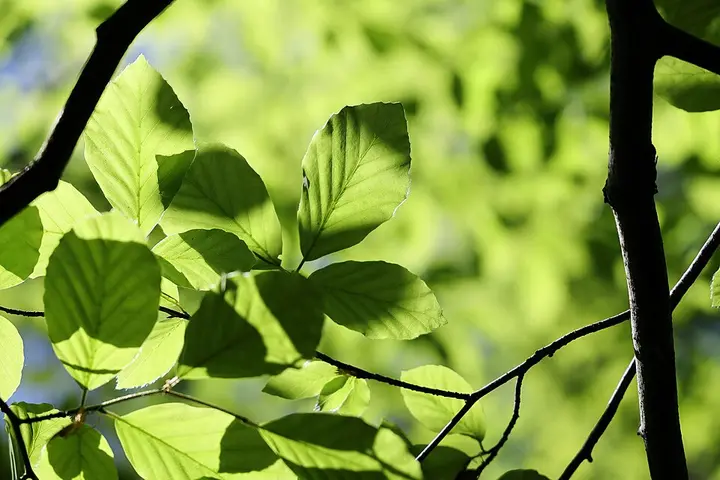
Beech, Fagus sylvatica

Tree or shrub

Beech

Fagus sylvatica

A large tree with smooth grey bark and oval, wavy-edged leaves that are silky and lime green when young. In winter, look for sharply pointed buds that stand away from the twig. Its triangular nuts, called beech mast, sit in prickly husks. In Britain it is thought to be native only in south-east England and south-east Wales.

When it flowers

April to May

Also called
common beech

Sources: Woodland Trust

Photo: T. Kebert, CC BY-SA 4.0, via Wikimedia Commons

Close

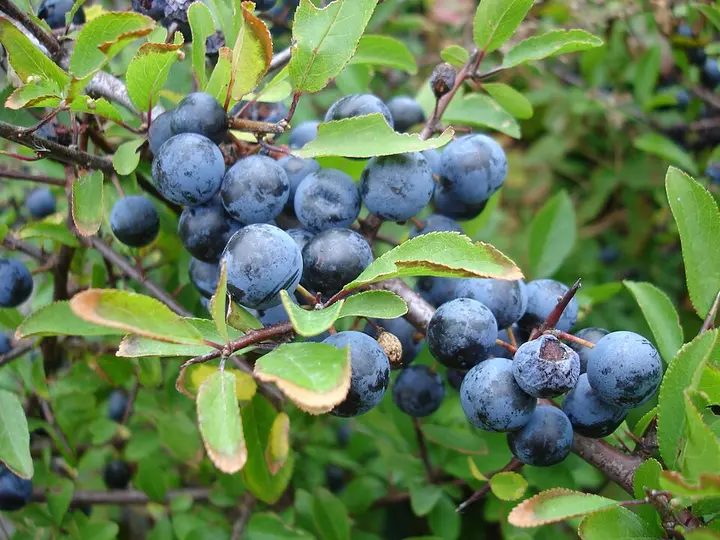
Blackthorn, Prunus spinosa

Tree or shrub

Blackthorn

Prunus spinosa

A thorny shrub that forms dense thickets in hedgerows, scrub and woods. Its white flowers open on bare, dark twigs in early spring, before the leaves appear. The blue-black fruits, called sloes, have a bluish bloom and are used to flavour sloe gin.

When it flowers

March to April

Also called
sloe

Sources: Woodland Trust, NatureSpot

Photo: Martin Olsson, CC BY-SA 3.0, via Wikimedia Commons

Close

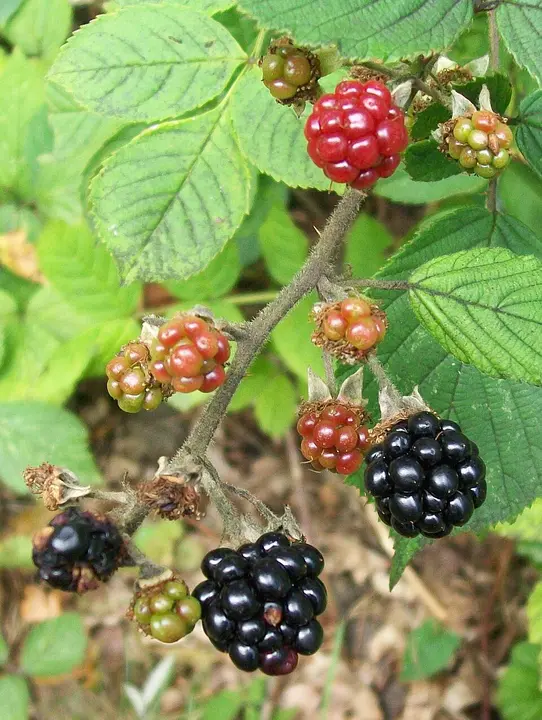
Bramble, Rubus fruticosus agg.

Tree or shrub

Bramble

Rubus fruticosus agg.

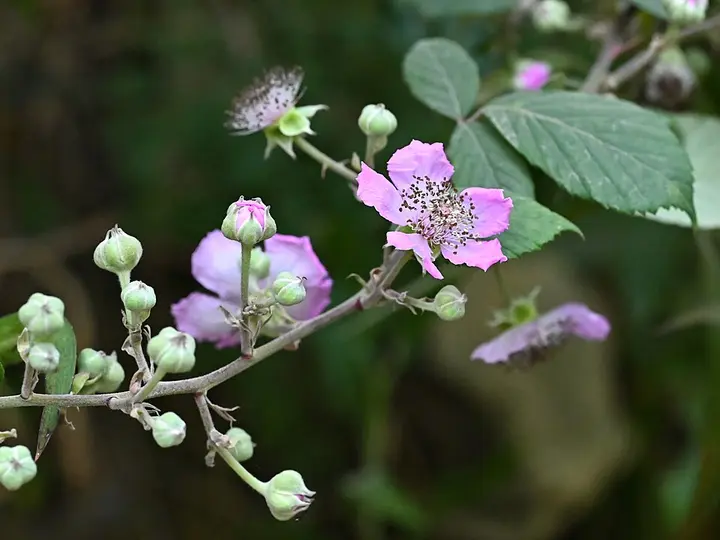
The familiar prickly shrub of woods, hedges and scrub, with arching stems, white or pink flowers from late spring and, later, blackberries. Botanists treat bramble as a group of more than 300 closely related microspecies in Britain and Ireland, which are hard to tell apart.

When it flowers

May to September

Also called
blackberry

Sources: BSBI, The Wildlife Trusts

Photo: Peter O'Connor, CC BY-SA 2.0, via Wikimedia Commons

Close

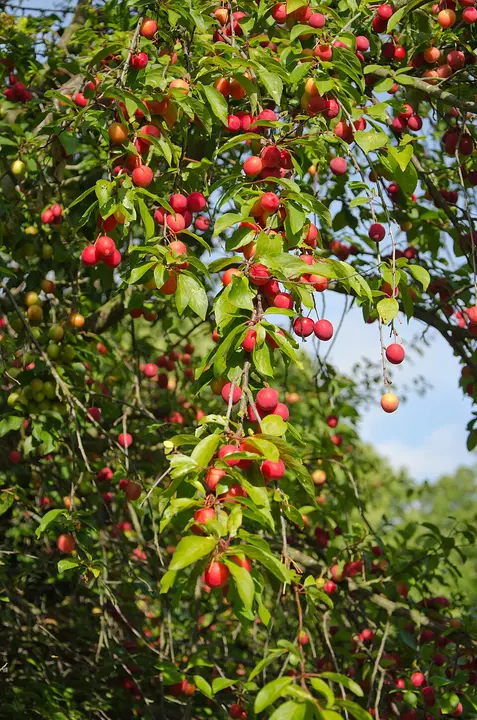
Cherry plum, Prunus cerasifera

Tree or shrub

Cherry plum

Prunus cerasifera

A small tree from south-east Europe and western Asia that is now found wild in hedgerows and woods. It is one of the first trees to blossom, with white flowers in late winter or early spring, about two weeks before blackthorn. It usually has no thorns, and its young twigs are green. Its plums are yellow or red.

When it flowers

February to March

Sources: Woodland Trust, NatureSpot

Photo: An-d, CC BY-SA 3.0, via Wikimedia Commons

Close

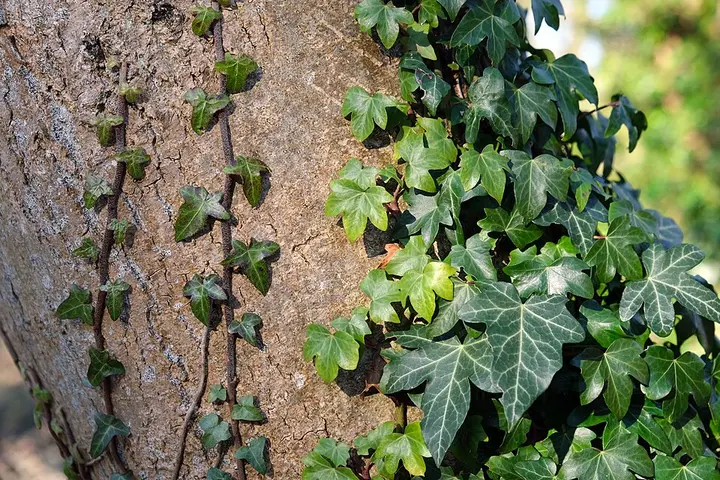
Common ivy, Hedera helix

Tree or shrub

Common ivy

Hedera helix

An evergreen climber of woods and hedgerows that grows up trees and walls or spreads across the ground. Leaves on non-flowering stems are often lobed, while those on flowering stems are oval or heart-shaped. Its autumn flowers are a rich late source of nectar for insects, but the plant is mildly poisonous if eaten and its leaves can irritate skin.

When it flowers

September to November

Also called
ivy

Sources: BSBI, BSBI (2), BSBI (3), The Wildlife Trusts, Woodland Trust, NatureSpot

Photo: kallerna, CC BY-SA 4.0, via Wikimedia Commons

Close

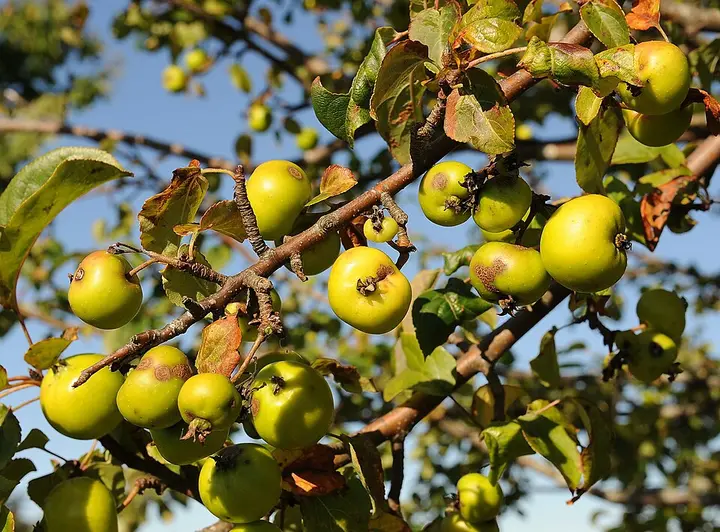
Crab apple, Malus sylvestris

Tree or shrubAncient woodland

Crab apple

Malus sylvestris

A small tree of woods and hedgerows, with twigs that are often spiny and oval, toothed leaves. White to pink blossom is followed by small yellow-green apples. Its mature leaves are hairless underneath, which helps tell it from apple trees that have grown wild from orchard and garden apples.

When it flowers

May

Sources: The Wildlife Trusts, Woodland Trust, NatureSpot

Photo: Per Arvid Åsen, CC BY-SA 3.0, via Wikimedia Commons

Close

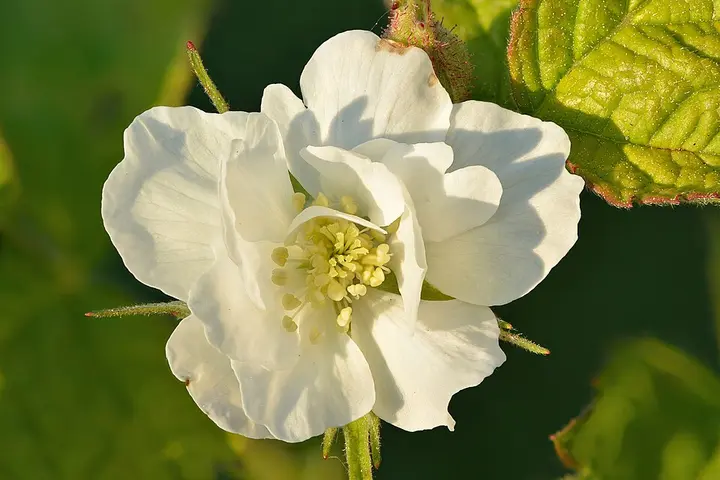
Dewberry, Rubus caesius

Tree or shrub

Dewberry

Rubus caesius

A low, sprawling relative of the bramble, with weak, slightly prickly stems covered in a whitish bloom and leaves of three leaflets. Its black fruits have fewer segments than a blackberry and a whitish, waxy bloom. It grows in scrub, grassland and damp places, often on chalk or limestone.

When it flowers

May to September

Sources: NatureSpot, JNEcology

Photo: Ivar Leidus, CC BY-SA 4.0, via Wikimedia Commons

Close

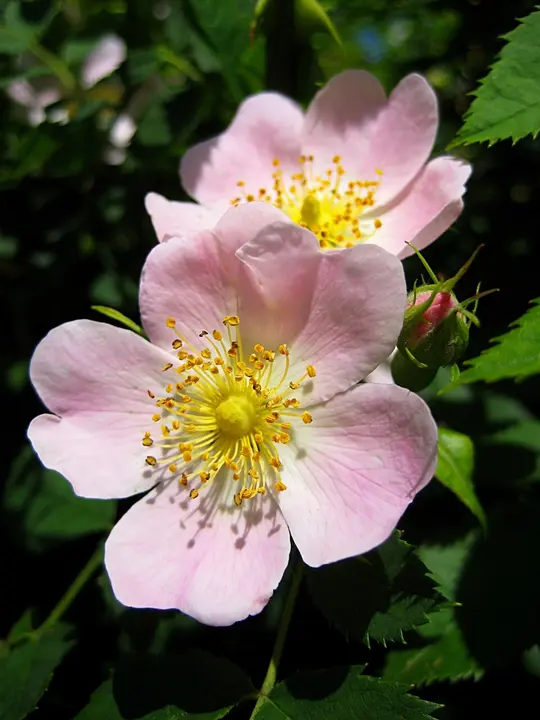
Dog-rose, Rosa canina agg.

Tree or shrub

Dog-rose

Rosa canina agg.

A scrambling shrub of hedgerows, woodland edges and rough grassland, with long, arching, prickly stems. Its pink or white flowers open in early summer and become smooth, orange-red hips in autumn. The name covers a group of closely related wild roses and hybrids, which need expert study to tell apart.

When it flowers

June to July

Sources: BSBI, BSBI (2), The Wildlife Trusts, NatureSpot

Photo: Roberta F, CC BY-SA 3.0, via Wikimedia Commons

Close

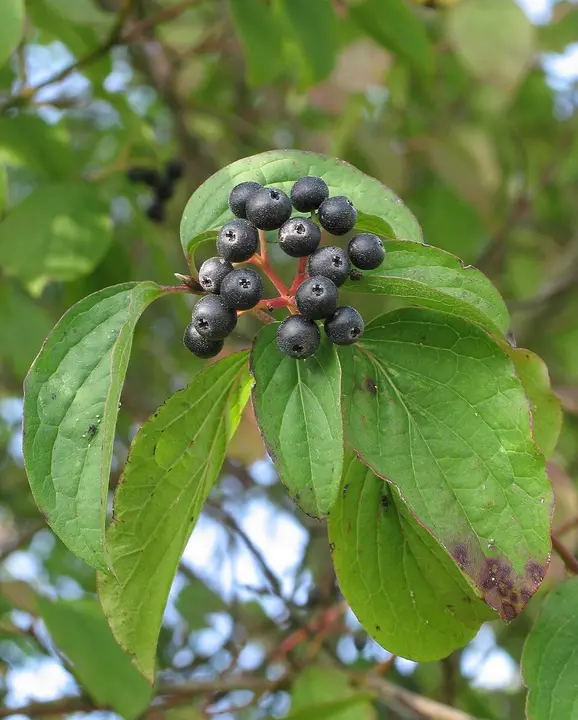
Dogwood, Cornus sanguinea

Tree or shrub

Dogwood

Cornus sanguinea

A shrub of hedgerows, scrub and woodland edges, with dark red young twigs that stand out in winter. Its oval, untoothed leaves grow in opposite pairs, have curving veins and turn deep red in autumn. Flat clusters of small creamy-white flowers are followed by black berries.

When it flowers

June to July

Sources: The Wildlife Trusts, Woodland Trust, NatureSpot

Photo: Robert Flogaus-Faust, CC BY 4.0, via Wikimedia Commons

Close

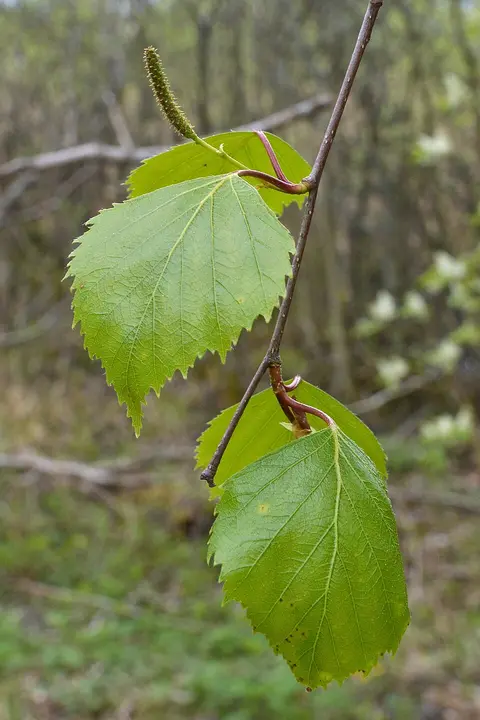
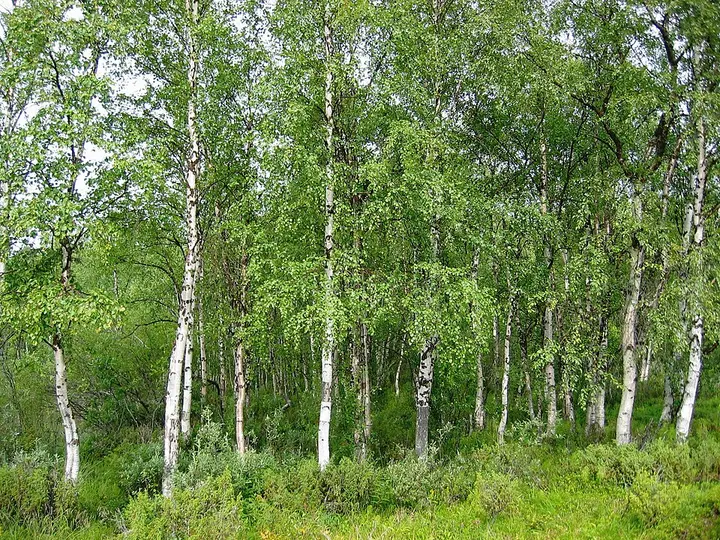
Downy birch, Betula pubescens

Tree or shrub

Downy birch

Betula pubescens

A birch of wetter ground than silver birch, able to grow on boggy peat and on clay. Its bark is browner than silver birch's, with more obvious horizontal lines, and lacks its papery look. Its young twigs are covered in soft hairs rather than warts, and its leaves are more rounded at the base. Long yellow-brown male catkins hang in spring.

When it flowers

April to May

Sources: Woodland Trust

Photo: Ryan Hodnett, CC BY-SA 4.0, via Wikimedia Commons

Close

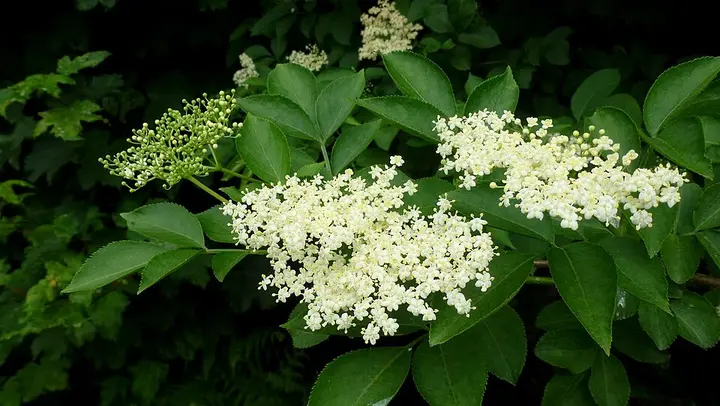
Elder, Sambucus nigra

Tree or shrub

Elder

Sambucus nigra

A shrub or small tree of woods, scrub, hedgerows and waste ground, with corky grey-brown bark. Its leaves have five to seven toothed leaflets that smell unpleasant when crushed. Flat heads of scented, creamy-white flowers in early summer become purple-black berries. The leaves, bark and raw berries are poisonous to people.

When it flowers

June to July

Sources: The Wildlife Trusts, Woodland Trust, NatureSpot

Photo: Jonathan Billinger, CC BY-SA 2.0, via Wikimedia Commons

Close

Elm-leaved bramble, Rubus ulmifolius

Tree or shrub

Elm-leaved bramble

Rubus ulmifolius

A bramble found across much of England, especially on chalky and neutral soils, in hedgerows and on waste ground. Look for stems with a whitish bloom, leaflets that are white-felted underneath, and pink flowers that open later in summer than most other brambles. Unlike most brambles, it reproduces sexually, so it can cross with other kinds.

When it flowers

July to August

Sources: BSBI, NatureSpot, JNEcology, UK Wildflowers

Photo: Krzysztof Ziarnek, Kenraiz, CC BY 4.0, via Wikimedia Commons

Close

Field maple, Acer campestre

Tree or shrubAncient woodland

Field maple

Acer campestre

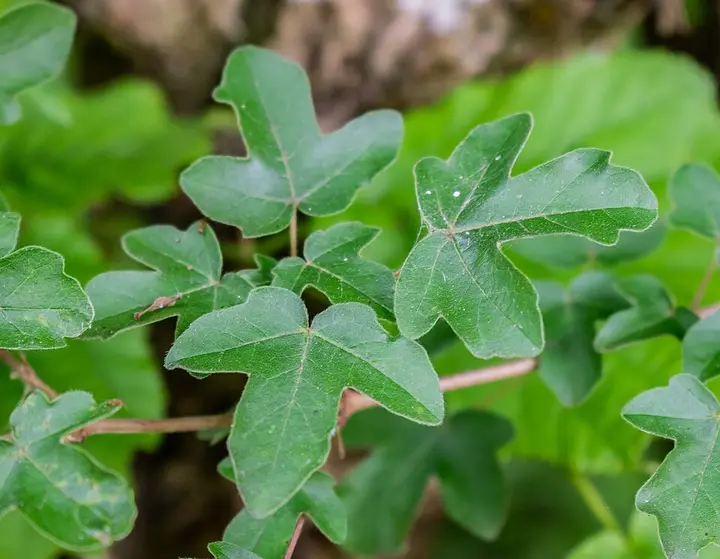
Britain's only native maple, a small tree of woods, scrub and hedgerows, including on chalk. Its small leaves have rounded lobes and turn golden yellow in autumn, and its older twigs often develop corky bark. The two wings of each seed spread out flat, in a straight line.

When it flowers

April to May

Sources: Woodland Trust, NatureSpot

Photo: Tournasol7, CC BY 4.0, via Wikimedia Commons

Close

Field-rose, Rosa arvensis

Tree or shrubAncient woodland

Field-rose

Rosa arvensis

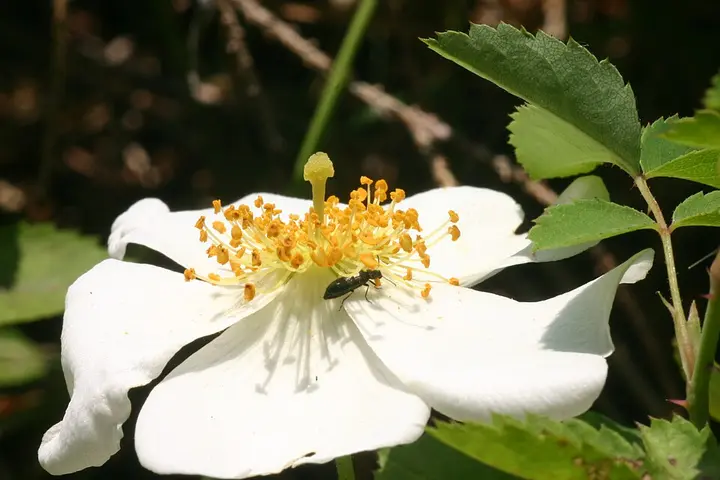
A rose with weak, trailing stems and sparse, hooked prickles, scrambling through hedgerows, woodland edges and scrub. Its flowers are always white. In the centre of each flower the styles are joined into a column, which dog-rose lacks.

When it flowers

June to August

Sources: BSBI, NatureSpot, NatureSpot (2), Woodlands.co.uk

Photo: HermannSchachner, CC0, via Wikimedia Commons

Close

Goat willow, Salix caprea

Tree or shrub

Goat willow

Salix caprea

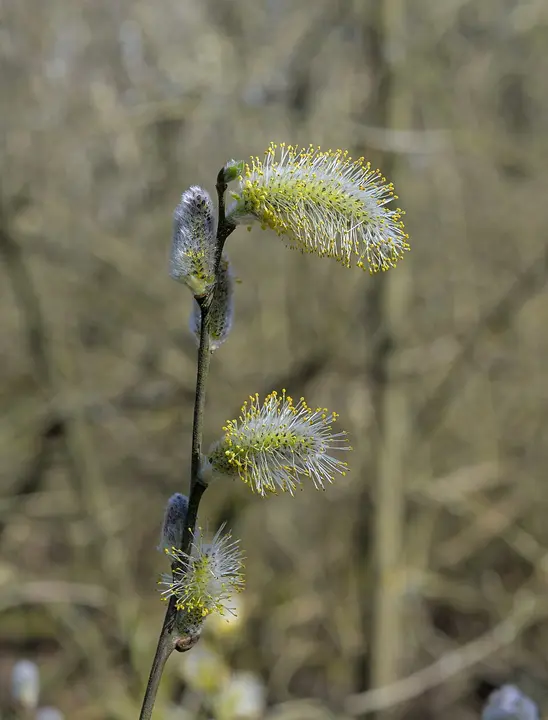
A small tree of woods, hedgerows, scrub and damp ground. Unlike most willows it has oval leaves, grey and felted underneath, with a tip bent to one side. Male and female catkins grow on separate trees; the silvery male catkins turn yellow with pollen, and the catkins are an early source of pollen and nectar for bees in spring.

When it flowers

March to April

Also called
pussy willow, great sallow

Sources: The Wildlife Trusts, Woodland Trust, NatureSpot

Photo: Trougnouf (Benoit Brummer), CC BY 4.0, via Wikimedia Commons

Close

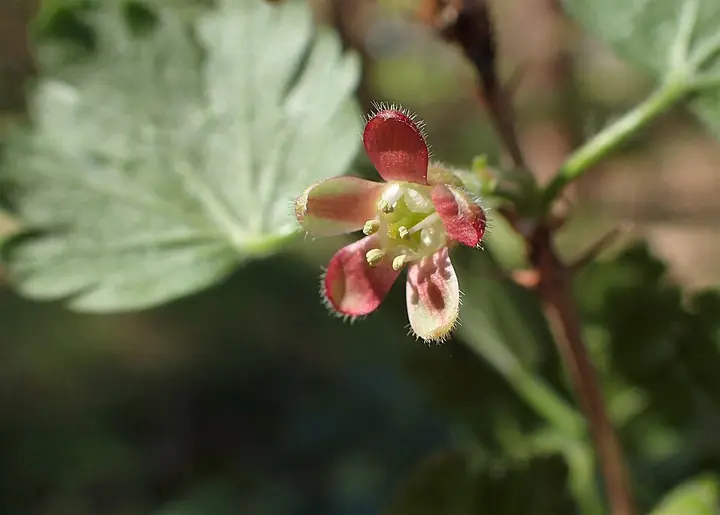
Gooseberry, Ribes uva-crispa

Tree or shrub

Gooseberry

Ribes uva-crispa

A low, spiny shrub of hedgerows, woods, scrub and waste ground, with small, deeply lobed leaves. In spring its small greenish flowers, often edged with purple, hang singly or in twos and threes, followed by bristly berries that can be greenish-yellow or purplish-red. It is the same species as the garden gooseberry, and many wild bushes have spread from gardens.

When it flowers

April to May

Sources: BSBI, BSBI (2), RHS, NatureSpot, UK Wildflowers, Wild Food UK

Photo: Krzysztof Ziarnek, Kenraiz, CC BY-SA 4.0, via Wikimedia Commons

Close

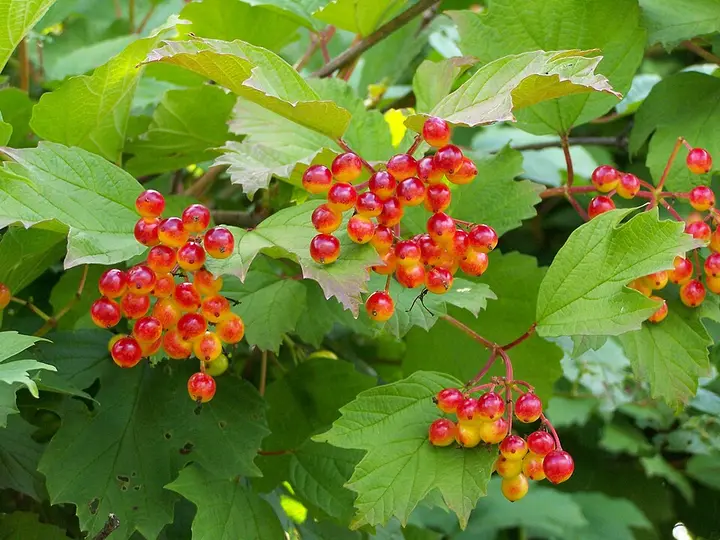
Guelder-rose, Viburnum opulus

Tree or shrubAncient woodland

Guelder-rose

Viburnum opulus

A shrub of woodland edges, hedgerows, scrub, fens and riversides, mostly on damp soils, with three-lobed, coarsely toothed leaves that turn red in autumn. In early summer it carries flat heads of small white flowers ringed by larger, sterile ones. Bunches of translucent red berries follow, which are mildly poisonous if eaten raw.

When it flowers

June to July

Sources: The Wildlife Trusts, Woodland Trust, NatureSpot

Photo: Lestat (Jan Mehlich), CC BY-SA 3.0, via Wikimedia Commons

Close

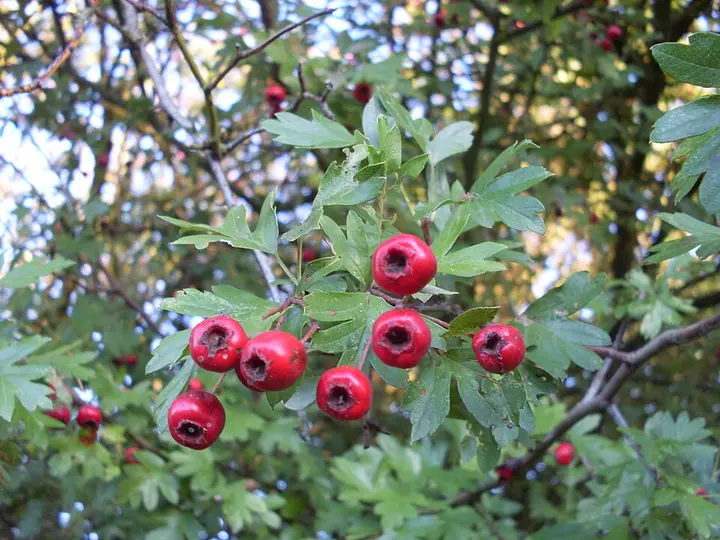
Hawthorn, Crataegus monogyna

Tree or shrub

Hawthorn

Crataegus monogyna

A thorny shrub or small tree of hedgerows, scrub and woodland, with leaves cut more than halfway to the midrib into toothed lobes. Its scented white, sometimes pink, blossom opens in May and is followed by dark red berries called haws. Its dense, thorny growth gives birds shelter for nesting.

When it flowers

May to June

Also called
may, whitethorn, quickthorn

Sources: BSBI, Woodland Trust, Woodland Trust (2), NatureSpot

Photo: Elstro, CC BY 3.0, via Wikimedia Commons

Close

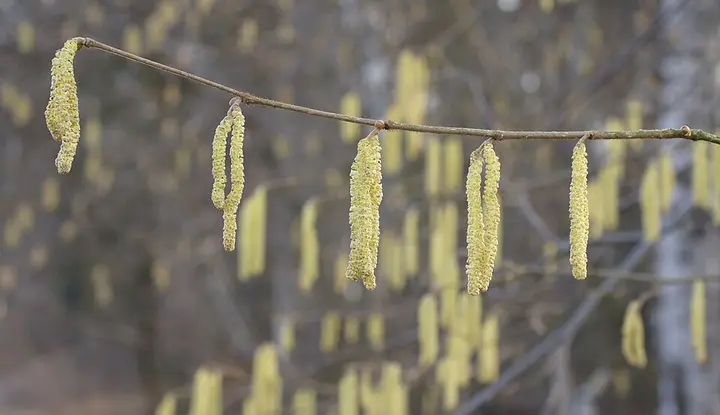
Hazel, Corylus avellana

Tree or shrub

Hazel

Corylus avellana

A shrub of hedgerows and the understorey of woods, with rounded, doubly toothed, hairy leaves. Yellow male catkins, known as lambs' tails, hang from bare twigs in late winter, while the tiny, bud-like female flowers have bright red styles. We coppice hazel by hand and sell hazel bean poles, pea sticks, hedging stakes and binders.

When it flowers

January to March

Sources: Woodland Trust, NatureSpot

Photo: Robert Flogaus-Faust, CC BY 4.0, via Wikimedia Commons

Close

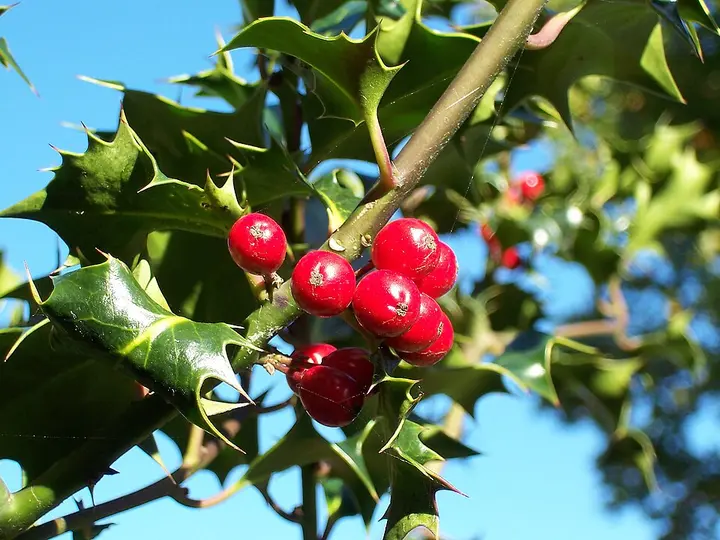
Holly, Ilex aquifolium

Tree or shrubAncient woodland

Holly

Ilex aquifolium

An evergreen shrub or tree of woods, scrub and hedgerows, especially in oak and beech woods, with glossy, dark green leaves. Leaves are spiny on young plants and often smooth on older trees. Male and female flowers grow on separate trees, and only female trees bear the red berries, which are poisonous to people.

When it flowers

April to June

Sources: Woodland Trust, NatureSpot, INCHEM

Photo: Jürgen Howaldt, CC BY-SA 2.0 de, via Wikimedia Commons

Close

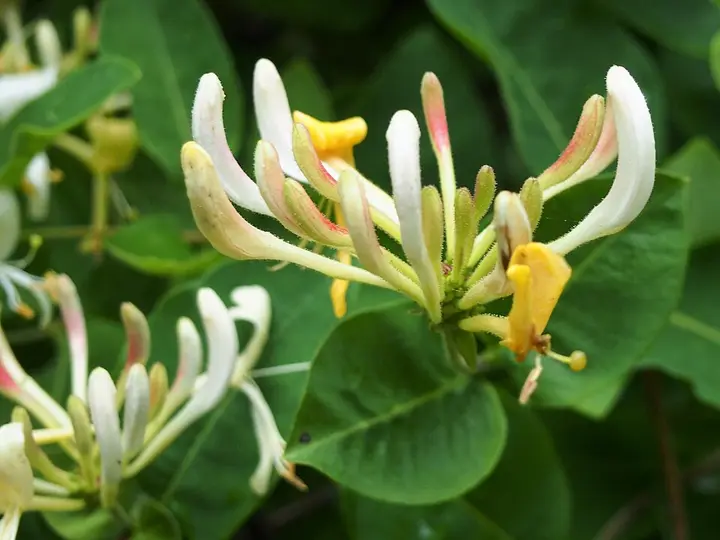
Honeysuckle, Lonicera periclymenum

Tree or shrub

Honeysuckle

Lonicera periclymenum

A woody climber that twines through shrubs and trees in woods and hedgerows. Its trumpet-shaped, cream flowers age to yellow, are sometimes flushed pink or red, and are strongly scented, drawing moths at night. Clusters of red berries follow in autumn, and these are poisonous to people.

When it flowers

June to September

Also called
woodbine

Sources: The Wildlife Trusts, Woodland Trust, NatureSpot

Photo: Agnieszka Kwiecień, Nova, CC BY-SA 4.0, via Wikimedia Commons

Close

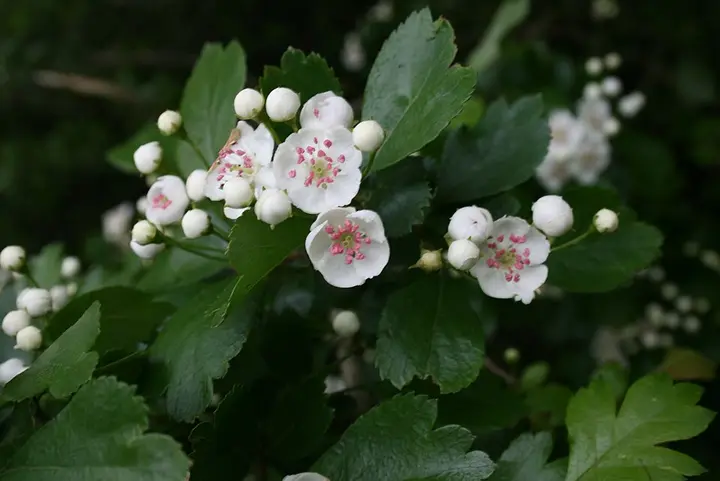
Midland hawthorn, Crataegus laevigata

Tree or shrubAncient woodland

Midland hawthorn

Crataegus laevigata

A close relative of hawthorn, most common in central and southern England, growing in old woods and on hedgebanks, often on clay. Its glossy leaves have shallow lobes cut less than halfway to the midrib, and its flowers usually have two or three styles. It tends to flower a week or two earlier than hawthorn.

When it flowers

May to June

Sources: BSBI, Woodland Trust, NatureSpot, Wild Flower Finder

Photo: Sten Porse, CC BY-SA 3.0, via Wikimedia Commons

Close

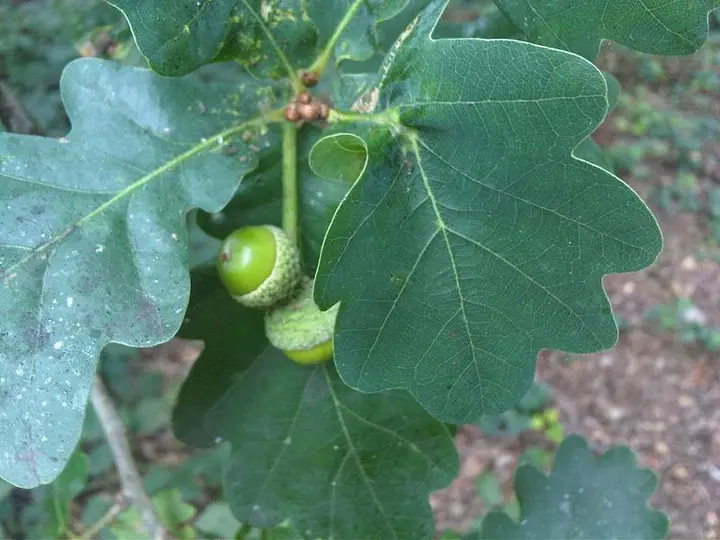
Pedunculate oak, Quercus robur

Tree or shrub

Pedunculate oak

Quercus robur

A large tree whose lobed leaves have almost no stalk, while its acorns hang on long stalks, the reverse of sessile oak. It grows in woods and hedgerows and is especially common in southern and central Britain. Oaks in the UK can support more than 2,300 species of wildlife.

When it flowers

April to May

Also called
English oak, common oak

Sources: The Wildlife Trusts, Woodland Trust, NatureSpot

Photo: Emőke Dénes, CC BY-SA 4.0, via Wikimedia Commons

Close

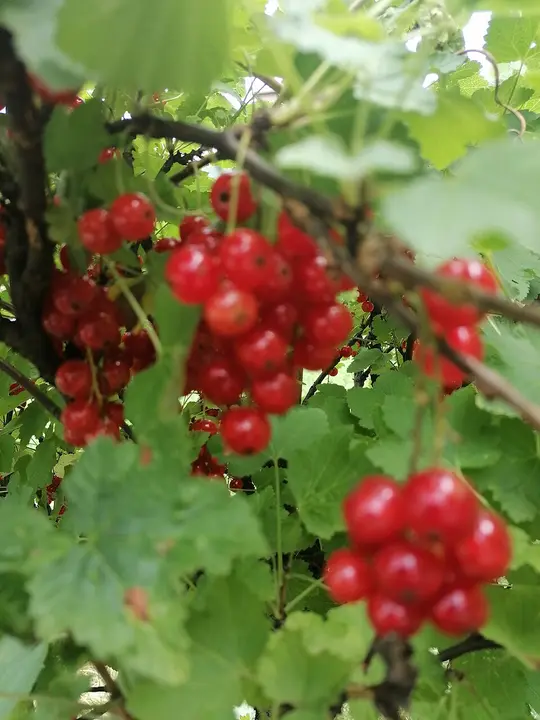
Red currant, Ribes rubrum

Tree or shrubAncient woodland

Red currant

Ribes rubrum

An upright shrub of damp woods, hedgerows and stream banks, with lobed leaves that are heart-shaped at the base. Drooping strings of small greenish flowers in spring are followed by shiny, bright red berries.

When it flowers

April to May

Also called
redcurrant

Sources: BSBI, NatureSpot

Photo: Abraham, CC BY-SA 4.0, via Wikimedia Commons

Close

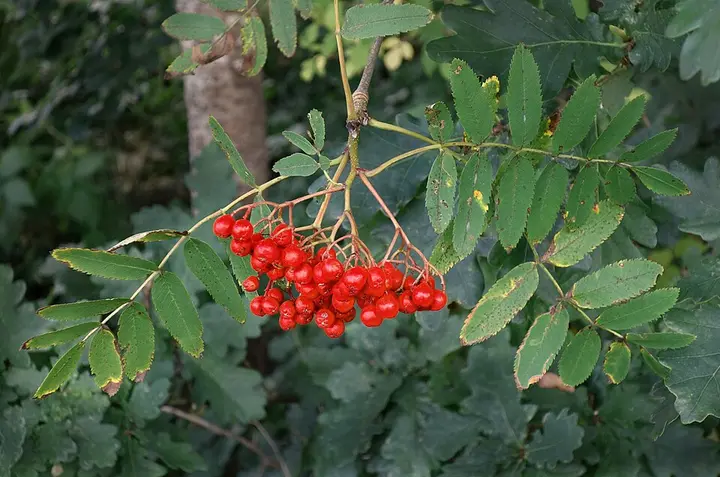
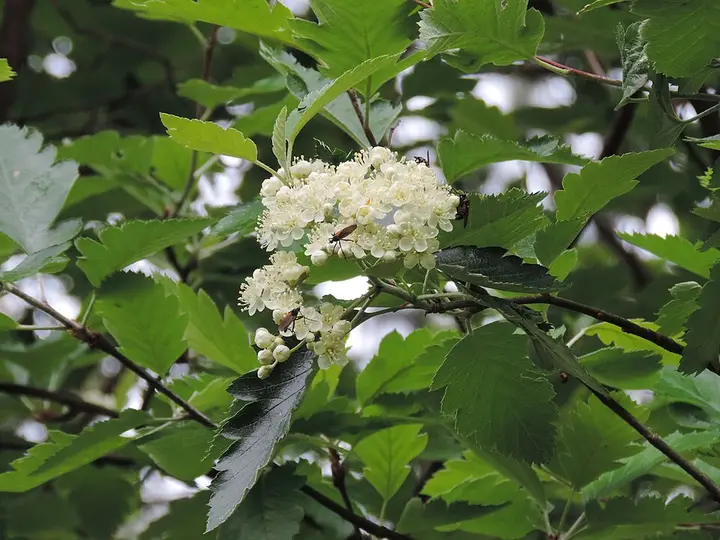
Rowan, Sorbus aucuparia

Tree or shrub

Rowan

Sorbus aucuparia

A tree with smooth, silvery-grey bark and leaves divided into pairs of long, toothed leaflets with one at the tip. Domed clusters of creamy-white flowers in late spring become bright red berries in autumn, eaten by thrushes and other birds. It is most common in the north and west of the UK, on mountains, heaths and woodland edges, and despite its other name it is not related to ash.

When it flowers

May to June

Also called
mountain ash

Sources: The Wildlife Trusts, Woodland Trust, NatureSpot

Photo: W.carter, CC BY-SA 4.0, via Wikimedia Commons

Close

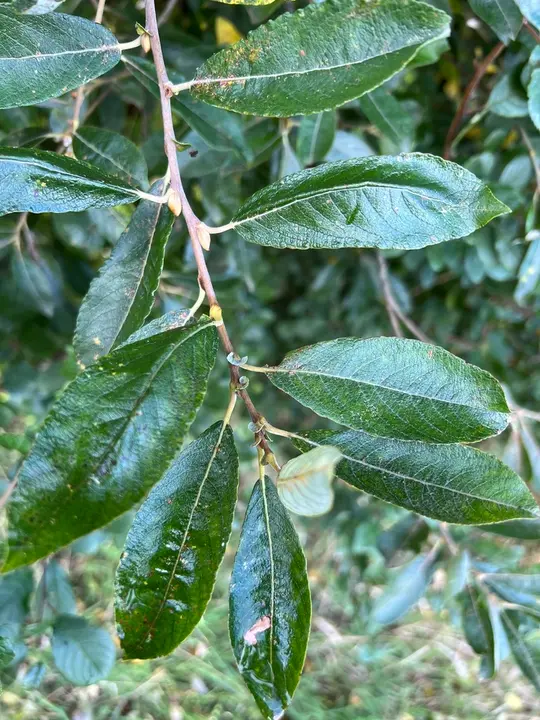
Rusty willow, Salix cinerea subsp. oleifolia

Tree or shrub

Rusty willow

Salix cinerea subsp. oleifolia

A shrub or small tree of damp ground, wet woods, stream banks and hedgerows. Its catkins open before the leaves, with male and female on separate bushes; the males are grey, then yellow with pollen. This subspecies, the most widespread one in much of Britain and Ireland, has rusty hairs along the veins on the undersides of its leaves.

When it flowers

March to April

Also called
grey willow, common sallow

Sources: BSBI, The Wildlife Trusts, Woodland Trust, SAPS

Photo: prodewald, CC0, via iNaturalist

Close

Silver birch, Betula pendula

Tree or shrub

Silver birch

Betula pendula

A tree with white bark that peels in thin, papery layers and becomes dark and rough at the base. Its small, triangular leaves are toothed, and its smooth twigs are dotted with small dark warts. It grows on drier soils in woods and on heaths, and supports more than 300 kinds of insect.

When it flowers

April to May

Sources: Woodland Trust

Photo: Percita at Flickr, CC BY-SA 2.0, via Wikimedia Commons

Close

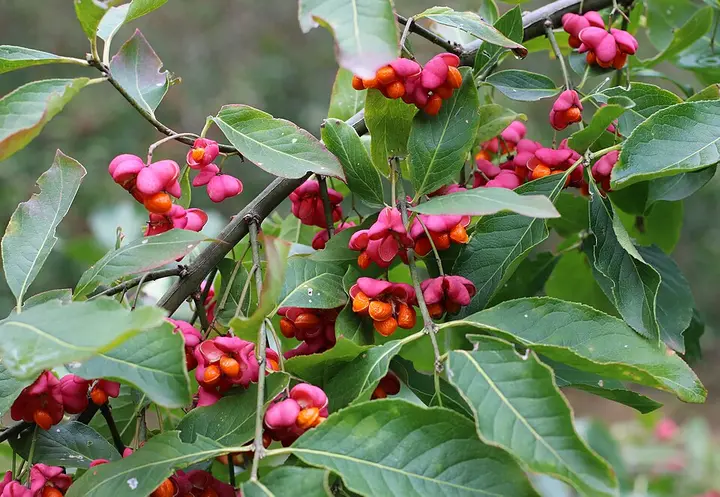
Spindle, Euonymus europaeus

Tree or shrub

Spindle

Euonymus europaeus

A small tree of woodland edges, hedgerows and scrub, often on chalky soils. In autumn its leaves turn orange-red and bright pink fruits split open to show orange seeds; the fruit and leaves are poisonous to people. Its pale, dense wood was once used to make spindles for spinning wool, which gives the tree its name.

When it flowers

May to June

Sources: The Wildlife Trusts, Woodland Trust

Photo: George Chernilevsky, CC BY 4.0, via Wikimedia Commons

Close

Swedish whitebeam, Sorbus intermedia

Tree or shrub

Swedish whitebeam

Sorbus intermedia

A tree native to southern Sweden and nearby parts of the Baltic region, widely planted in streets and parks and sometimes spread by birds into woods and hedges. Its leaves are lobed towards the base, glossy green above and covered in grey felt beneath. Flat clusters of white flowers in May are followed by red berries.

When it flowers

May

Sources: BSBI, RHS, Trees and Shrubs Online

Photo: Krzysztof Ziarnek, Kenraiz, CC BY-SA 4.0, via Wikimedia Commons

Close

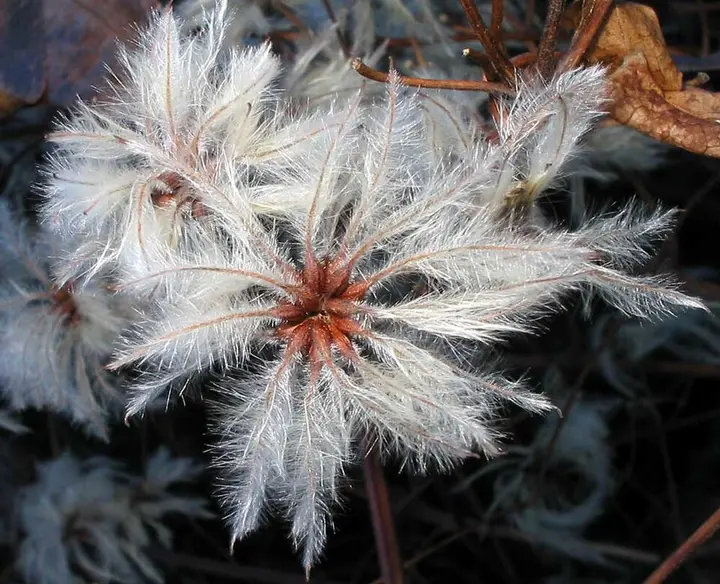
Traveller's-joy, Clematis vitalba

Tree or shrub

Traveller's-joy

Clematis vitalba

A woody climber that scrambles over hedges, scrub and trees, mostly on chalk or limestone. Clusters of scented, creamy-white flowers in late summer are followed by feathery, grey-white seed heads that last through autumn and winter and give it the name old man's beard. Bees and hoverflies visit the flowers, and goldfinches eat the seeds.

When it flowers

July to September

Also called
old man's beard

Sources: The Wildlife Trusts, Woodland Trust, NatureSpot

Photo: Michael Gasperl (Migas), CC BY-SA 3.0, via Wikimedia Commons

Close

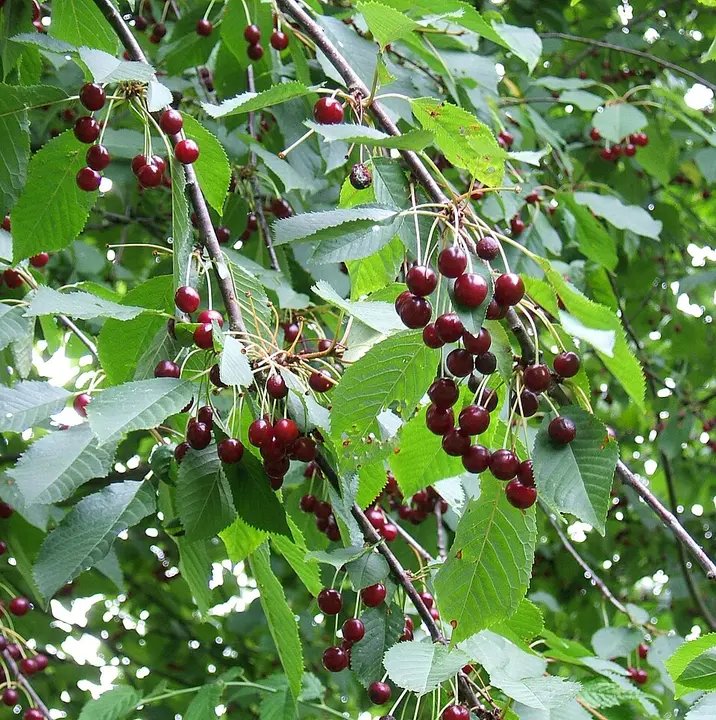
Wild cherry, Prunus avium

Tree or shrubAncient woodland

Wild cherry

Prunus avium

A tree of woodland edges and hedgerows, with shiny reddish-brown bark that peels in horizontal bands. Clusters of white, five-petalled flowers open in spring, and the small red cherries that follow are eaten by birds and mammals. Its hard, honey-coloured wood is used for furniture and veneers.

When it flowers

April to May

Also called
gean

Sources: The Wildlife Trusts, Woodland Trust, NatureSpot

Photo: MPF, CC BY 2.5, via Wikimedia Commons

Close

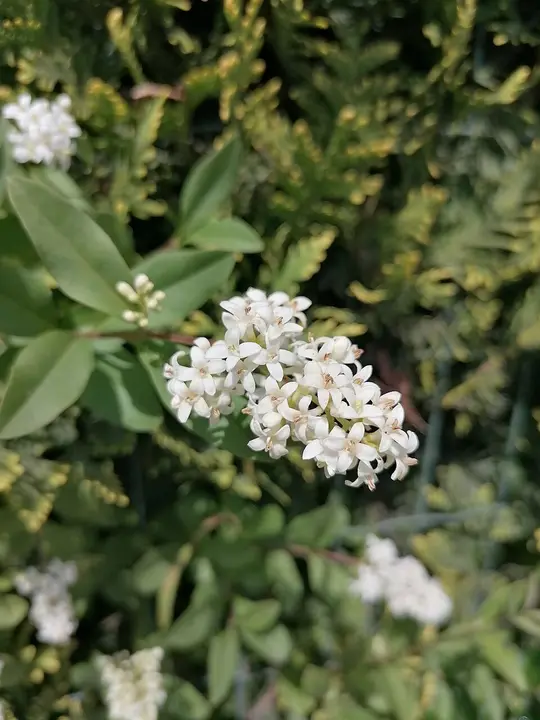
Wild privet, Ligustrum vulgare

Tree or shrub

Wild privet

Ligustrum vulgare

A semi-evergreen shrub of hedgerows, woodland edges and scrub, mainly on chalky or limy soils. It has small, glossy, oval leaves without teeth and clusters of scented white flowers in early summer, followed by black berries. The berries are poisonous to people.

When it flowers

June to July

Sources: BSBI, The Wildlife Trusts, NatureSpot, Wild Flower Finder

Photo: Abraham, CC BY 4.0, via Wikimedia Commons

Close

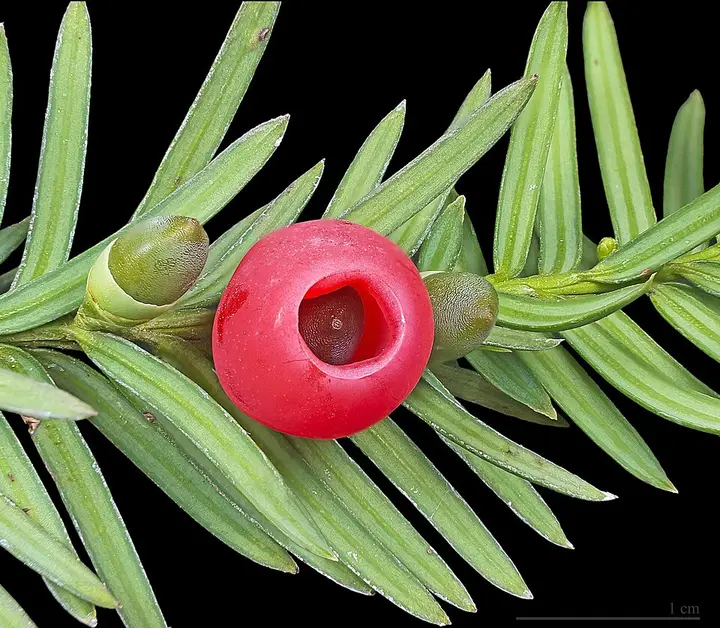
Yew, Taxus baccata

Tree or shrub

Yew

Taxus baccata

An evergreen tree with short, dark green needles in two rows along each twig and peeling, reddish-brown bark. It grows wild on chalk and limestone, often beneath beech, and female trees bear their seeds in red, fleshy cups. The leaves, bark and seeds are poisonous to people and highly toxic to livestock.

When it flowers

March to April

Sources: The Wildlife Trusts, Woodland Trust

Photo: Didier Descouens, CC BY-SA 4.0, via Wikimedia Commons

Close

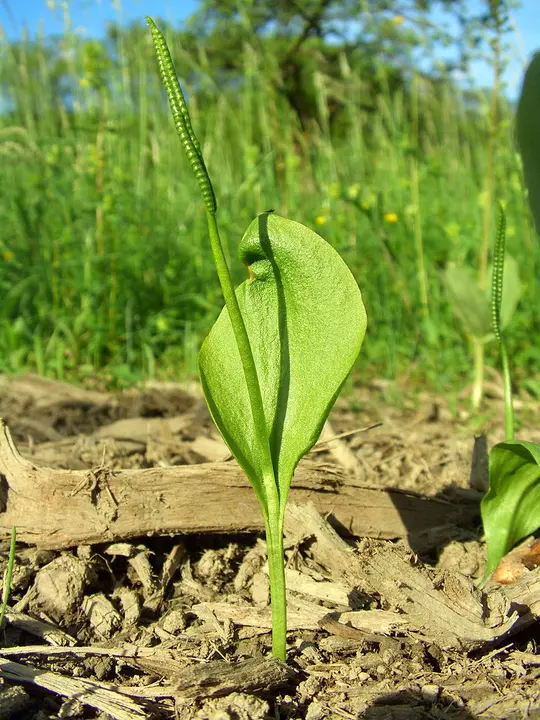
Adder's-tongue, Ophioglossum vulgatum s.l.

Wild flower

Adder's-tongue

Ophioglossum vulgatum s.l.

A small fern that looks nothing like most ferns: each plant has a single blunt, oval leaf, with a narrow, stalked spike carrying the spores rising from its base. It grows in old meadows, unimproved pastures and open woodland.

When it flowers

No flowering months listed.

Also called
adder's-tongue fern

Sources: BSBI, NatureSpot

Photo: Orchi, CC BY-SA 3.0, via Wikimedia Commons

Close

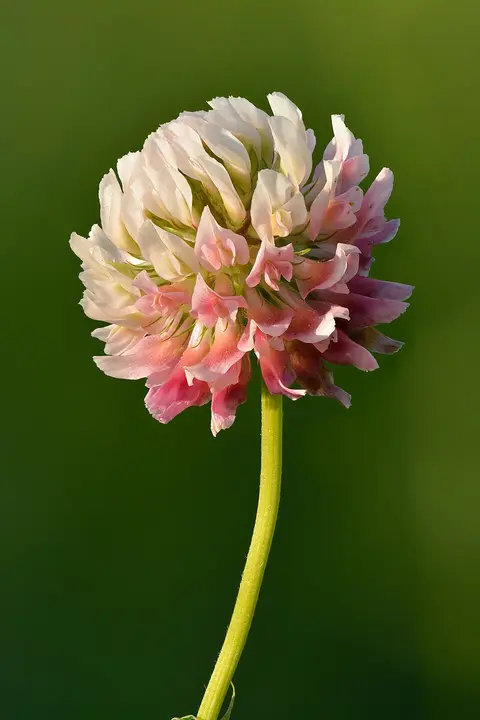
Alsike clover, Trifolium hybridum subsp. hybridum

Wild flower

Alsike clover

Trifolium hybridum subsp. hybridum

A clover with round heads of white and pink flowers that turn brown as they fade, on upright stems that do not root as they spread, unlike white clover. Its leaves lack white clover's pale markings. It was introduced as a fodder crop and now turns up on verges, field margins and waste ground, often where seed mixes have been sown.

When it flowers

June to September

Sources: BSBI, BSBI (2), NatureSpot

Photo: Ivar Leidus, CC BY-SA 4.0, via Wikimedia Commons

Close

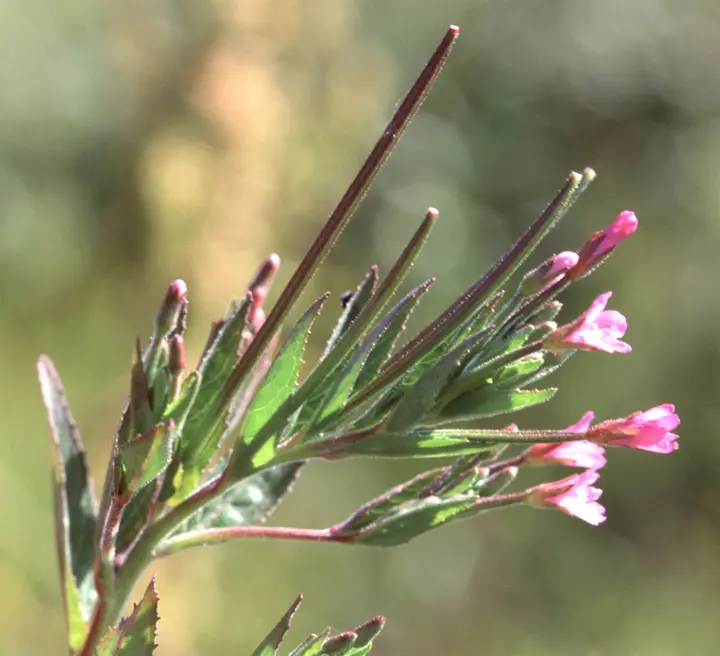
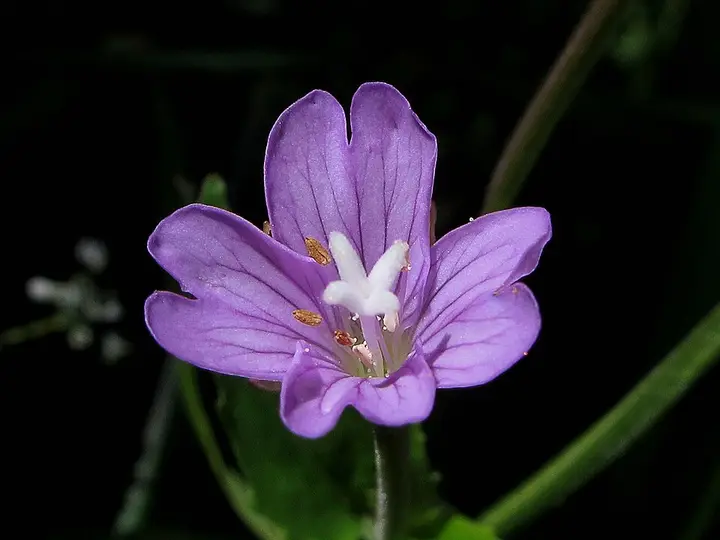
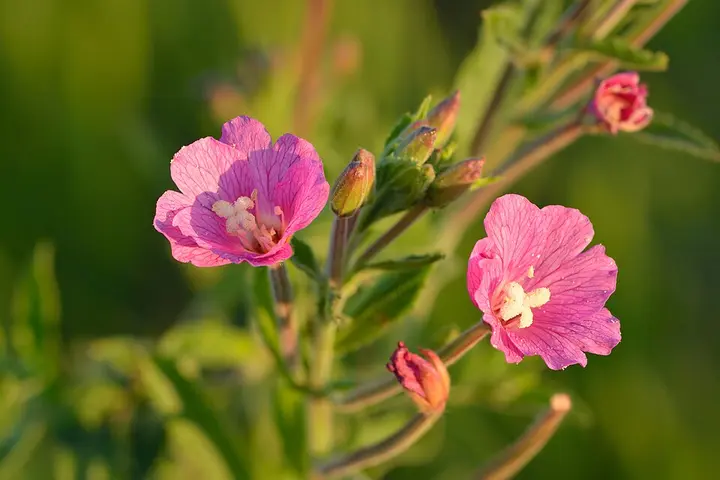
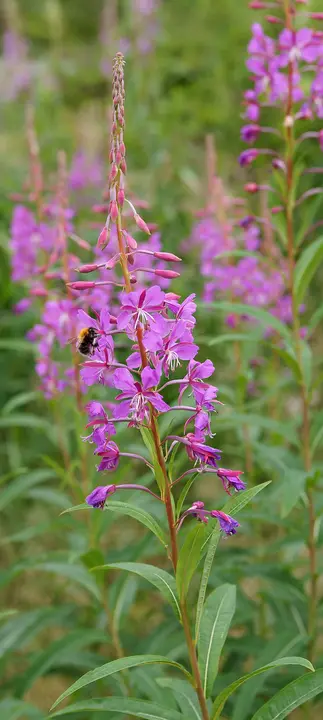
American willowherb, Epilobium ciliatum

Wild flower

American willowherb

Epilobium ciliatum

A North American plant that has spread quickly across Britain and is now one of the most frequent introduced plants. It has small pink flowers with deeply notched petals and a club-shaped stigma, and often reddish stems with four raised lines. It grows on disturbed ground, in gardens and pavement cracks, and in felled woodland.

When it flowers

June to August

Sources: NatureSpot

Photo: Gordon Leppig & Andrea J. Pickart, Public domain, via Wikimedia Commons

Close

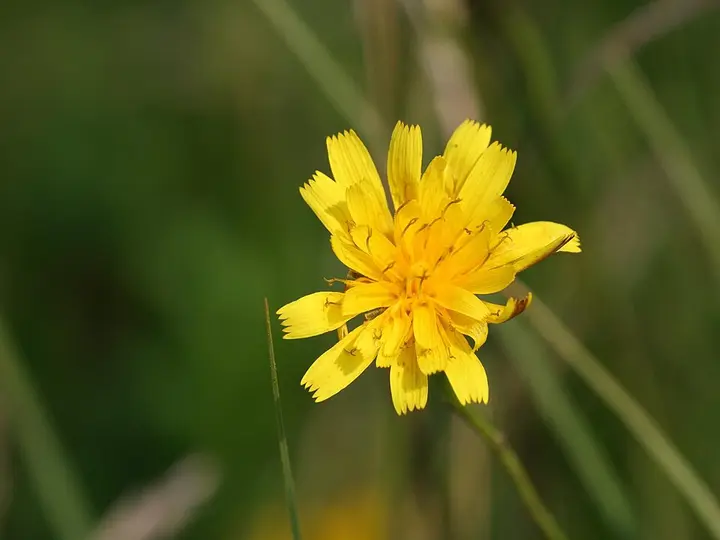
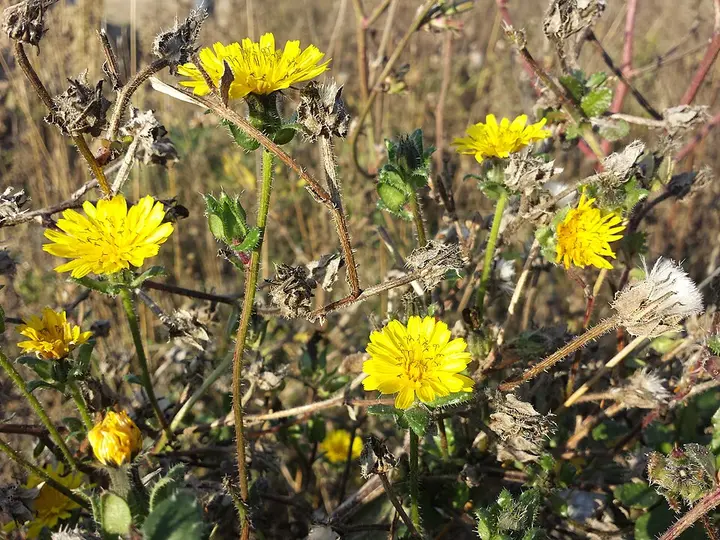
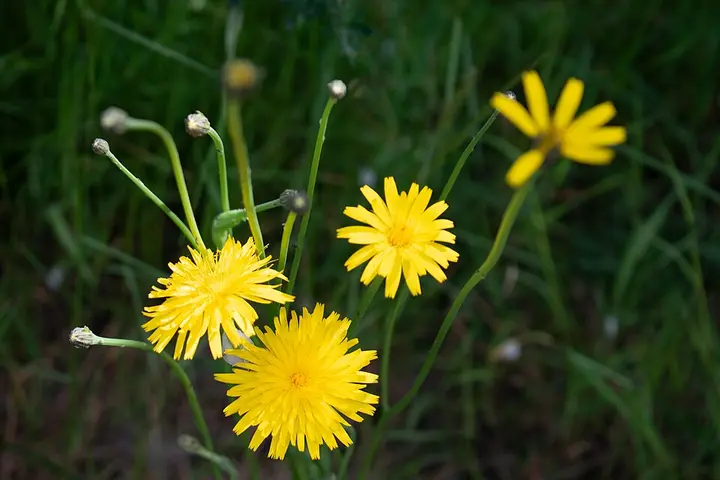
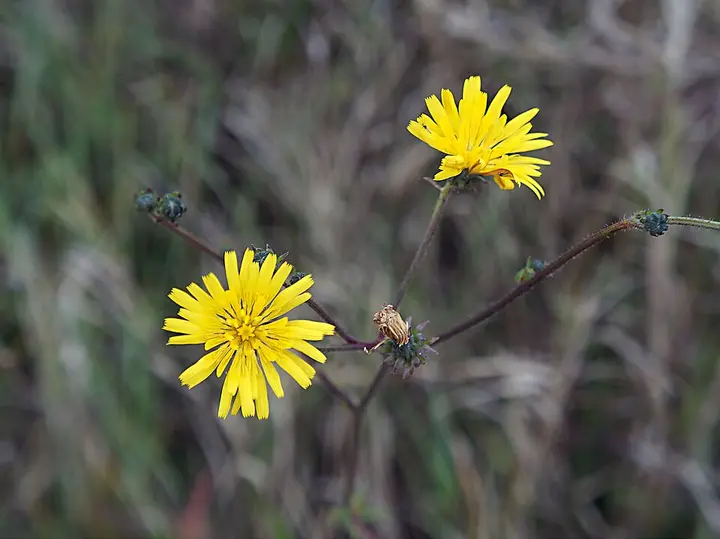
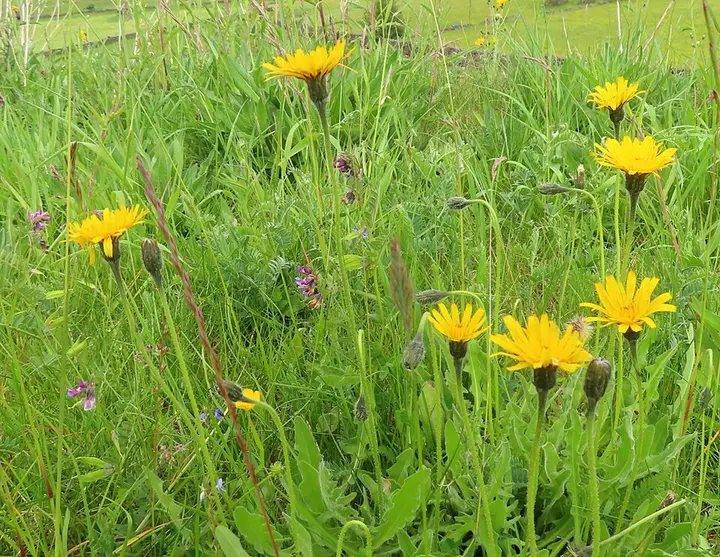
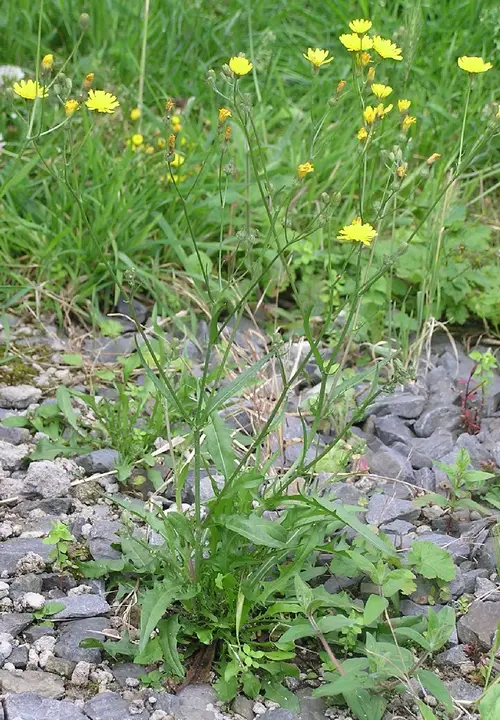
Autumn hawkbit, Scorzoneroides autumnalis

Wild flower

Autumn hawkbit

Scorzoneroides autumnalis

A dandelion-like plant of meadows, pastures, lawns, grassy banks and paths that flowers well into autumn. Its stems are usually branched, with yellow flowerheads whose outer florets are striped red underneath. Its leaves are hairless or carry a few simple hairs, unlike the forked hairs of rough and lesser hawkbit.

When it flowers

June to October

Formerly
Leontodon autumnalis

Sources: BSBI, NatureSpot, NatureSpot (2), NatureSpot (3), Floodplain Meadows Partnership

Photo: Kristian Peters, CC BY-SA 3.0, via Wikimedia Commons

Close

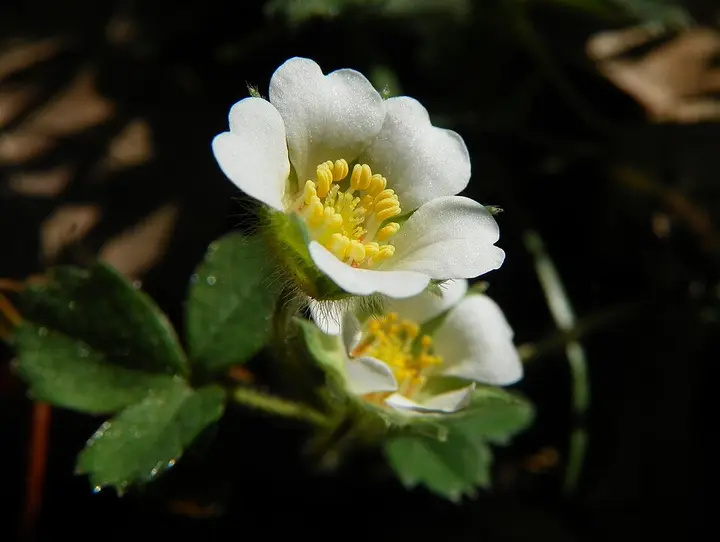
Barren strawberry, Potentilla sterilis

Wild flowerAncient woodland

Barren strawberry

Potentilla sterilis

A low, hairy plant with grey-green leaves of three toothed leaflets and white flowers with gaps between the petals, appearing from late winter. The end tooth of each leaflet is shorter than those beside it, and its fruit is dry, never a fleshy strawberry. It grows on dry banks, in open woods and along hedgerows.

When it flowers

February to May

Sources: BSBI, NatureSpot

Photo: AnemoneProjectors, CC BY-SA 2.0, via Wikimedia Commons

Close

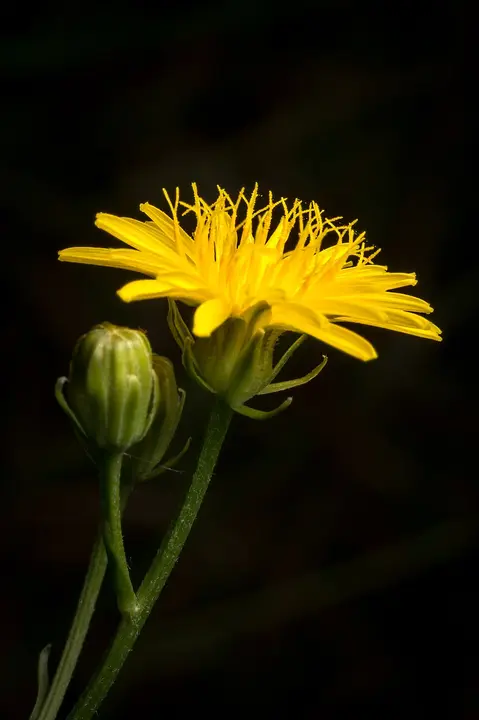
Beaked hawk's-beard, Crepis vesicaria

Wild flower

Beaked hawk's-beard

Crepis vesicaria

A tall, branched, hairy plant, common on road verges, banks and rough grassland in late spring. The yellow flowerheads have outer florets striped reddish-brown underneath, and the seeds have a long beak below their parachute of hairs. It is native to the Mediterranean region and south-west Asia, and was first recorded in Britain in Kent in 1713.

When it flowers

May to July

Sources: BSBI, NatureSpot, Wild Flower Finder

Photo: Manfred Moitzi, CC BY-SA 2.0, via Wikimedia Commons

Close

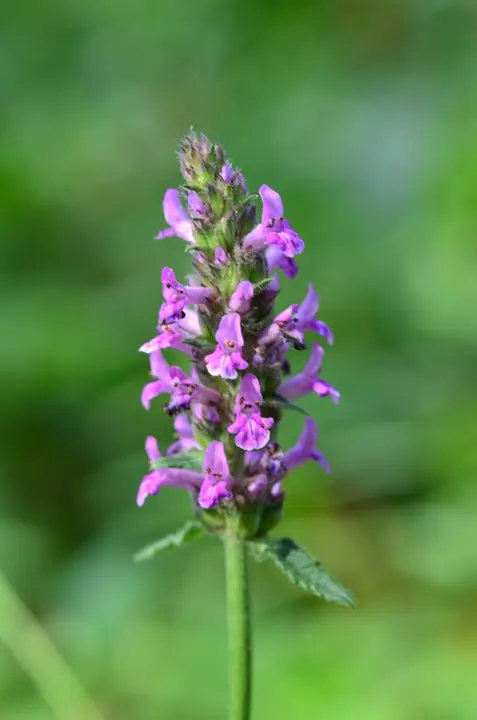
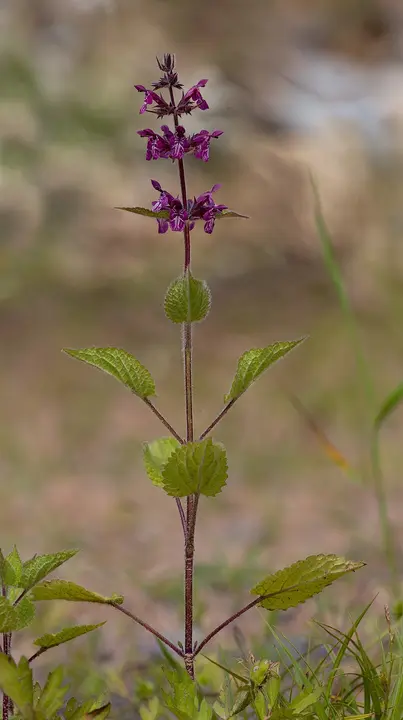
Betony, Betonica officinalis

Wild flowerAncient woodland

Betony

Betonica officinalis

Dense spikes of bright reddish-purple flowers top upright, softly hairy stems that rise from a rosette of coarsely toothed leaves. It grows in permanent grassland, on heaths and hedgebanks, and along woodland rides and edges. Bees visit the flowers, and finding it can suggest that a grassland is ancient.

When it flowers

June to October

Also called
wood betony, bishop's wort
Formerly
Stachys officinalis

Sources: BSBI, The Wildlife Trusts, NatureSpot

Photo: Radio Tonreg from Vienna, Austria, CC BY 2.0, via Wikimedia Commons

Close

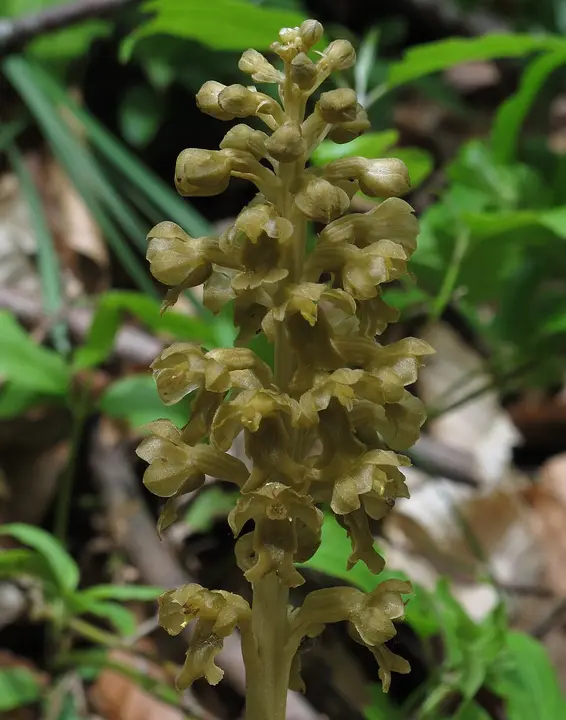
Bird's-nest orchid, Neottia nidus-avis

Wild flowerAncient woodland

Bird's-nest orchid

Neottia nidus-avis

A honey-brown orchid with no green leaves, found in deep shade in woods, especially under beech. The upright stem carries a spike of small, hooded, brownish flowers. Having no green colouring, it cannot feed itself from sunlight and instead gets its food from fungi in the soil.

When it flowers

May to July

Sources: The Wildlife Trusts, NatureSpot, Wild Flower Finder

Photo: Robert Flogaus-Faust, CC BY 4.0, via Wikimedia Commons

Close

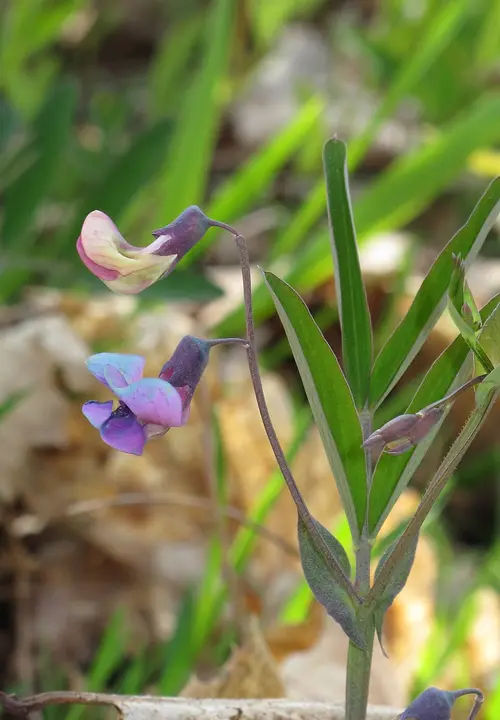
Bitter-vetch, Lathyrus linifolius

Wild flowerAncient woodland

Bitter-vetch

Lathyrus linifolius

An upright, hairless plant with winged stems, whose leaves have two to four pairs of narrow leaflets and end in a short point instead of a tendril. Its crimson-pink flowers turn bluish as they age. It grows on infertile, neutral to acid soils in heathy grassland, woodland edges and open woods, and has declined in the lowlands.

When it flowers

April to July

Formerly
Lathyrus montanus

Sources: NatureSpot, Wikipedia

Photo: Robert Flogaus-Faust, CC BY 4.0, via Wikimedia Commons

Close

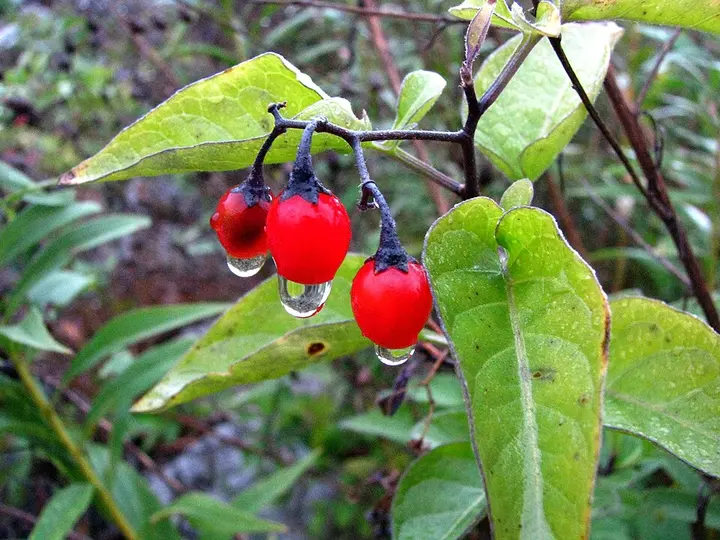
Bittersweet, Solanum dulcamara

Wild flower

Bittersweet

Solanum dulcamara

A scrambling, climbing plant of hedges, woods, scrub and watersides. Its purple flowers have swept-back petals around a yellow spike of anthers, and are followed by egg-shaped berries that ripen from green through yellow and orange to bright red. The plant is poisonous, and so are its berries.

When it flowers

June to September

Also called
woody nightshade

Sources: The Wildlife Trusts, NatureSpot, Wild Flower Finder

Photo: David Eickhoff from Pearl City, Hawaii, USA, CC BY 2.0, via Wikimedia Commons

Close

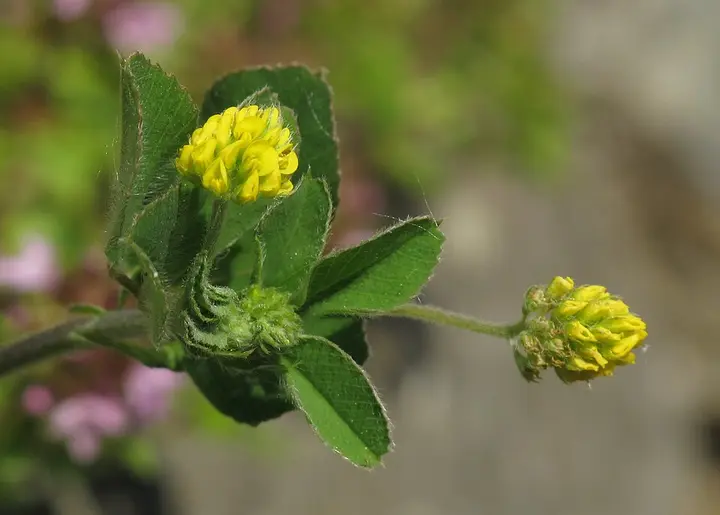
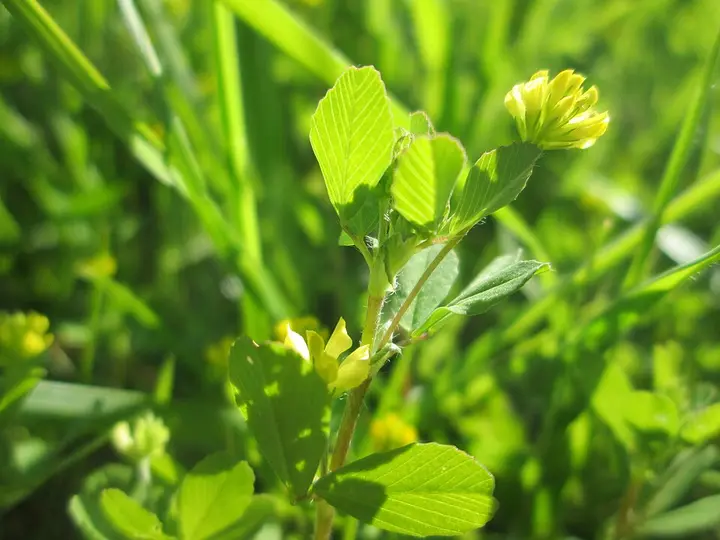
Black medick, Medicago lupulina

Wild flower

Black medick

Medicago lupulina

A low, often sprawling plant with clover-like leaves in threes and small, rounded heads of tiny yellow flowers. Its curled seed pods turn black when ripe. It grows in short grassland, on verges and in mown areas, and is one of the food plants of common blue butterfly caterpillars.

When it flowers

April to October

Sources: NatureSpot, Wild Flower Finder, Butterfly Conservation, First Nature, UK South West wild flowers

Photo: Robert Flogaus-Faust, CC BY 4.0, via Wikimedia Commons

Close

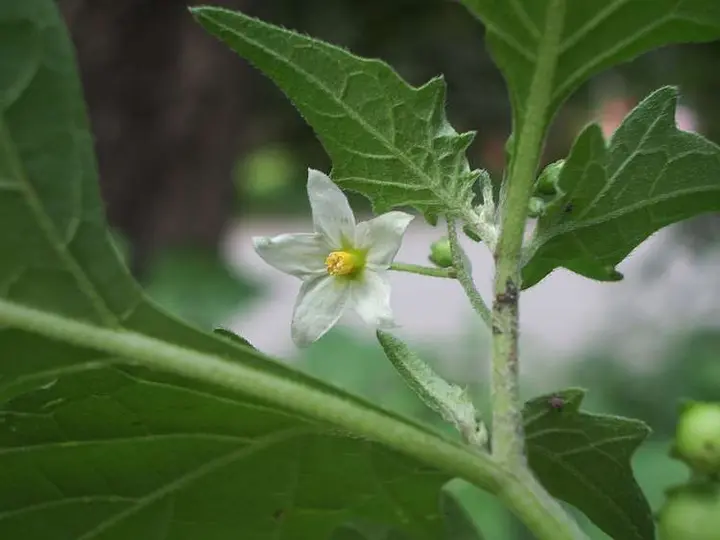
Black nightshade, Solanum nigrum

Wild flower

Black nightshade

Solanum nigrum

A low to medium annual of cultivated and disturbed ground, with stems that are often blackish and small clusters of white flowers with yellow anthers in the centre. The berries are green at first and turn dull black when ripe. The plant contains poisonous substances.

When it flowers

July to September

Sources: NatureSpot, Wild Flower Finder, UK South West wild flowers

Photo: Harald Hubich, CC BY-SA 3.0, via Wikimedia Commons

Close

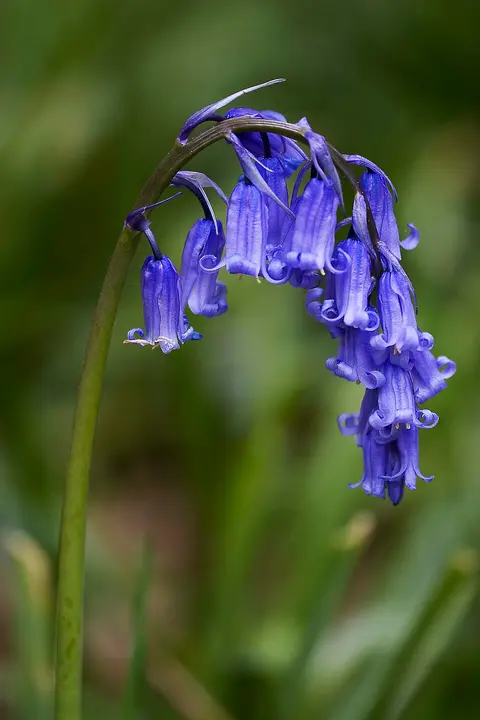
Bluebell, Hyacinthoides non-scripta

Wild flowerAncient woodland

Bluebell

Hyacinthoides non-scripta

Nodding, sweet-scented, deep violet-blue bells hang from one side of a drooping stem. It grows in broadleaved woodland, along hedgerows and in fields, is one of the plants used as indicators of ancient woodland, and is protected under the Wildlife and Countryside Act 1981. The Spanish bluebell grown in gardens has paler flowers all round an upright stem and blue or pale green pollen, where the native's is cream, and the two can hybridise.

When it flowers

April to June

Sources: The Wildlife Trusts, The Wildlife Trusts (2), Woodland Trust

Photo: MichaelMaggs, CC BY-SA 3.0, via Wikimedia Commons

Close

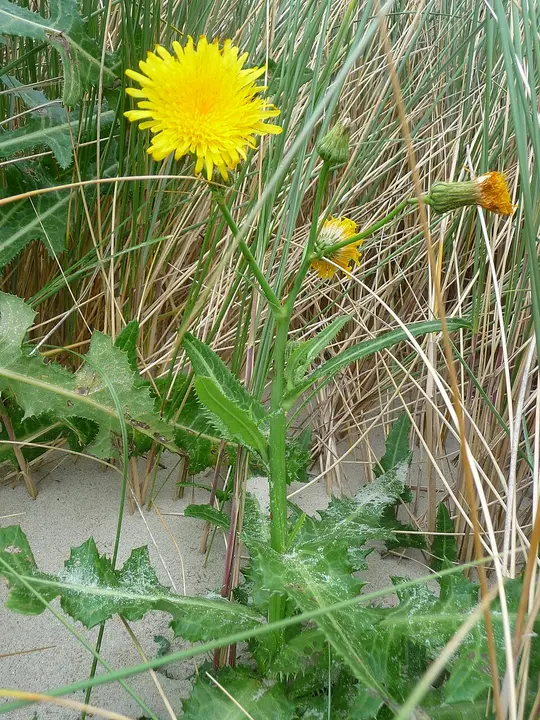
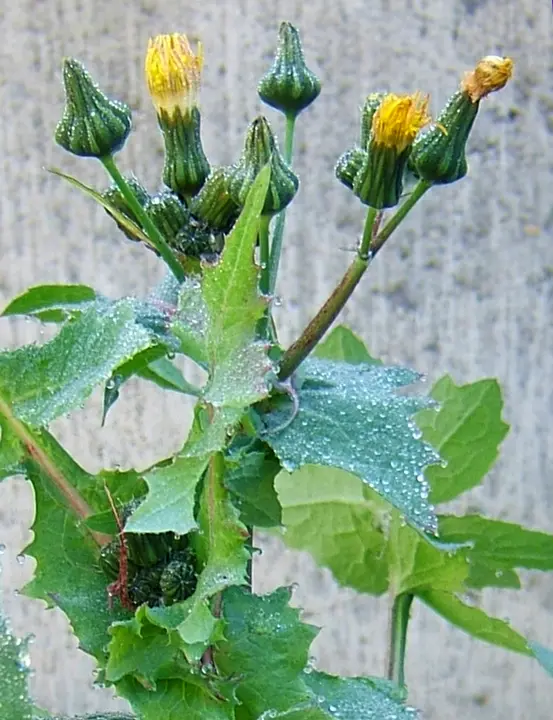
Bristly oxtongue, Helminthotheca echioides

Wild flower

Bristly oxtongue

Helminthotheca echioides

A branched plant covered in stiff bristles, many rising from pale pimples on the leaves, with yellow, dandelion-like flower heads. Each flower head sits in a loose cup of broad outer bracts. It grows in rough grassy places and on waste ground, especially on clay soils and near the sea.

When it flowers

June to November

Formerly
Picris echioides

Sources: NatureSpot, Wild Flower Finder, UK South West wild flowers

Photo: Stefan.lefnaer, CC BY-SA 4.0, via Wikimedia Commons

Close

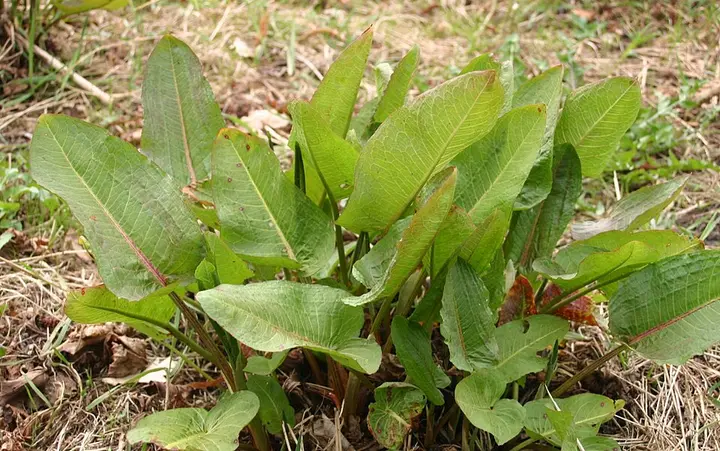
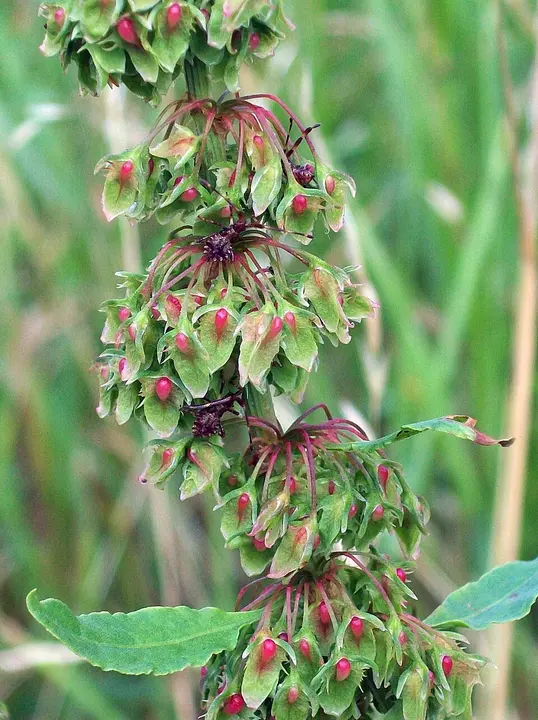
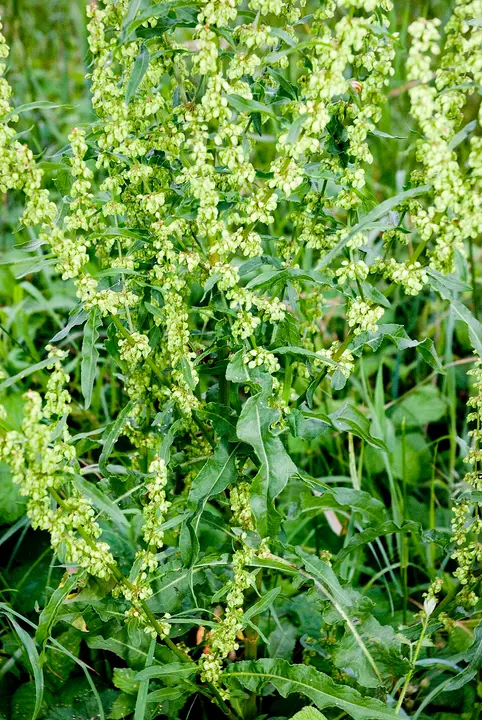
Broad-leaved dock, Rumex obtusifolius

Wild flower

Broad-leaved dock

Rumex obtusifolius

A tall plant with very large, broad leaves, the lower ones heart-shaped at the base, and branched spikes of small reddish-brown flowers. It grows on verges, waste ground, in hedgerows and poor pasture, and is a food plant of the small copper butterfly. It is one of the injurious weeds named in the Weeds Act 1959.

When it flowers

June to October

Sources: The Wildlife Trusts, NatureSpot, legislation.gov.uk

Photo: Sten Porse, CC BY-SA 3.0, via Wikimedia Commons

Close

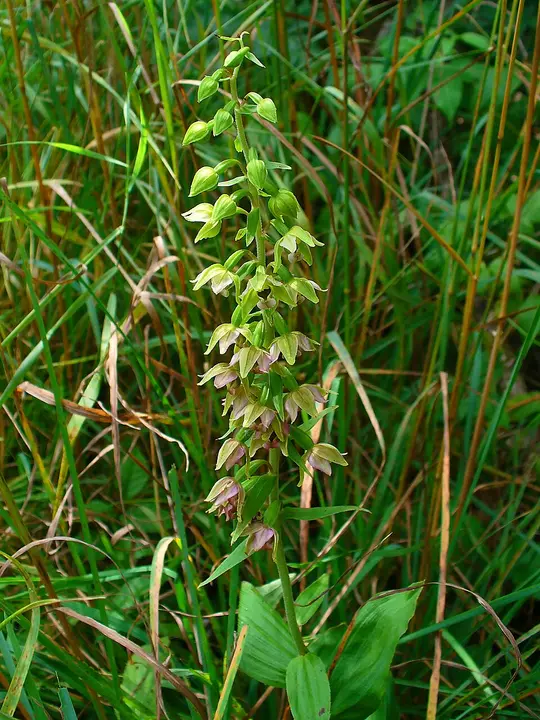
Broad-leaved helleborine, Epipactis helleborine

Wild flowerAncient woodland

Broad-leaved helleborine

Epipactis helleborine

A tall orchid of woods, scrub, hedgerows and shady roadsides. Broad, oval, strongly veined leaves spiral up the stem below a spike of drooping flowers, greenish with a purple tinge but sometimes wholly green or purple. It is pollinated mainly by wasps, which visit the flowers for nectar.

When it flowers

July to September

Sources: BSBI, The Wildlife Trusts, NatureSpot, Wild Flower Finder, BioImages

Photo: H. Zell, CC BY-SA 3.0, via Wikimedia Commons

Close

Broad-leaved willowherb, Epilobium montanum

Wild flower

Broad-leaved willowherb

Epilobium montanum

A common willowherb with small pink flowers that have notched petals and a four-lobed stigma. Its oval, toothed leaves are almost stalkless and mostly in opposite pairs on a rounded stem. It grows in gardens, on walls, paths and waste ground, and naturally in rocky woodland and along woodland edges.

When it flowers

June to August

Sources: NatureSpot

Photo: jacilluch, CC BY-SA 2.0, via Wikimedia Commons

Close

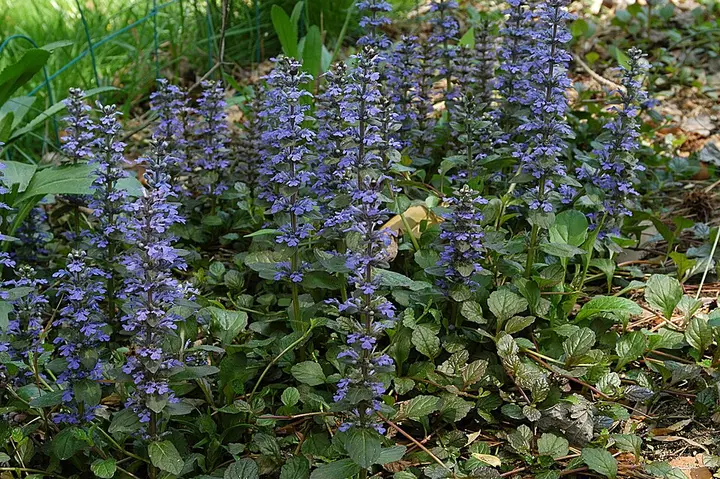
Bugle, Ajuga reptans

Wild flower

Bugle

Ajuga reptans

A low plant that spreads by runners rooting along the ground, carpeting damp grassland, scrub and woodland clearings. Spikes of violet-blue flowers rise above oval, often bronze-tinged leaves. Bumblebees and butterflies visit the flowers.

When it flowers

April to July

Sources: The Wildlife Trusts, NatureSpot

Photo: G. Edward Johnson, CC BY-SA 3.0, via Wikimedia Commons

Close

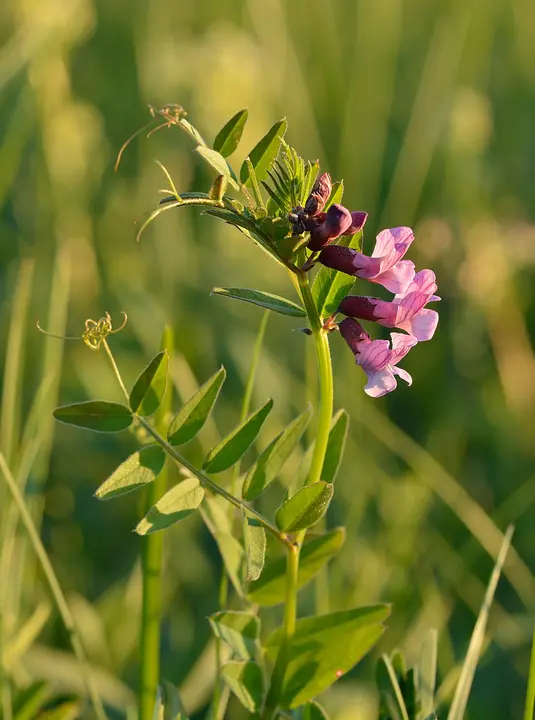
Bush vetch, Vicia sepium

Wild flowerAncient woodland

Bush vetch

Vicia sepium

A scrambling plant of hedgerows, woodland edges, scrub and road verges that climbs with branched tendrils. It has short-stalked clusters of two to six purple to lilac-blue flowers, followed by black, hairless pods. Bumblebees visit the flowers.

When it flowers

April to November

Sources: The Wildlife Trusts, NatureSpot

Photo: Ivar Leidus, CC BY-SA 3.0, via Wikimedia Commons

Close

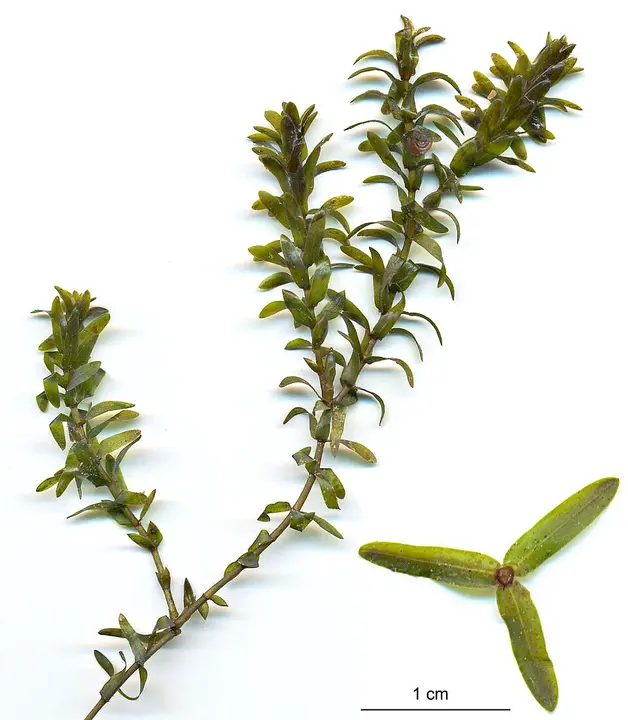
Canadian waterweed, Elodea canadensis

Wild flower

Canadian waterweed

Elodea canadensis

A submerged North American plant of ponds, lakes, canals and slow rivers, forming dense, deep green masses of small leaves, mostly in whorls of three. Only female plants grow in Britain, so it does not set seed here and spreads mainly from broken pieces of stem. It is listed as an invasive non-native species, and planting it or causing it to grow in the wild is an offence.

When it flowers

May to September

Also called
Canadian pondweed

Sources: RHS, NatureSpot, GB Non-native Species Secretariat, Shire Group of IDBs

Photo: Christian Fischer, CC BY-SA 3.0, via Wikimedia Commons

Close

Cat's-ear, Hypochaeris radicata

Wild flower

Cat's-ear

Hypochaeris radicata

A dandelion-like plant with yellow flowerheads on branched stems that have few or no leaves. The leaves lie in a flat rosette and are wavy-edged and covered in stiff hairs. It is common in lawns, on verges and in dry grassland.

When it flowers

June to September

Also called
common cat's-ear

Sources: BSBI, BSBI (2), NatureSpot, First Nature

Photo: Roc0ast3r, CC0, via Wikimedia Commons

Close

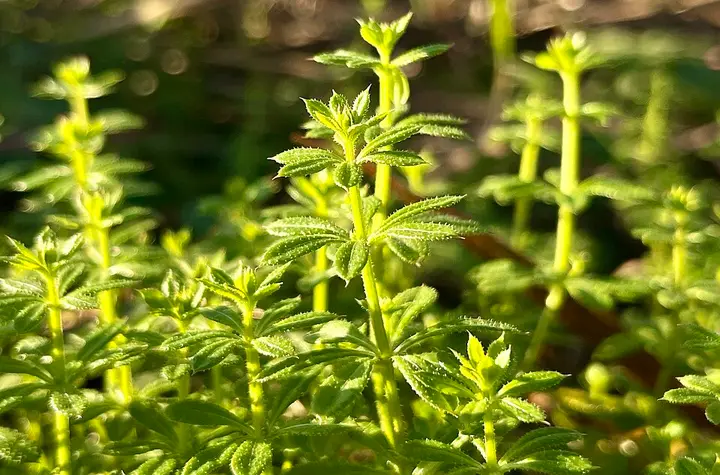
Cleavers, Galium aparine

Wild flower

Cleavers

Galium aparine

A scrambling annual covered in tiny hooked bristles, so its stems, leaves and round fruits cling to clothing and fur. Narrow leaves grow in whorls of six to nine around the square stems, with tiny white flowers. It climbs through hedges and over woodland edges.

When it flowers

May to September

Also called
goosegrass, sticky willie

Sources: The Wildlife Trusts, RHS, NatureSpot

Photo: Kieran Roy Powell, CC BY 4.0, via Wikimedia Commons

Close

Clustered dock, Rumex conglomeratus

Wild flower

Clustered dock

Rumex conglomeratus

A dock with zig-zag stems and spreading branches that carry leaves almost to their tips, with the flowers in well-spaced clusters. Each fruit has three well-developed, smooth swellings called tubercles. It grows in damp grassland, marshy meadows, ditches and along streams.

When it flowers

June to August

Sources: NatureSpot

Photo: Peter O'Connor, CC BY-SA 2.0, via Wikimedia Commons

Close

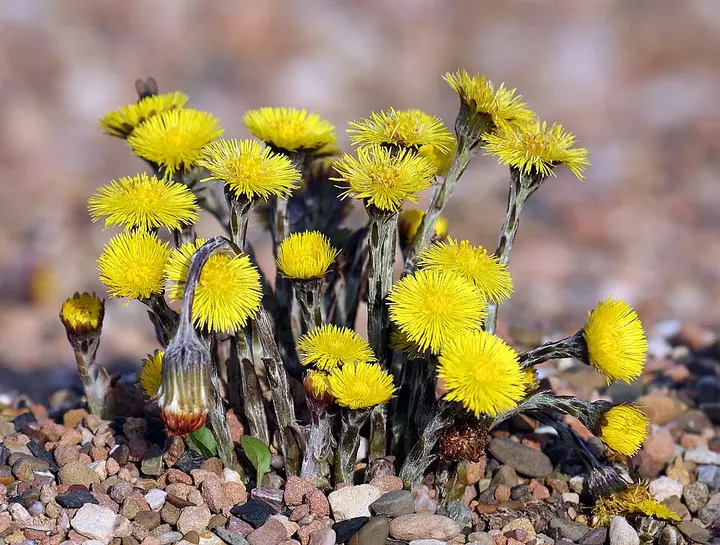
Colt's-foot, Tussilago farfara

Wild flower

Colt's-foot

Tussilago farfara

Yellow flowerheads appear in early spring on short, scaly stems, well before any leaves, which explains the old name son-before-father. The large, roughly hoof-shaped leaves follow later and are silvery white underneath. It grows on waste ground, field edges and verges, especially where the ground is poorly drained.

When it flowers

February to April

Also called
coltsfoot

Sources: BSBI, The Wildlife Trusts, Plantlife

Photo: Andreas Trepte, CC BY-SA 2.5, via Wikimedia Commons

Close

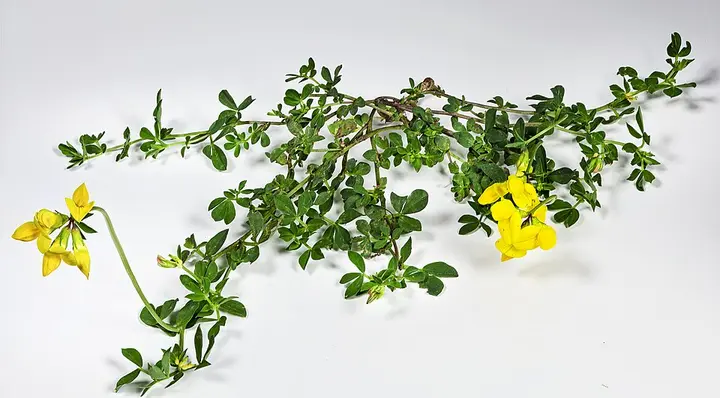
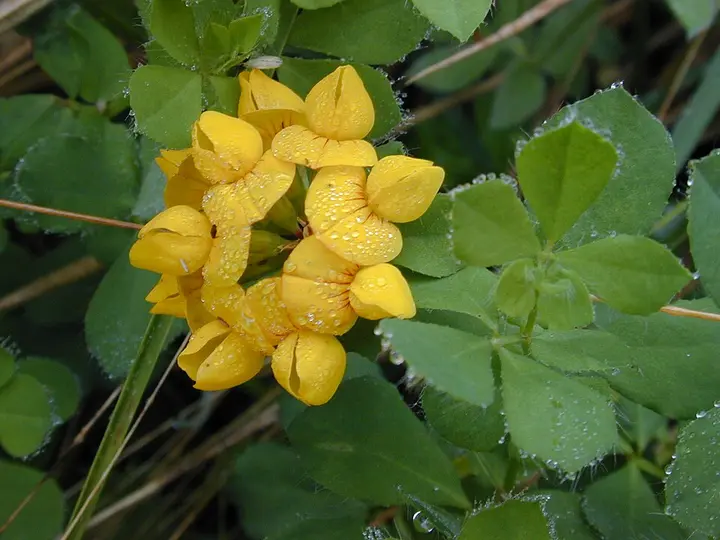
Common bird's-foot-trefoil, Lotus corniculatus

Wild flower

Common bird's-foot-trefoil

Lotus corniculatus

A low, sprawling plant with clusters of yellow pea flowers, sometimes tinged red, hence its nickname eggs and bacon. The slender seed pods spread out like a bird's foot. It grows in short grassland, lawns and road verges, and its leaves feed the caterpillars of the common blue butterfly.

When it flowers

May to September

Also called
eggs and bacon, granny's toenails

Sources: The Wildlife Trusts, NatureSpot

Photo: Didier Descouens, CC BY-SA 4.0, via Wikimedia Commons

Close

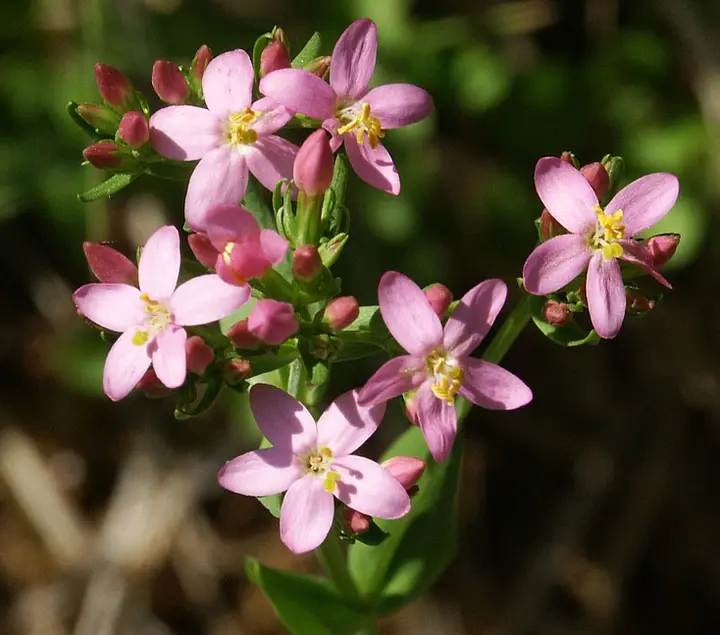
Common centaury, Centaurium erythraea

Wild flower

Common centaury

Centaurium erythraea

A low plant with clusters of small pink, five-petalled flowers at the top of upright stems, above a rosette of oval leaves. It grows in dry, grassy places such as woodland rides, heaths and chalk downland. It belongs to the gentian family, and its flowers close during the afternoon.

When it flowers

June to September

Sources: BSBI, The Wildlife Trusts, UK South West wild flowers

Photo: BerndH, CC BY-SA 3.0, via Wikimedia Commons

Close

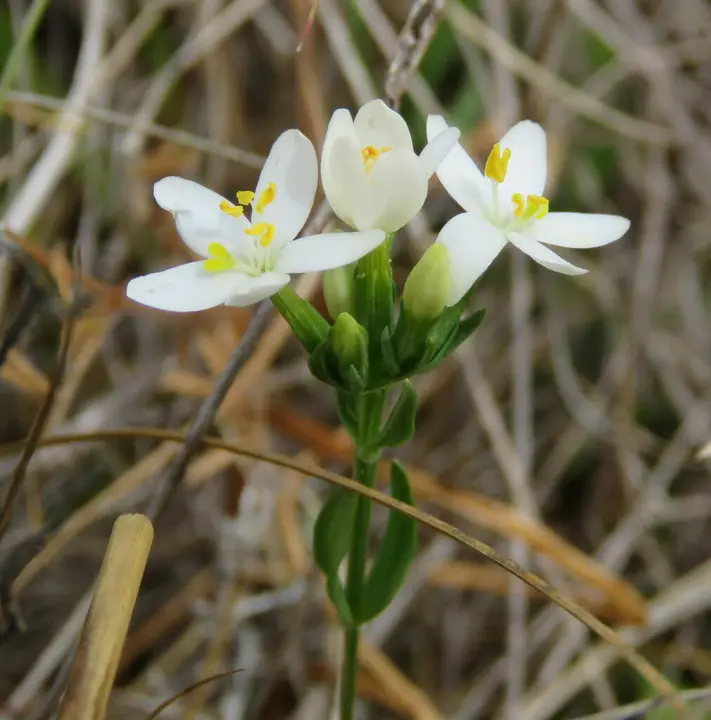
Common centaury (white-flowered form), Centaurium erythraea

Wild flower

Common centaury (white-flowered form)

Centaurium erythraea

Common centaury occasionally produces plants with all-white flowers in place of the usual pink. Apart from the colour they are the same plant, with clusters of small five-petalled flowers above a rosette of oval leaves, in dry, grassy places. Botanists do not treat the white form as a separate species.

When it flowers

June to September

Sources: BSBI, The Wildlife Trusts, UK South West wild flowers

Photo: William Harland, CC BY 4.0, via iNaturalist

Close

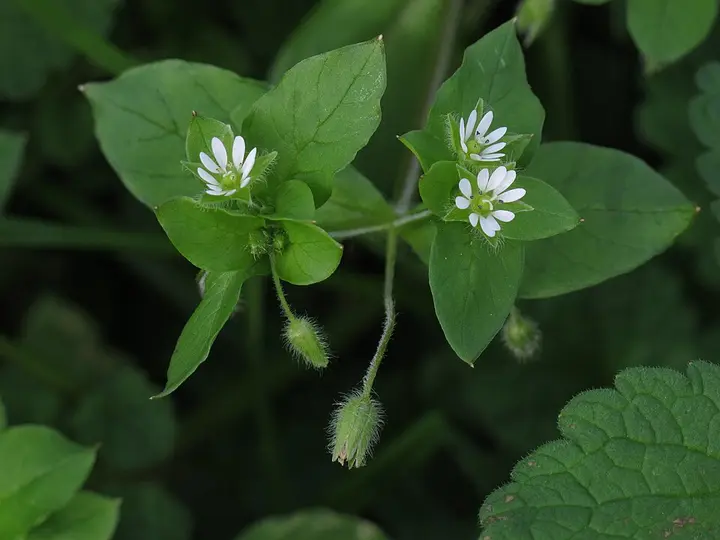
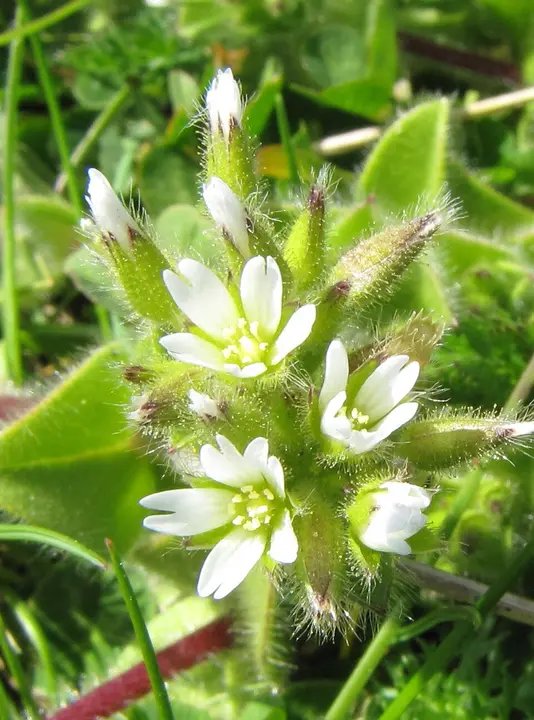
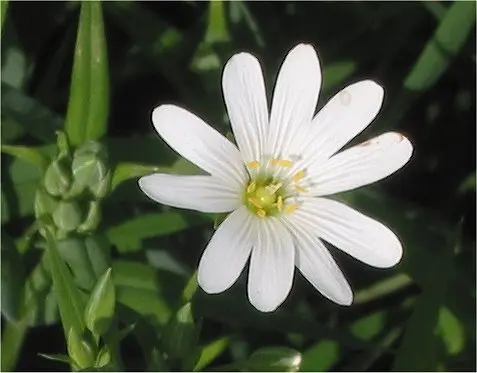
Common chickweed, Stellaria media

Wild flower

Common chickweed

Stellaria media

A low, sprawling annual with small white flowers whose five petals are split so deeply they look like ten. A single line of hairs runs down the stem, switching sides at each pair of leaves. It grows on disturbed and cultivated ground, on verges and in gardens, and gets its name from being fed to chickens.

When it flowers

All year

Also called
chickweed

Sources: The Wildlife Trusts, RHS, NatureSpot

Photo: Robert Flogaus-Faust, CC BY 4.0, via Wikimedia Commons

Close

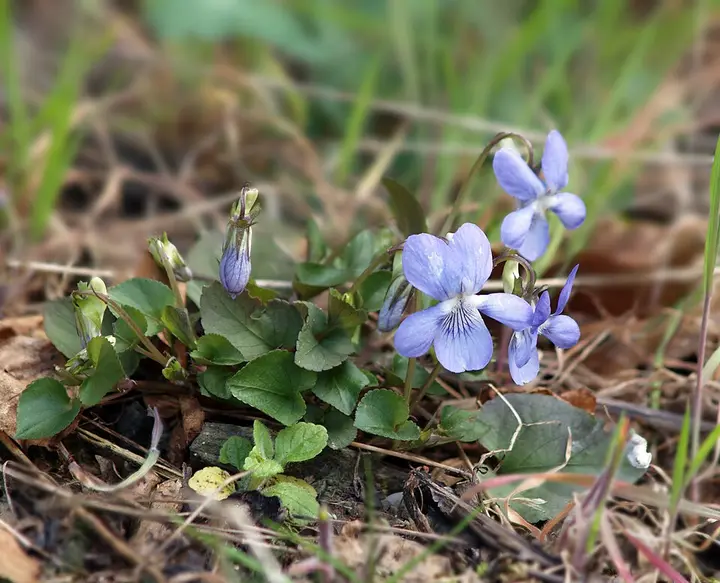
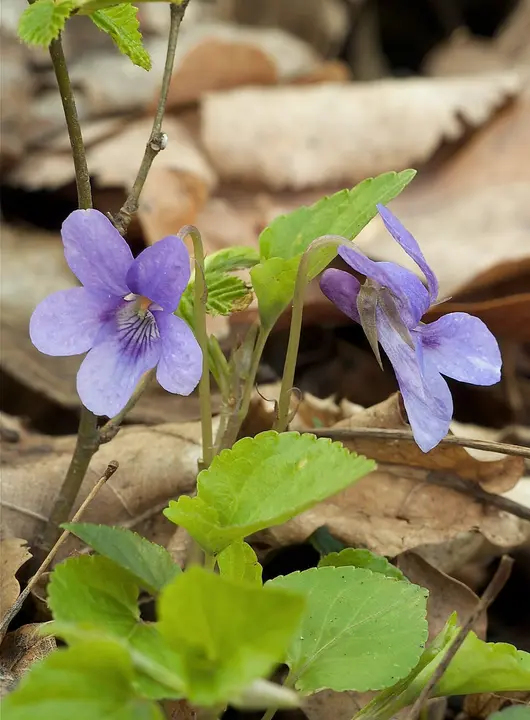
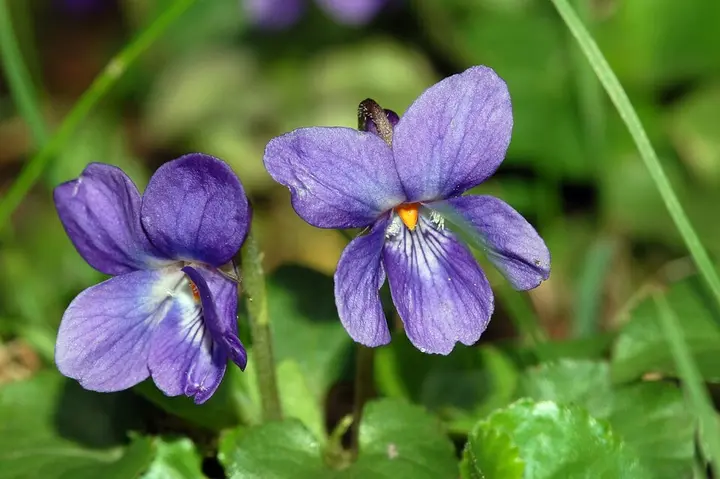
Common dog-violet, Viola riviniana

Wild flower

Common dog-violet

Viola riviniana

The most common violet in Britain, with heart-shaped leaves and unscented bluish-purple flowers. Look at the back of the flower for a pale, stout spur with a notch at its tip. It grows in woods, hedgebanks, grassland and heath, and several fritillary butterflies lay their eggs on it.

When it flowers

April to June

Sources: The Wildlife Trusts, NatureSpot

Photo: Jörg Hempel, CC BY-SA 2.0 de, via Wikimedia Commons

Close

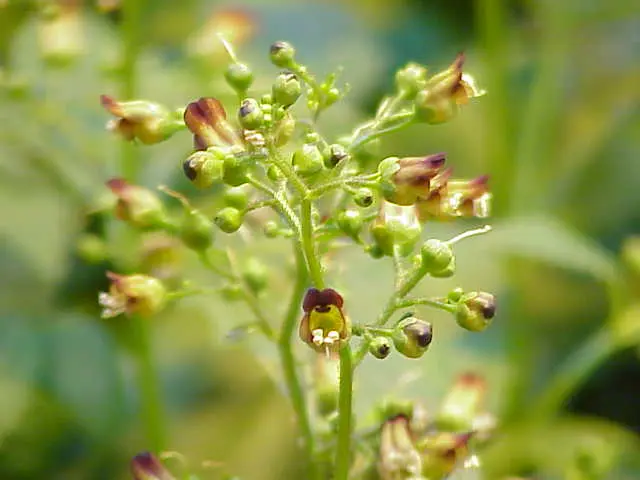
Common figwort, Scrophularia nodosa

Wild flower

Common figwort

Scrophularia nodosa

A tall, hairless plant of damp woods and shady hedgerows, with square stems and pointed, toothed leaves in opposite pairs. Its small flowers are greenish with a purplish-brown upper lip and are pollinated mainly by wasps.

When it flowers

June to September

Sources: BSBI, NatureSpot, Wild Flower Finder, First Nature

Photo: Kurt Stüber [1], CC BY-SA 3.0, via Wikimedia Commons

Close

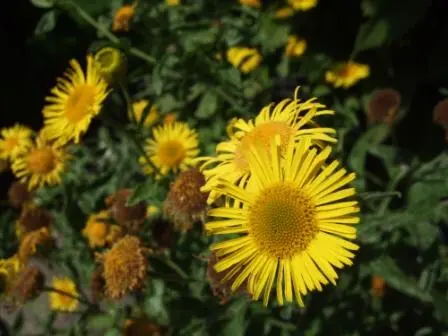
Common fleabane, Pulicaria dysenterica

Wild flower

Common fleabane

Pulicaria dysenterica

A downy perennial of damp ground, ditches, marshes and wet meadows, spreading by creeping underground stems. Its golden-yellow, daisy-like flowerheads have many narrow rays. The name comes from its old use for keeping fleas away.

When it flowers

August to September

Sources: RHS, NatureSpot, Wild Flower Finder, First Nature

Photo: DDennisM, CC BY 3.0, via Wikimedia Commons

Close

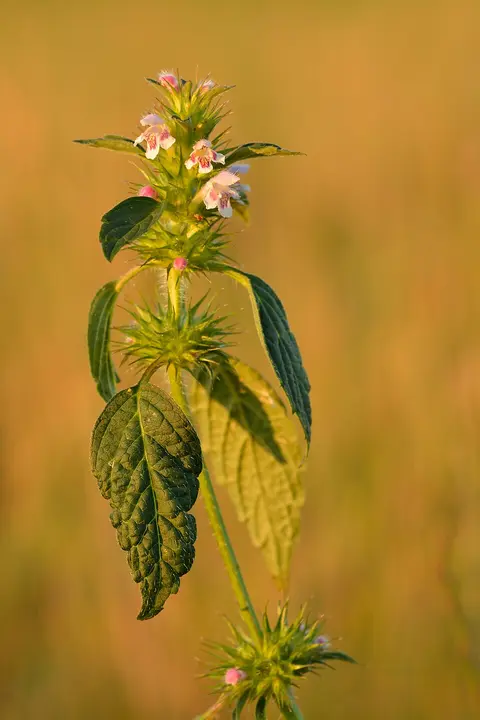
Common hemp-nettle, Galeopsis tetrahit

Wild flower

Common hemp-nettle

Galeopsis tetrahit

A roughly hairy annual of arable fields, woodland clearings, verges and other disturbed ground, with nettle-like leaves that do not sting. Its square stems are swollen at the leaf joints. The pinkish-purple or white flowers have darker markings on an unnotched lower lip, which separates it from the similar bifid hemp-nettle.

When it flowers

July to September

Sources: NatureSpot, Wild Flower Finder, First Nature

Photo: Ivar Leidus, CC BY-SA 3.0, via Wikimedia Commons

Close

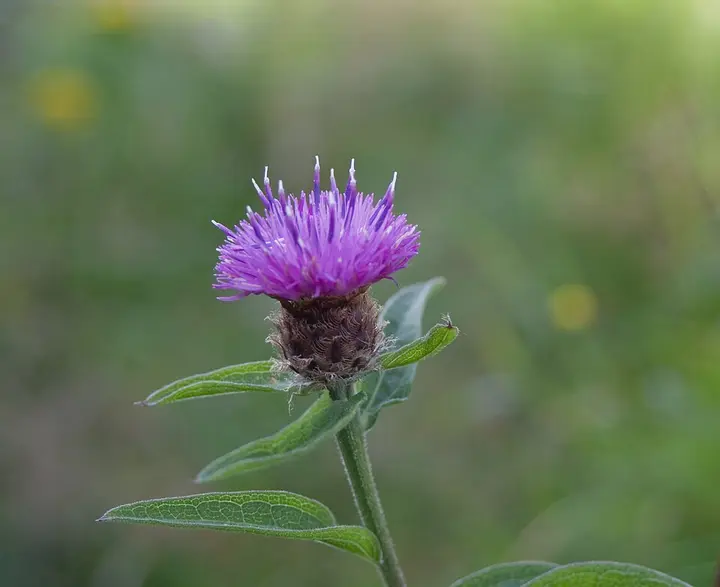
Common knapweed, Centaurea nigra agg.

Wild flower

Common knapweed

Centaurea nigra agg.

A thistle-like perennial of meadows, pastures, road verges, woodland rides and other grassland. Its purple flowerheads grow from rounded, blackish-brown heads of bracts. It is a good source of nectar for bees and for butterflies such as meadow browns and marbled whites.

When it flowers

June to September

Also called
black knapweed, hardheads

Sources: The Wildlife Trusts, Plantlife

Photo: Julie Anne Workman, CC BY-SA 3.0, via Wikimedia Commons

Close

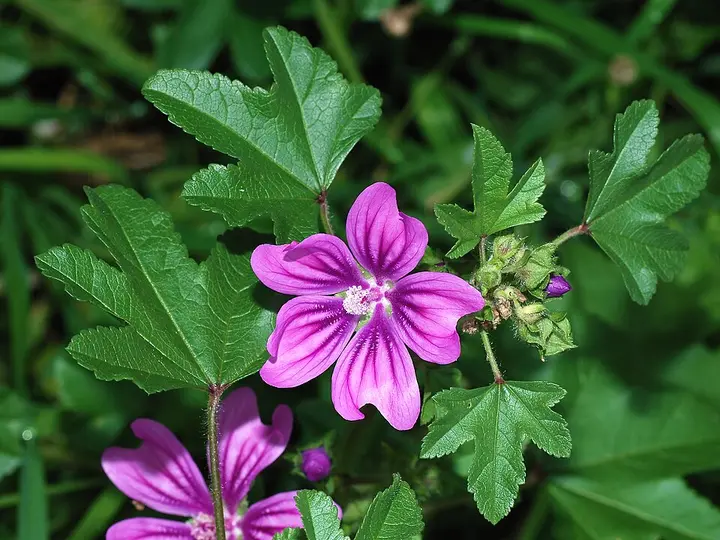
Common mallow, Malva sylvestris

Wild flower

Common mallow

Malva sylvestris

A sprawling, hairy plant of road verges, footpaths, meadows and waste ground. Its large pinkish-purple flowers have five petals with dark purple stripes, and its rounded leaves have shallow, toothed lobes. The colour mauve takes its name from the French word for mallow.

When it flowers

June to September

Sources: The Wildlife Trusts, NatureSpot, Wild Flower Finder

Photo: Alvesgaspar, CC BY-SA 3.0, via Wikimedia Commons

Close

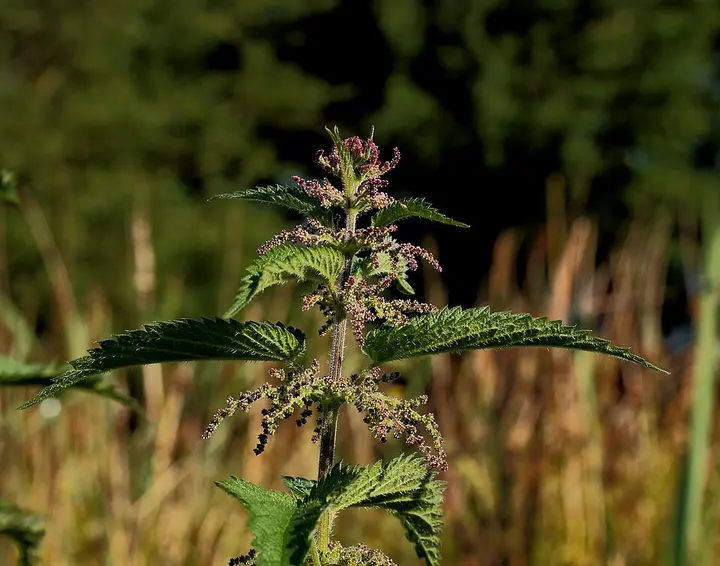
Common nettle, Urtica dioica

Wild flower

Common nettle

Urtica dioica

A patch-forming plant whose toothed, heart-shaped leaves and square stems are covered in stinging hairs, usually found on damp, fertile ground. Tiny green flowers hang in catkin-like strings, with male and female flowers on separate plants. Its leaves feed the caterpillars of small tortoiseshell and peacock butterflies.

When it flowers

June to September

Also called
stinging nettle

Sources: BSBI, The Wildlife Trusts, NatureSpot, Wild Flower Finder, Butterfly Conservation, Butterfly Conservation (2)

Photo: Dominicus Johannes Bergsma, CC BY-SA 4.0, via Wikimedia Commons

Close

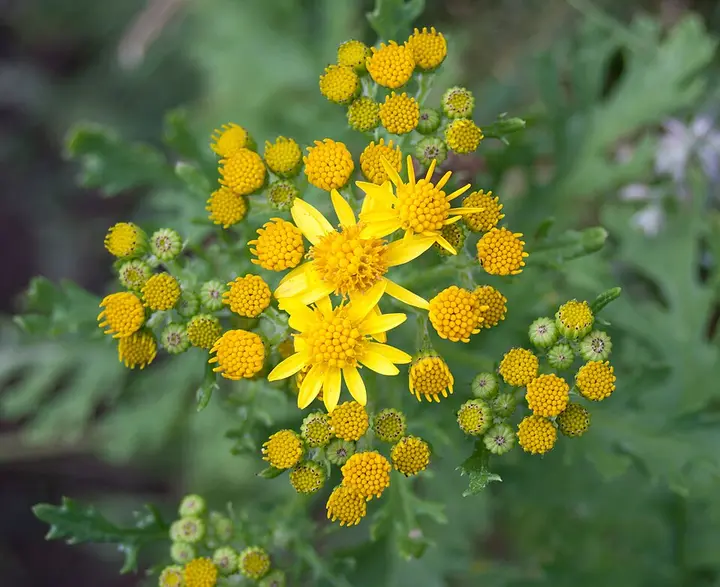
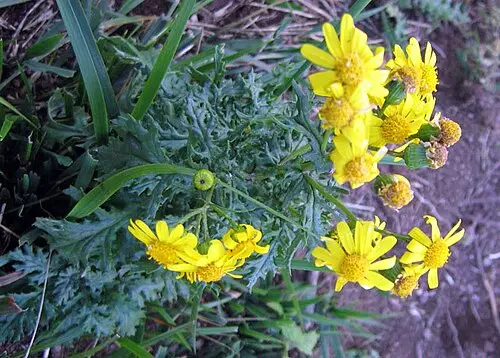
Common ragwort, Jacobaea vulgaris

Wild flower

Common ragwort

Jacobaea vulgaris

Tall stems carry broad, flat-topped clusters of bright yellow, daisy-like flowers above ragged, deeply divided leaves. It grows in rough grassland, on verges and on waste ground. It is poisonous and can harm livestock that eat it, but it supports many insects, including the caterpillars of the cinnabar moth.

When it flowers

June to November

Also called
ragwort
Formerly
Senecio jacobaea

Sources: The Wildlife Trusts, NatureSpot

Photo: Julie Anne Workman, CC BY-SA 3.0, via Wikimedia Commons

Close

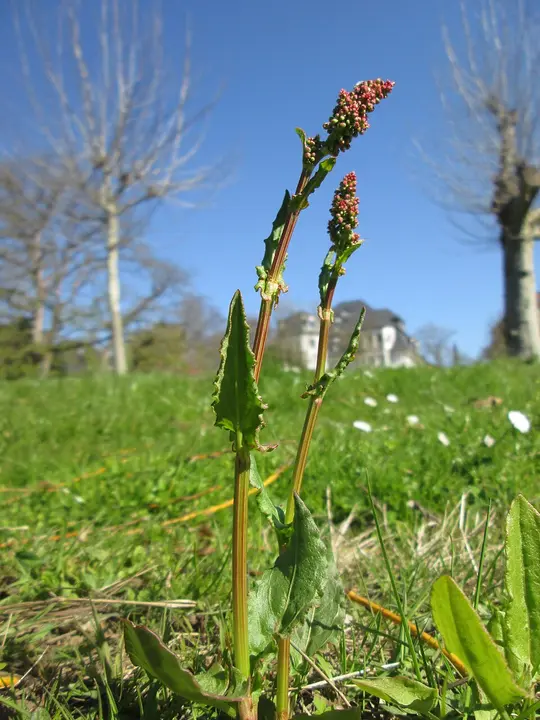
Common sorrel, Rumex acetosa

Wild flower

Common sorrel

Rumex acetosa

An upright plant of meadows and grassy places, with arrow-shaped leaves whose lower lobes point backwards; the upper leaves clasp the stem. Slender spikes of small reddish flowers appear in early summer, with male and female flowers on separate plants, and the leaves often turn deep red as it sets seed.

When it flowers

May to June

Also called
sorrel

Sources: The Wildlife Trusts, NatureSpot

Photo: AnRo0002, CC0, via Wikimedia Commons

Close

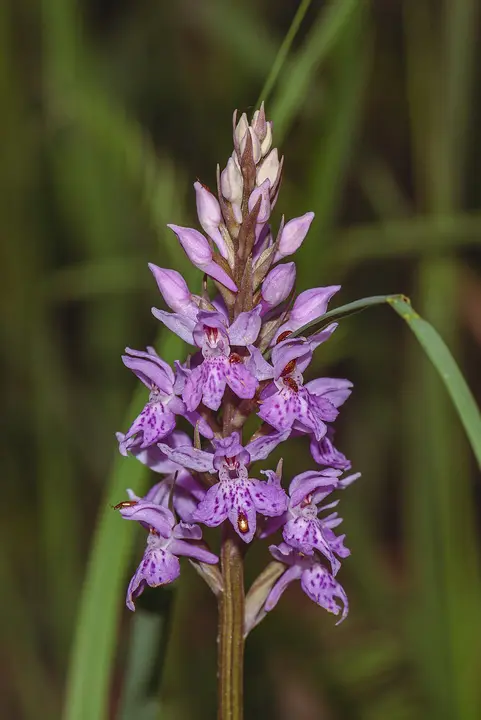
Common spotted-orchid, Dactylorhiza fuchsii

Wild flower

Common spotted-orchid

Dactylorhiza fuchsii

An orchid with dense, cone-shaped spikes of flowers ranging from white to pale pink or purple, marked with darker spots and loops on a three-lobed lip. The leaves are usually covered in dark oval spots. It grows in grassland, on verges and in open woodland, and is the commonest orchid in the UK.

When it flowers

June to August

Sources: The Wildlife Trusts, NatureSpot, UK South West wild flowers

Photo: Flocci Nivis, CC BY 4.0, via Wikimedia Commons

Close

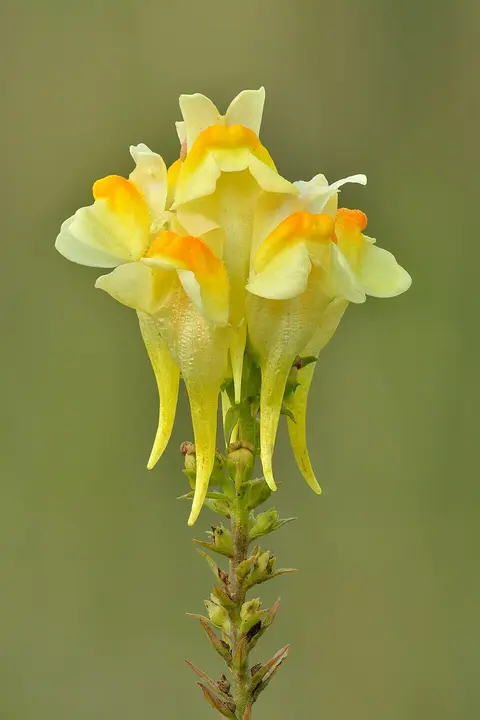
Common toadflax, Linaria vulgaris

Wild flower

Common toadflax

Linaria vulgaris

Its yellow flowers look like small snapdragons, each with an orange centre and a long spur behind, crowded in spikes at the top of upright stems with narrow leaves. It grows in grassland, on road verges, railway banks and waste ground, especially on lime-rich soils. Bumblebees are among the insects that visit it.

When it flowers

June to October

Also called
butter and eggs

Sources: The Wildlife Trusts, NatureSpot, Wikipedia

Photo: Ivar Leidus, CC BY-SA 4.0, via Wikimedia Commons

Close

Common twayblade, Neottia ovata

Wild flower

Common twayblade

Neottia ovata

An orchid named for its single pair of broad, oval leaves near the base of the stem. A slender spike above carries many small yellow-green flowers, each with a long, notched lip, which some say look like tiny people. It grows in woods, scrub, hedgerows and grassland, especially on chalky soils.

When it flowers

May to July

Formerly
Listera ovata

Sources: The Wildlife Trusts, NatureSpot, First Nature, Kent Wildlife Trust

Photo: Joachim Lutz, CC BY-SA 3.0, via Wikimedia Commons

Close

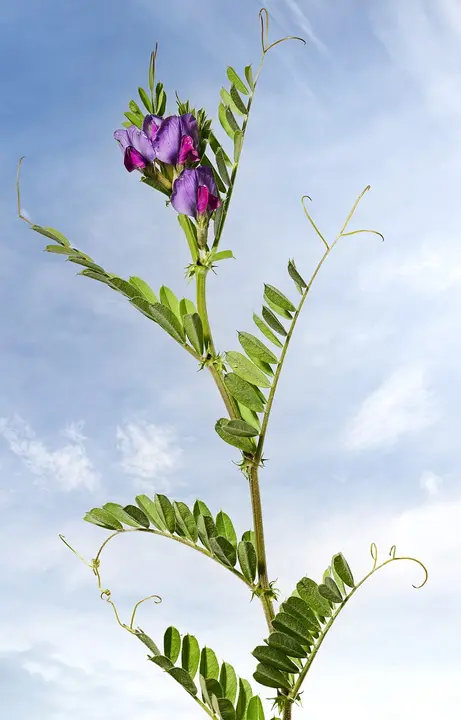
Common vetch, Vicia sativa

Wild flower

Common vetch

Vicia sativa

A scrambling plant with tendrils and leaves made up of pairs of leaflets. Its pink to purple pea flowers grow singly or in pairs, and the stipules at the base of each leaf have a dark spot. It grows in grassland, waste ground and road verges, and has been grown as a fodder crop and escaped widely.

When it flowers

May to September

Sources: The Wildlife Trusts, NatureSpot

Photo: Didier Descouens, CC BY-SA 4.0, via Wikimedia Commons

Close

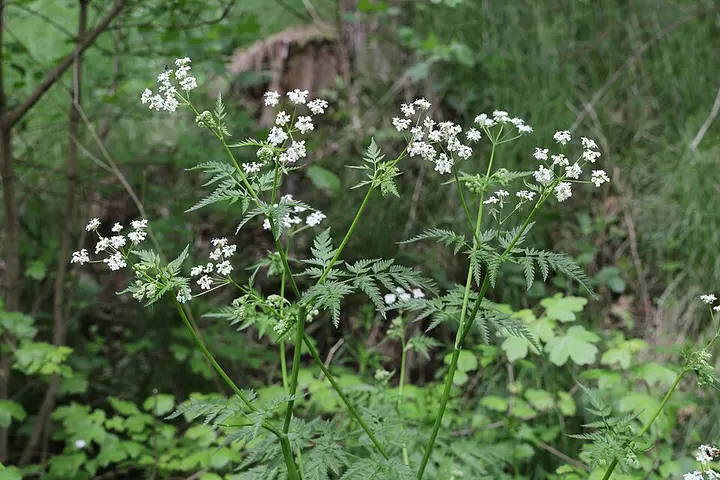
Cow parsley, Anthriscus sylvestris

Wild flower

Cow parsley

Anthriscus sylvestris

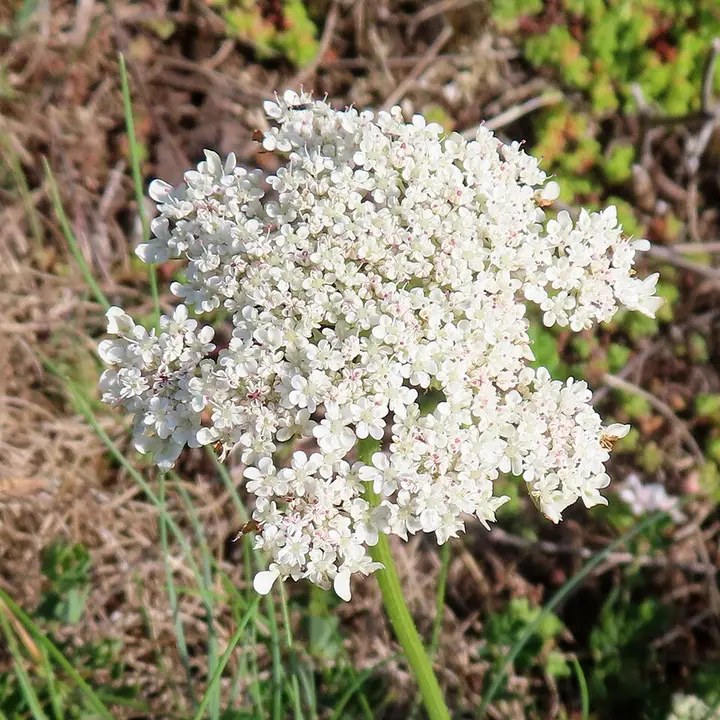
A tall plant with fern-like leaves and frothy heads of tiny white flowers, common along roadsides, hedgerows and woodland edges. Its stems are hollow and unspotted, which helps tell it from hemlock, a very poisonous look-alike with purple-spotted stems.

When it flowers

April to June

Also called
Queen Anne's lace

Sources: Woodland Trust, Plantlife

Photo: T. Kebert, CC BY-SA 4.0, via Wikimedia Commons

Close

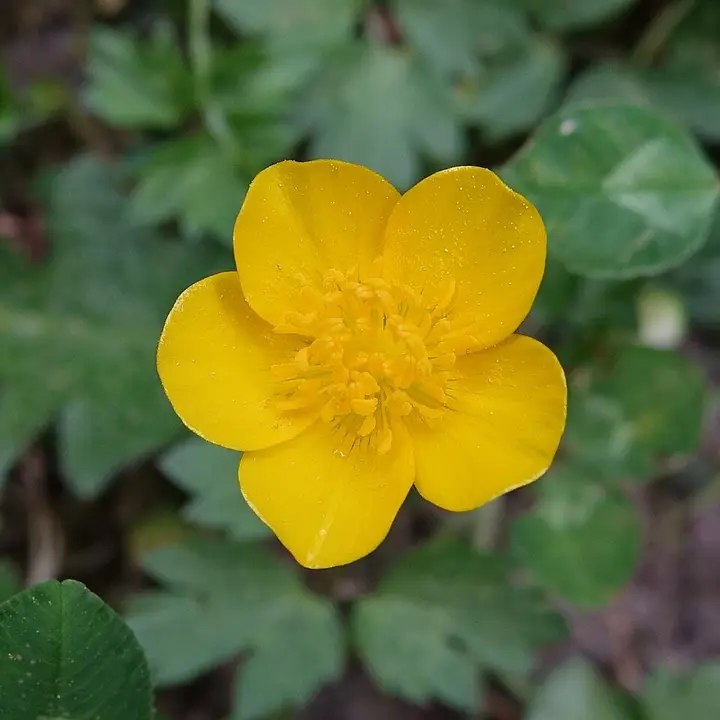
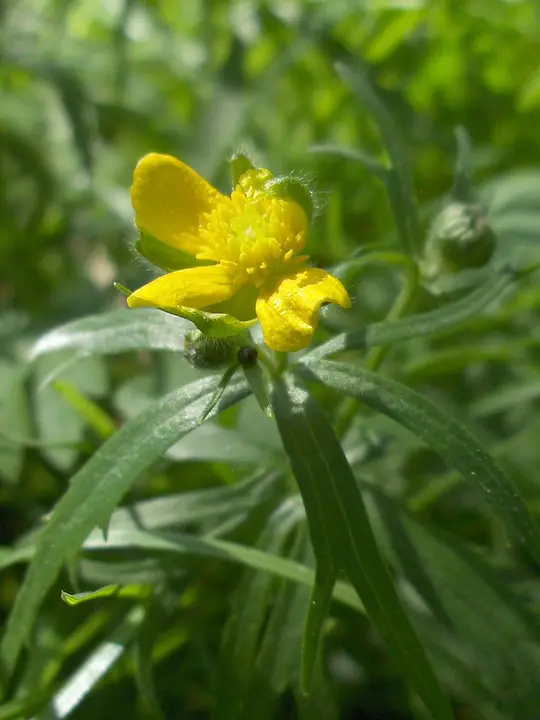
Creeping buttercup, Ranunculus repens

Wild flower

Creeping buttercup

Ranunculus repens

A buttercup that spreads by long runners rooting along the ground, which sets it apart from other buttercups. Its hairy leaves are divided into three lobes with ragged edges, and its open yellow flowers give nectar and pollen to short-tongued bees. It grows in damp grassland, along field and woodland edges and in lawns and gardens.

When it flowers

May to August

Sources: The Wildlife Trusts

Photo: Gzen92, CC BY-SA 4.0, via Wikimedia Commons

Close

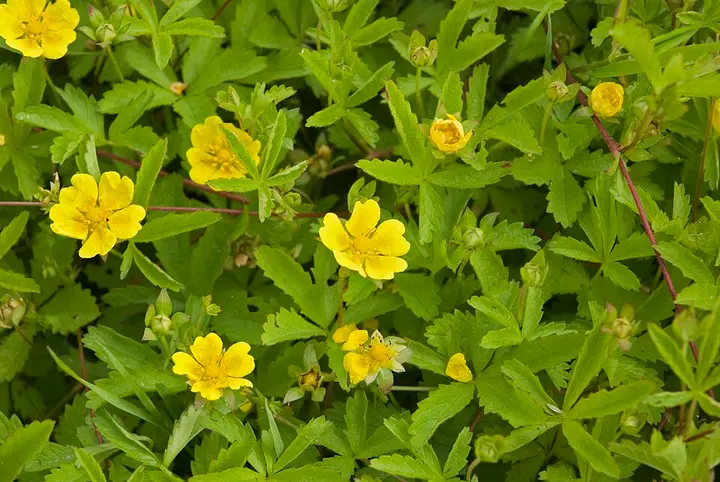
Creeping cinquefoil, Potentilla reptans

Wild flower

Creeping cinquefoil

Potentilla reptans

A low plant whose long runners root as they spread over the ground. Each leaf has five, sometimes seven, toothed leaflets, and the yellow five-petalled flowers grow singly. It is common on verges, waste ground and bare places, and its close relative tormentil can be told apart by its four petals.

When it flowers

June to September

Sources: The Wildlife Trusts, NatureSpot, First Nature

Photo: Olivier Pichard, CC BY-SA 3.0, via Wikimedia Commons

Close

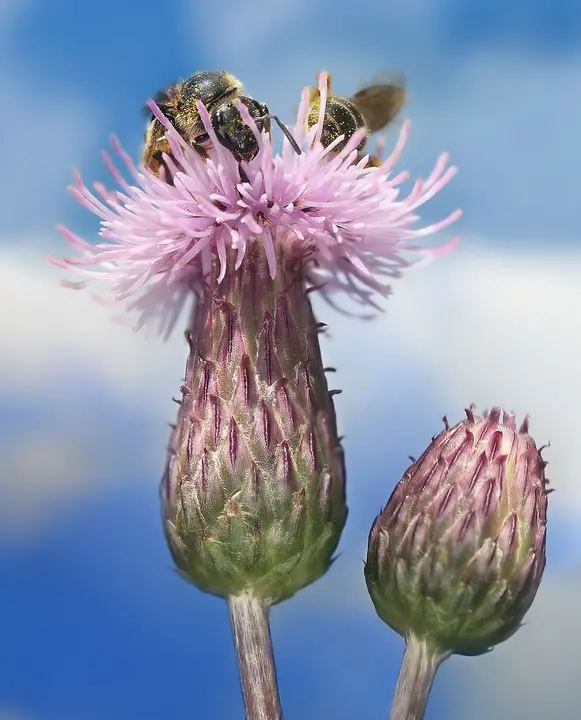
Creeping thistle, Cirsium arvense

Wild flower

Creeping thistle

Cirsium arvense

A thistle that spreads by creeping underground stems and grows in pasture, arable fields, road verges and waste ground. Its scented flower heads are pale lilac, and its stems lack spiny wings. It is listed as an injurious weed under the Weeds Act 1959.

When it flowers

June to September

Sources: NatureSpot, legislation.gov.uk

Photo: Richard Bartz, Munich aka Makro Freak, CC BY-SA 2.5, via Wikimedia Commons

Close

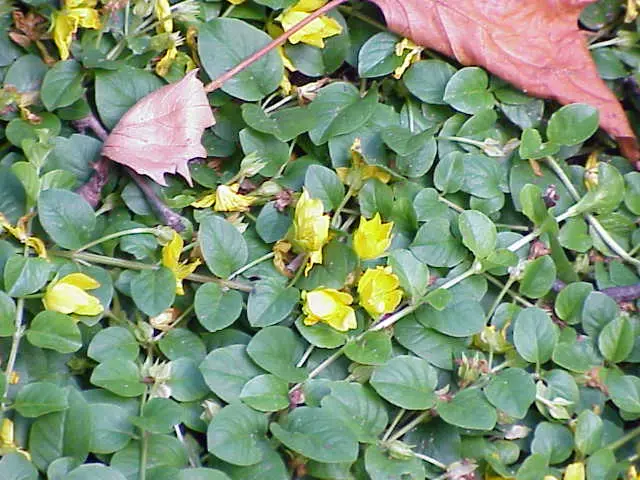
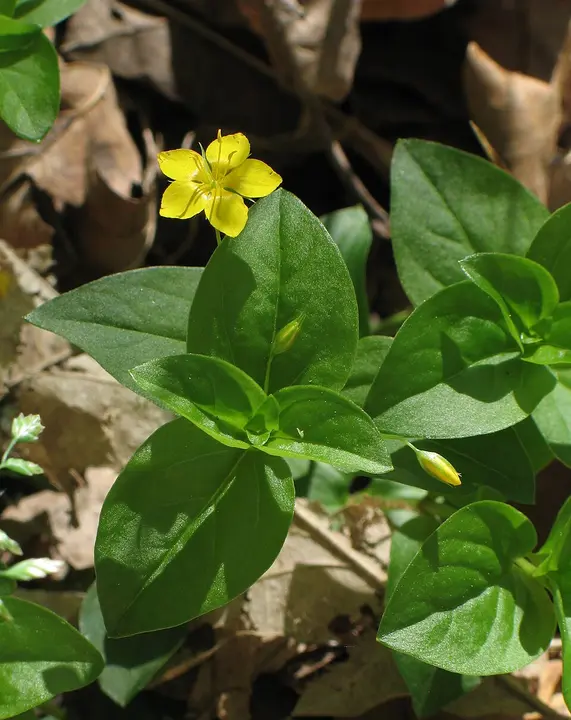
Creeping-Jenny, Lysimachia nummularia

Wild flower

Creeping-Jenny

Lysimachia nummularia

A hairless plant with stems that creep along the ground, pairs of rounded leaves and cup-shaped yellow flowers about 2 cm across. It grows in damp, shady grassland, wet woodland and beside ponds and streams, and is also grown in gardens. Yellow pimpernel looks similar but has narrower leaves and star-shaped flowers.

When it flowers

May to August

Sources: The Wildlife Trusts, First Nature

Photo: Kurt Stüber [1], CC BY-SA 3.0, via Wikimedia Commons

Close

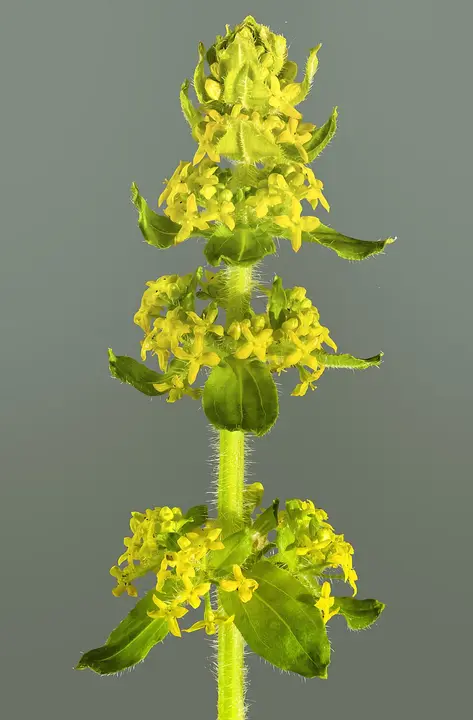
Crosswort, Cruciata laevipes

Wild flower

Crosswort

Cruciata laevipes

A hairy plant whose leaves grow in fours around the stem, forming a cross at each level. Rings of tiny, honey-scented yellow flowers grow around the stem at each cross of leaves. It grows in grassland, on verges and at woodland edges, mostly on chalky or neutral soils.

When it flowers

April to June

Formerly
Galium cruciata

Sources: The Wildlife Trusts, First Nature

Photo: Didier Descouens, CC BY-SA 4.0, via Wikimedia Commons

Close

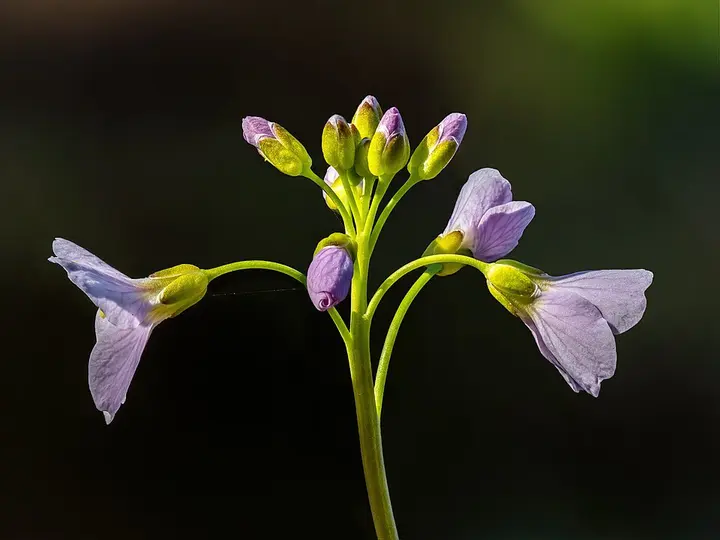
Cuckooflower, Cardamine pratensis

Wild flower

Cuckooflower

Cardamine pratensis

A plant of damp grassland, ditches and stream banks, with pale lilac four-petalled flowers on an upright stem above a rosette of leaves. It comes into flower at about the time the first cuckoos are heard. The caterpillars of the orange-tip and green-veined white butterflies feed on it.

When it flowers

April to June

Also called
lady's smock, milkmaids

Sources: The Wildlife Trusts, Plantlife

Photo: Ermell, CC BY-SA 4.0, via Wikimedia Commons

Close

Curled dock, Rumex crispus

Wild flower

Curled dock

Rumex crispus

A tall dock with long, narrow leaves whose edges are strongly wavy, and dense, fairly upright flower spikes. It grows on disturbed ground, verges, hedge banks and waste places, and can cross with broad-leaved dock. It is one of the injurious weeds named in the Weeds Act 1959.

When it flowers

June to October

Sources: The Wildlife Trusts, NatureSpot, First Nature, legislation.gov.uk

Photo: Olivier Pichard, CC BY-SA 3.0, via Wikimedia Commons

Close

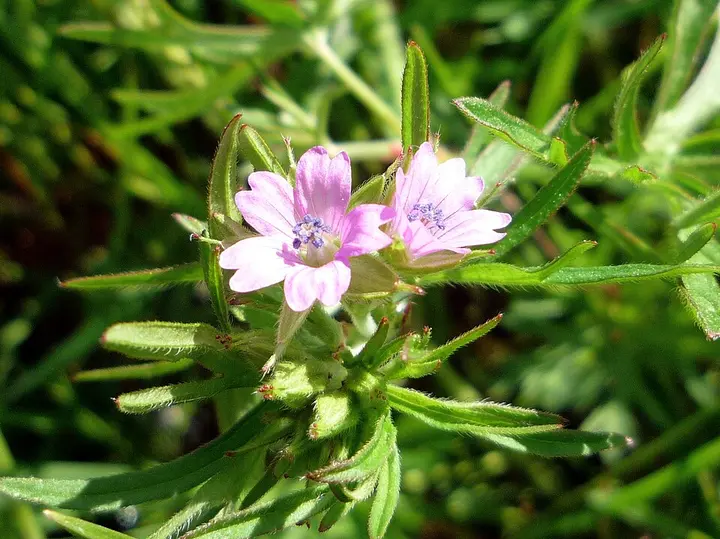
Cut-leaved crane's-bill, Geranium dissectum

Wild flower

Cut-leaved crane's-bill

Geranium dissectum

A hairy annual whose leaves are cut almost to the base into narrow, divided lobes. The small mauve flowers have slightly notched petals and sit on very short stalks. It grows on disturbed ground, field edges, verges and hedge banks, and like other crane's-bills is named for its beak-like fruit.

When it flowers

May to August

Sources: NatureSpot, First Nature

Photo: AnemoneProjectors, CC BY-SA 2.0, via Wikimedia Commons

Close

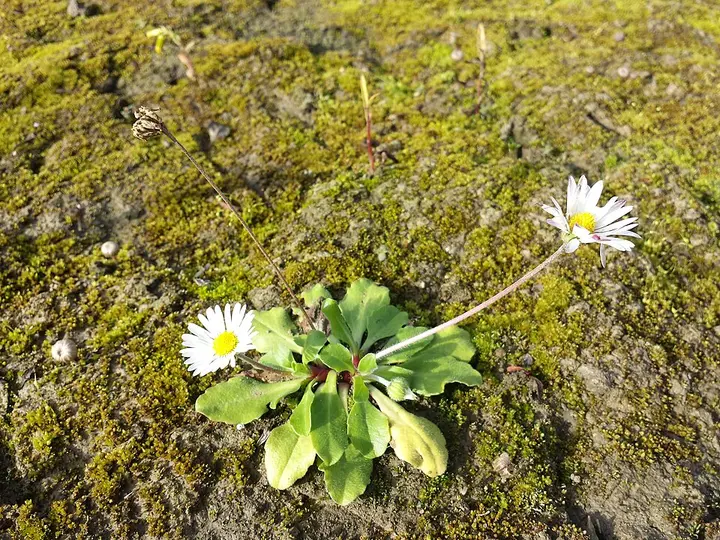
Daisy, Bellis perennis

Wild flower

Daisy

Bellis perennis

A low plant of short grass, with a rosette of spoon-shaped leaves and single flowerheads of white rays, sometimes tinged pink, around a yellow centre. It can be found in flower in almost every month. The name comes from 'day's eye', because the flowers open in the morning and close in the evening.

When it flowers

All year

Also called
common daisy

Sources: The Wildlife Trusts, Plantlife, NatureSpot

Photo: Stefan.lefnaer, CC BY-SA 4.0, via Wikimedia Commons

Close

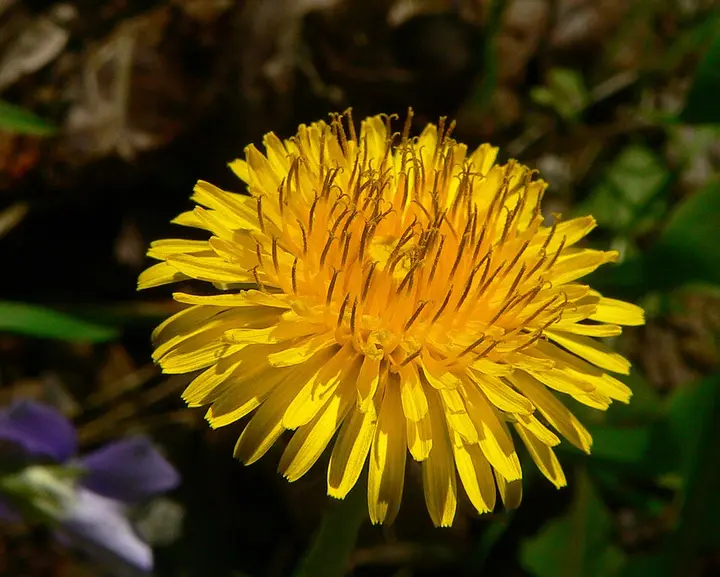
Dandelion, Taraxacum agg.

Wild flower

Dandelion

Taraxacum agg.

Yellow flowerheads rise singly on hollow stalks from a rosette of leaves, and the stalks and leaves leak milky sap when broken. The round, fluffy seed heads are known as clocks. Botanists recognise more than 200 closely similar dandelion microspecies in the UK, and the flowers are an important early food source for pollinators.

When it flowers

March to October

Also called
common dandelion
Formerly
Taraxacum officinale

Sources: BSBI, The Wildlife Trusts, RHS, NatureSpot

Photo: Greg Hume, CC BY-SA 3.0, via Wikimedia Commons

Close

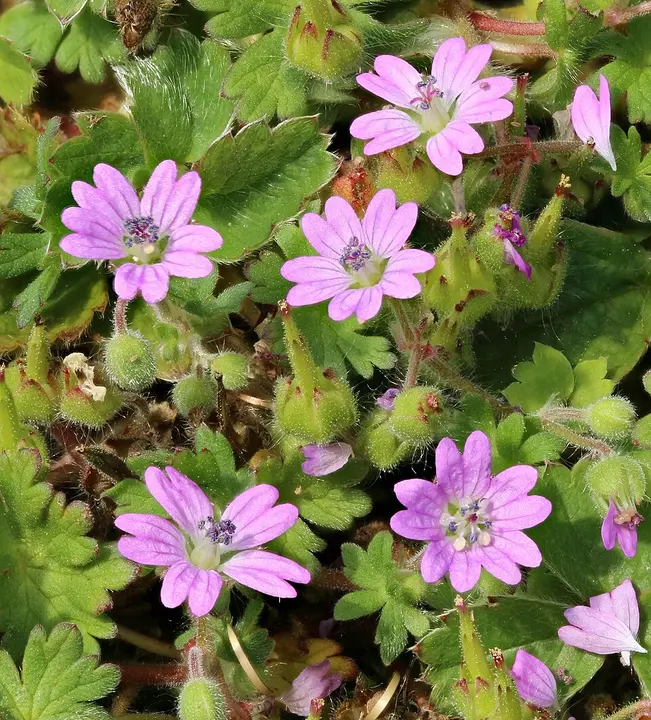
Dove's-foot crane's-bill, Geranium molle

Wild flower

Dove's-foot crane's-bill

Geranium molle

A low, softly hairy annual with rounded leaves cut more than halfway into several lobes. The small pink flowers have deeply notched petals, and the leaves and stems often turn red in autumn. It grows in dry grassland, lawns and verges and on waste ground.

When it flowers

April to September

Sources: NatureSpot, First Nature

Photo: janetgraham84new, CC BY 2.0, via Wikimedia Commons

Close

Early dog-violet, Viola reichenbachiana

Wild flowerAncient woodland

Early dog-violet

Viola reichenbachiana

Very like common dog-violet, but it starts flowering a little earlier and has a slender, straight, dark violet spur with no notch. It grows in woods, coppices and shady hedgebanks, most often on chalk, limestone or base-rich clay.

When it flowers

March to May

Sources: NatureSpot

Photo: Jörg Hempel, CC BY-SA 2.0 de, via Wikimedia Commons

Close

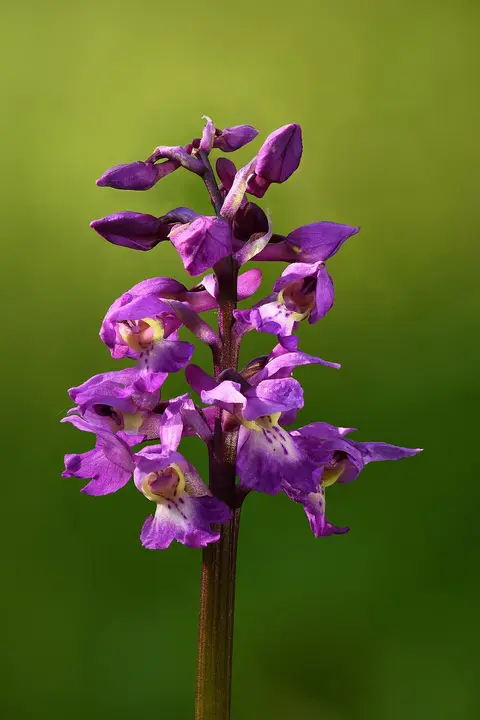
Early-purple orchid, Orchis mascula

Wild flowerAncient woodland

Early-purple orchid

Orchis mascula

One of the first orchids to flower in spring, often alongside bluebells, with spikes of purple-pink flowers above glossy leaves that are often blotched with dark purple. The flowers smell sweet at first, but take on an unpleasant smell likened to tomcats as they age. It grows in ancient woodland, especially coppice, and in grassland and on verges.

When it flowers

April to June

Sources: The Wildlife Trusts, Woodland Trust, Plantlife

Photo: Ivar Leidus, CC BY-SA 4.0, via Wikimedia Commons

Close

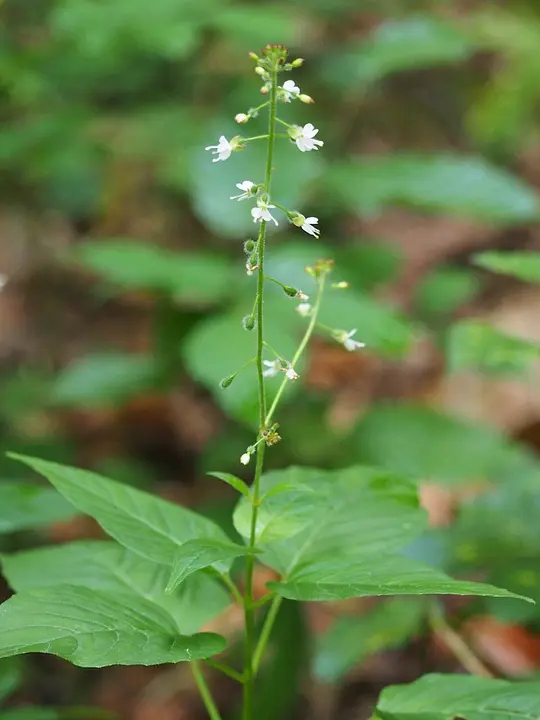
Enchanter's-nightshade, Circaea lutetiana

Wild flower

Enchanter's-nightshade

Circaea lutetiana

A short to medium plant of shady woods, with pairs of oval, pointed leaves and loose spikes of tiny white or pinkish flowers, each with two deeply notched petals. The small fruits are covered in hooked hairs that catch on animal fur. Despite its name, it belongs to the willowherb family and is not closely related to deadly nightshade.

When it flowers

June to August

Sources: The Wildlife Trusts, Woodland Trust, NatureSpot, Wild Flower Finder

Photo: Agnieszka Kwiecień, Nova, CC BY-SA 4.0, via Wikimedia Commons

Close

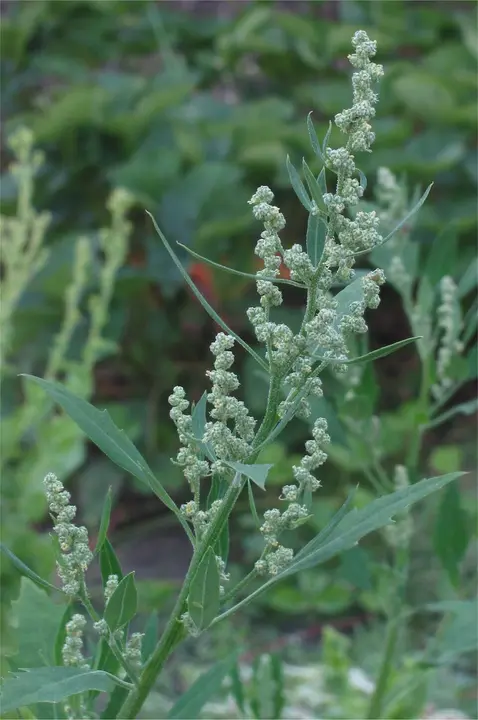
Fat-hen, Chenopodium album

Wild flower

Fat-hen

Chenopodium album

A common weed of arable land, gardens, waste ground and manure heaps, growing best on rich, disturbed soil. It varies a great deal in size and leaf shape, but the plant is usually coated in a whitish, mealy powder. The tiny green flowers grow in leafy spikes.

When it flowers

June to October

Sources: BSBI, NatureSpot, Wild Flower Finder

Photo: Rasbak, CC BY-SA 3.0, via Wikimedia Commons

Close

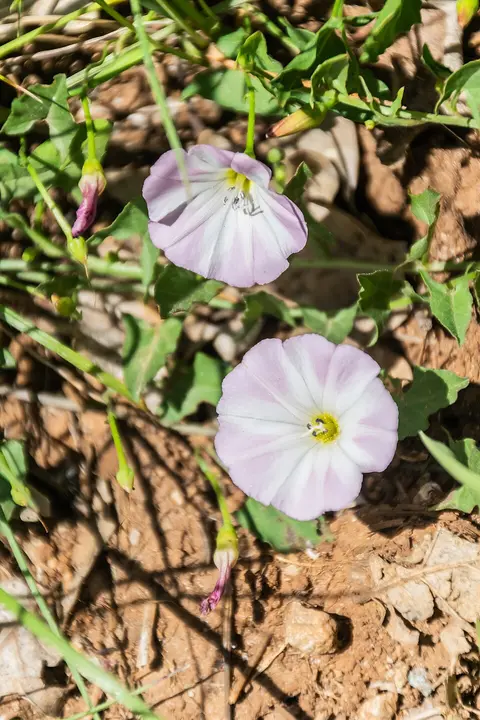
Field bindweed, Convolvulus arvensis

Wild flower

Field bindweed

Convolvulus arvensis

A creeping and twining plant with arrow-shaped leaves and scented, funnel-shaped flowers that are white, pink or striped pink and white. It grows in grassland, on farmland and waste ground and in gardens. It is often treated as a weed in gardens, and it can trail over cereal crops and hold back their growth.

When it flowers

June to September

Sources: The Wildlife Trusts

Photo: Krzysztof Golik, CC BY-SA 4.0, via Wikimedia Commons

Close

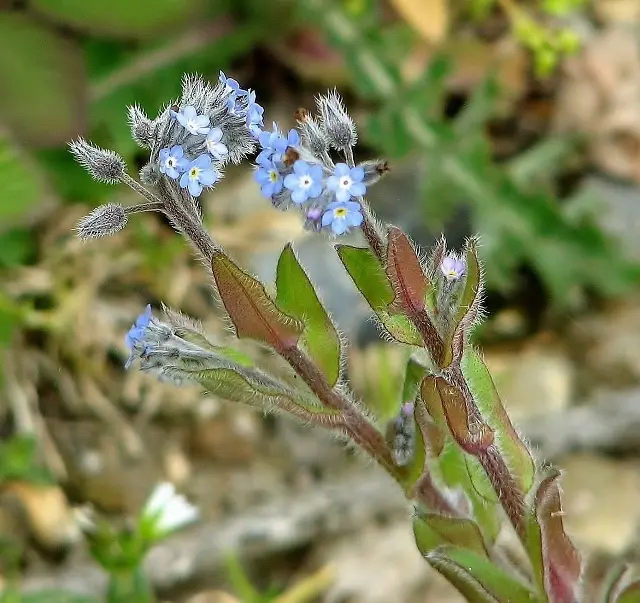
Field forget-me-not, Myosotis arvensis

Wild flower

Field forget-me-not

Myosotis arvensis

A small, softly hairy plant of arable fields, roadsides, waste ground and other open or disturbed ground. Its very small blue flowers, sometimes tinged pink, grow in spikes above oval, hairy leaves. They are smaller than those of wood forget-me-not, and the calyx closes around the ripening seeds.

When it flowers

April to October

Also called
common forget-me-not

Sources: BSBI, Plantlife, NatureSpot, NatureSpot (2), Wild Flower Finder, First Nature

Photo: Evelyn Simak, CC BY-SA 2.0, via Wikimedia Commons

Close

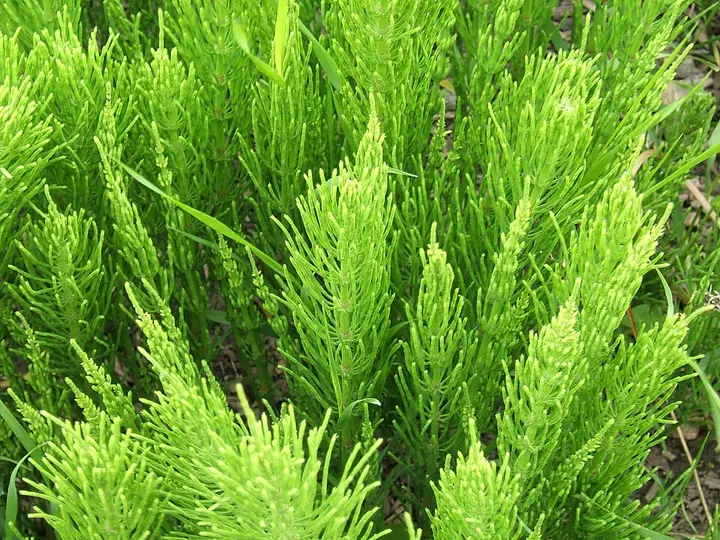
Field horsetail, Equisetum arvense

Wild flower

Field horsetail

Equisetum arvense

A spore-bearing plant with no flowers. In early spring it sends up pale, unbranched stems tipped with spore cones, followed by green stems with dense whorls of slender branches. It grows on cultivated and waste ground, in gardens and on verges, and its deep underground stems make it a hard weed to clear.

When it flowers

No flowering months listed.

Also called
common horsetail

Sources: BSBI, RHS, NatureSpot

Photo: MPF, CC BY-SA 3.0, via Wikimedia Commons

Close

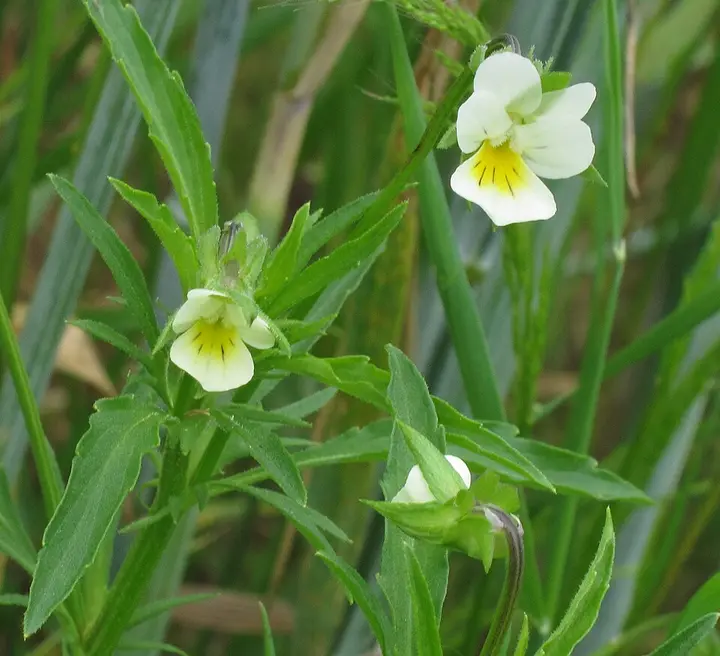
Field pansy, Viola arvensis

Wild flower

Field pansy

Viola arvensis

A low annual with small, cream or pale yellow flowers, often with an orange flush on the lower petal, and pointed sepals that are often as long as or longer than the petals. It is a weed of arable fields, field margins and other disturbed ground. It can cross with wild pansy, which makes some plants hard to name.

When it flowers

April to October

Sources: BSBI, The Wildlife Trusts, Plantlife, NatureSpot, Wild Flower Finder, AHDB

Photo: Robert Flogaus-Faust, CC BY 4.0, via Wikimedia Commons

Close

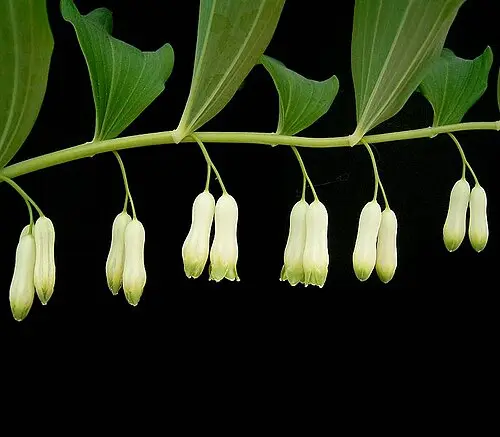
Garden Solomon's-seal, Polygonatum × hybridum

Wild flower

Garden Solomon's-seal

Polygonatum × hybridum

Arching stems carry oval leaves, with creamy-white, green-tipped tubular flowers hanging beneath them, followed by black berries. It is a garden hybrid of two native Solomon's-seals and is usually found as an escape near houses. It is harmful if eaten.

When it flowers

May to June

Sources: RHS, NatureSpot

Photo: Frank Vincentz, CC BY-SA 3.0, via Wikimedia Commons

Close

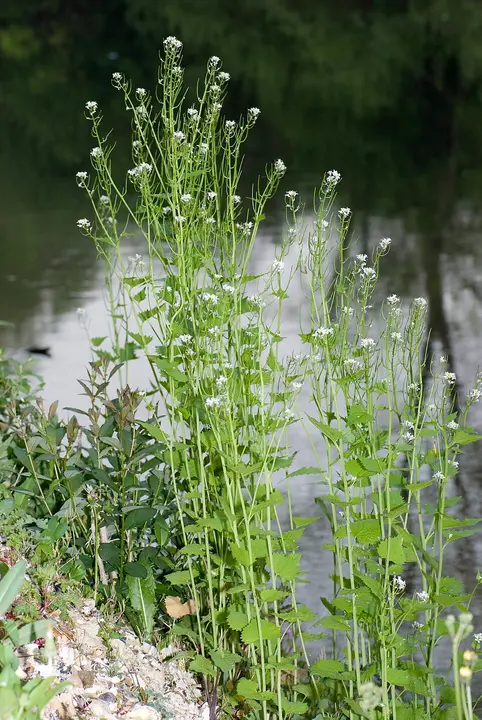
Garlic mustard, Alliaria petiolata

Wild flower

Garlic mustard

Alliaria petiolata

An upright plant of shady hedgerows and woodland edges, with heart-shaped, toothed leaves that smell of garlic when crushed and clusters of small white flowers with four petals. It is one of the main food plants of orange-tip butterfly caterpillars.

When it flowers

April to June

Also called
Jack-by-the-hedge, hedge garlic

Sources: The Wildlife Trusts, Plantlife, Butterfly Conservation

Photo: O. Pichard, CC BY-SA 3.0, via Wikimedia Commons

Close

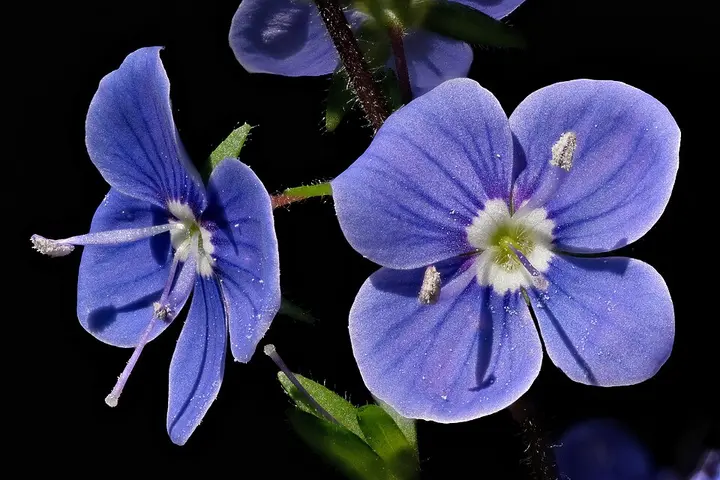
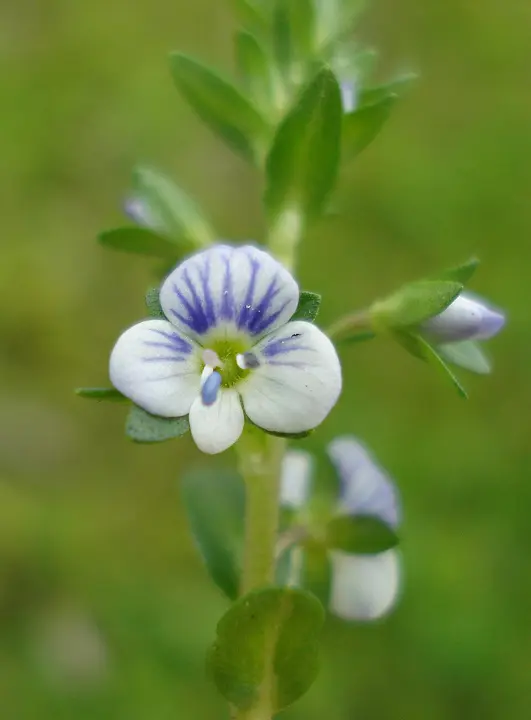
Germander speedwell, Veronica chamaedrys

Wild flower

Germander speedwell

Veronica chamaedrys

Bright blue flowers with four petals and a white centre grow on low, spreading stems that have two lines of long white hairs down opposite sides. It grows on verges, in hedgerows, grassland and open woodland. It was traditionally thought to bring travellers good luck.

When it flowers

March to July

Also called
bird's-eye speedwell

Sources: The Wildlife Trusts, NatureSpot, Wild Flower Finder

Photo: Johannes Robalotoff, CC BY-SA 4.0, via Wikimedia Commons

Close

Goldilocks buttercup, Ranunculus auricomus

Wild flowerAncient woodland

Goldilocks buttercup

Ranunculus auricomus

A buttercup of woods, copses, woodland edges and roadside verges, often on lime-rich soils. Its flowers frequently have one or more petals stunted or missing. The leaves at its base are rounded and lobed, while those on the stem are cut into narrow, finger-like segments.

When it flowers

April to May

Sources: NatureSpot, First Nature

Photo: Stemonitis, CC BY-SA 3.0, via Wikimedia Commons

Close

Great marsh-bedstraw, Galium palustre subsp. elongatum

Wild flower

Great marsh-bedstraw

Galium palustre subsp. elongatum

A taller, more vigorous form of marsh-bedstraw that can grow to about a metre, with square stems, whorls of oblong leaves and small four-petalled white flowers. It is found in reedbeds and on wet ground at the edges of lakes, ponds and marshes.

When it flowers

June to August

Formerly
Galium elongatum

Sources: BSBI, Wild Flower Finder, Wild Flowers of Ireland

Photo: Krzysztof Ziarnek, Kenraiz, CC BY-SA 4.0, via Wikimedia Commons

Close

Great willowherb, Epilobium hirsutum

Wild flower

Great willowherb

Epilobium hirsutum

A tall, softly hairy plant, up to about 2 metres, that forms large patches in ditches and marshes, along streams and ponds, and at damp woodland edges. Its bright purplish-pink flowers have four notched petals around a pale centre, and its leaves half-clasp the stem. The seeds have fluffy hairs and are carried away on the wind.

When it flowers

July to August

Sources: The Wildlife Trusts, NatureSpot

Photo: Ivar Leidus, CC BY-SA 3.0, via Wikimedia Commons

Close

Greater bird's-foot-trefoil, Lotus pedunculatus

Wild flower

Greater bird's-foot-trefoil

Lotus pedunculatus

A larger, often hairier relative of common bird's-foot-trefoil, with hollow stems and heads of five to twelve yellow pea flowers. It grows in damp places such as rushy pastures, wet meadows, marshes, ditches and the edges of ponds and rivers.

When it flowers

June to August

Sources: NatureSpot

Photo: Forest & Kim Starr, CC BY 3.0, via Wikimedia Commons

Close

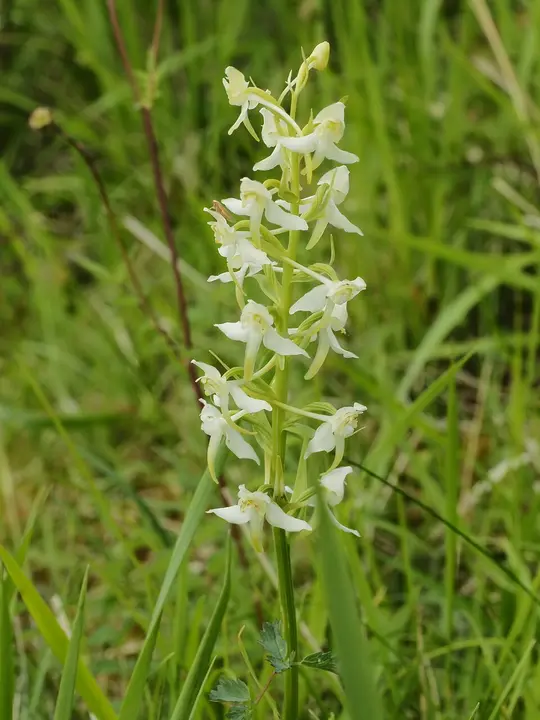
Greater butterfly-orchid, Platanthera chlorantha

Wild flowerAncient woodland

Greater butterfly-orchid

Platanthera chlorantha

An orchid with a loose spike of greenish-white flowers, each with a long, narrow lip and a long spur, above a pair of broad, shiny leaves at the base. It grows in old hay meadows, open scrub and woodland. At night the flowers give off a vanilla-like scent that attracts the moths that pollinate them.

When it flowers

May to July

Sources: The Wildlife Trusts, Plantlife

Photo: Hans Hillewaert, CC BY-SA 3.0, via Wikimedia Commons

Close

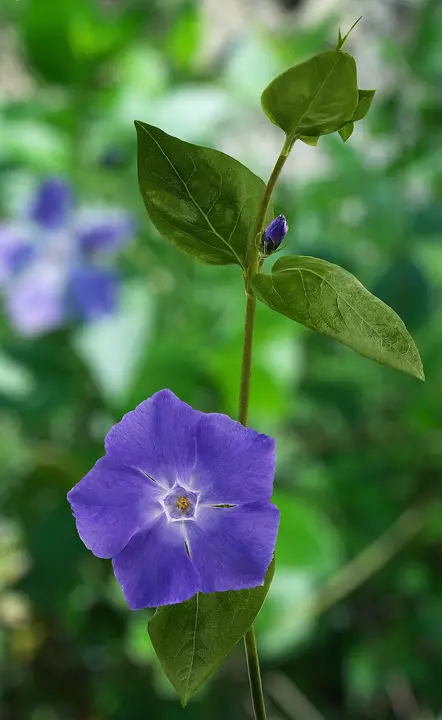
Greater periwinkle, Vinca major

Wild flower

Greater periwinkle

Vinca major

An evergreen with long trailing and arching stems that often root where their tips touch the ground, glossy oval leaves with finely hairy edges, and large violet-blue flowers with five lobes. It is a garden plant that has escaped into hedgerows and onto road and railway verges. Lesser periwinkle is smaller and its leaf edges are hairless.

When it flowers

March to May

Sources: NatureSpot, UK South West wild flowers

Photo: Didier Descouens, CC BY-SA 4.0, via Wikimedia Commons

Close

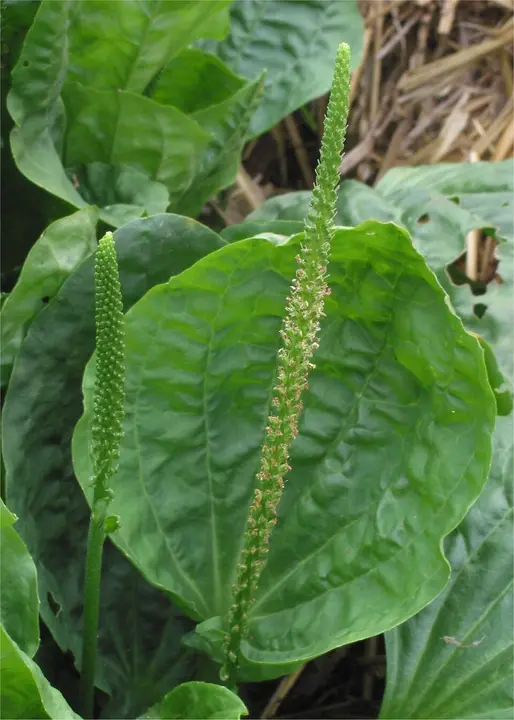
Greater plantain, Plantago major

Wild flower

Greater plantain

Plantago major

A low rosette of broad, oval leaves, each with several strong veins running lengthwise, lies flat on the ground and sends up long, thin spikes of tiny greenish-yellow flowers. Its tough leaves withstand trampling, so it is common on paths, lawns, roadsides, field edges and waste ground.

When it flowers

June to October

Also called
broad-leaved plantain

Sources: The Wildlife Trusts, NatureSpot

Photo: Rasbak, CC BY-SA 3.0, via Wikimedia Commons

Close

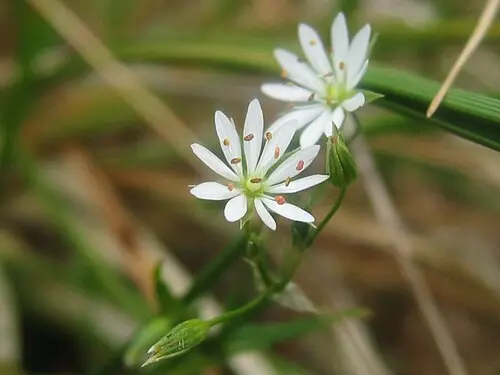
Greater stitchwort, Stellaria holostea

Wild flower

Greater stitchwort

Stellaria holostea

Starry white flowers have five petals, each split halfway, so they can look like ten. The weak, square stems snap easily and carry narrow, grass-like leaves. It grows in woods, hedgerows and verges, and its name comes from its old use as a herbal remedy for a stitch in the side.

When it flowers

April to June

Sources: BSBI, The Wildlife Trusts, Woodland Trust, NatureSpot

Photo: Rasbak, CC BY-SA 3.0, via Wikimedia Commons

Close

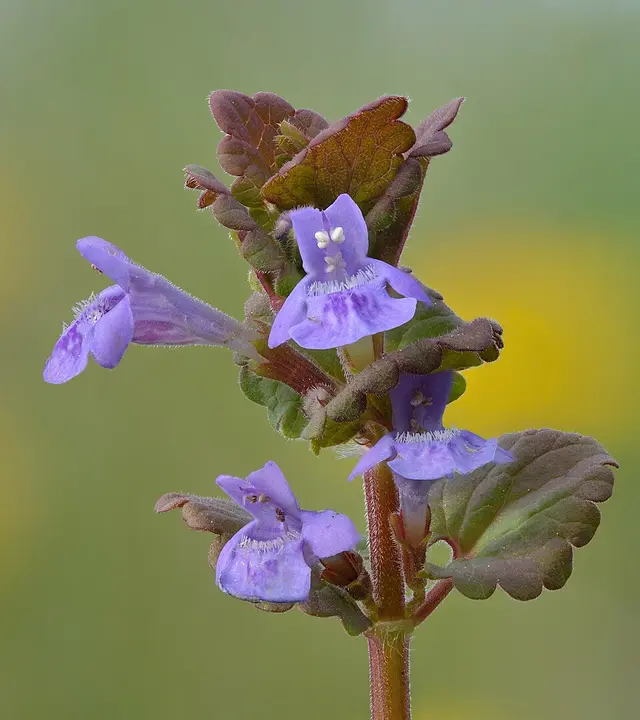
Ground-ivy, Glechoma hederacea

Wild flower

Ground-ivy

Glechoma hederacea

A low, creeping member of the dead-nettle family found in woods, hedgerows and grassland, spreading by rooting runners. It has kidney-shaped, round-toothed leaves with a strong smell, and small violet flowers in whorls up the stems. It was once used to make beer bitter, until hops replaced it.

When it flowers

March to June

Sources: BSBI, The Wildlife Trusts, NatureSpot, Wild Flower Finder

Photo: Ivar Leidus, CC BY-SA 4.0, via Wikimedia Commons

Close

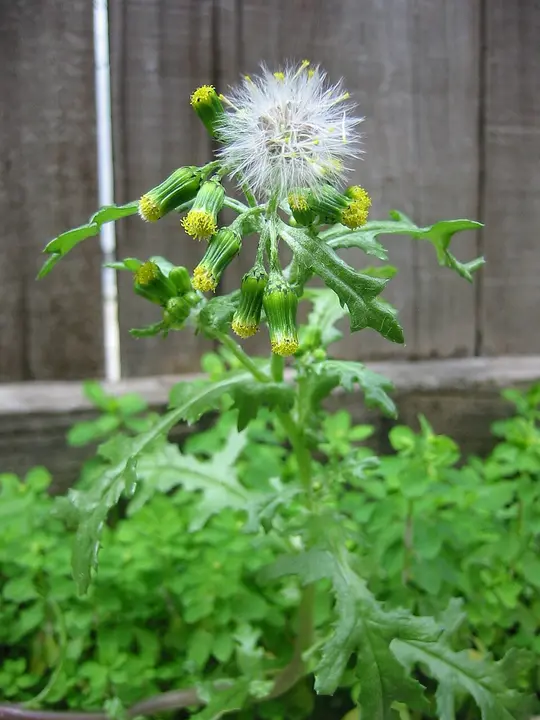
Groundsel, Senecio vulgaris

Wild flower

Groundsel

Senecio vulgaris

A common weed of gardens, field edges, verges and waste ground that can flower in any month. Its small yellow flowerheads look like tubes, usually with no outer petals and often with black-tipped bracts. They soon become white, fluffy seed heads, which gave it the Latin name Senecio, from the word for old man.

When it flowers

All year

Sources: The Wildlife Trusts, Plantlife, NatureSpot, Wild Flower Finder

Photo: carol, CC BY-SA 3.0, via Wikimedia Commons

Close

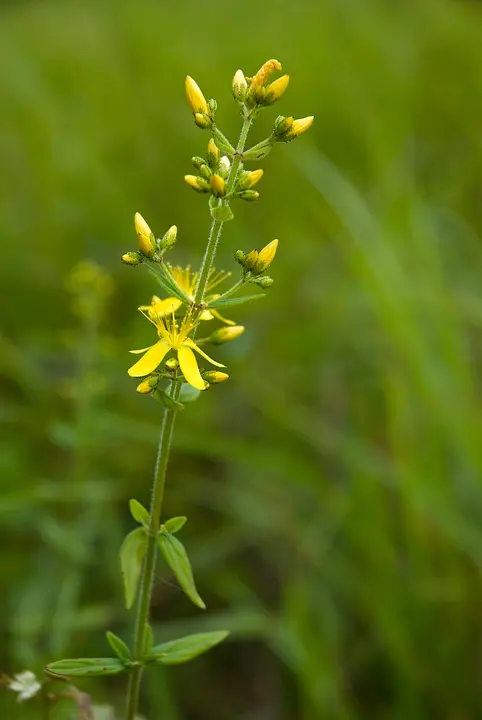
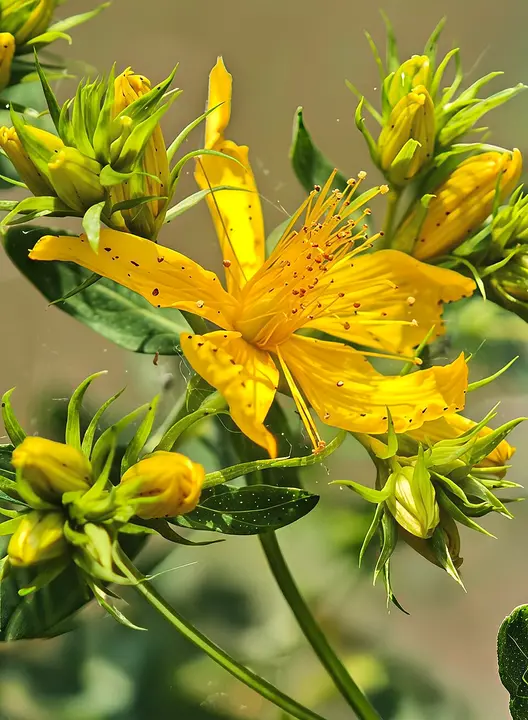
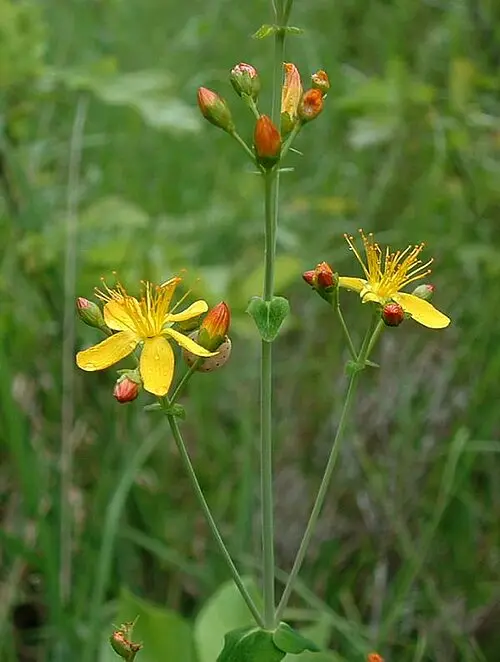
Hairy St John's-wort, Hypericum hirsutum

Wild flower

Hairy St John's-wort

Hypericum hirsutum

A tall, upright plant with hairy stems and leaves and loose heads of pale yellow flowers, sometimes veined with red. Held up to the light, the leaves show tiny translucent dots. It grows in woodland, scrub and rough grassland.

When it flowers

July to August

Sources: NatureSpot

Photo: Olivier Pichard, CC BY-SA 3.0, via Wikimedia Commons

Close

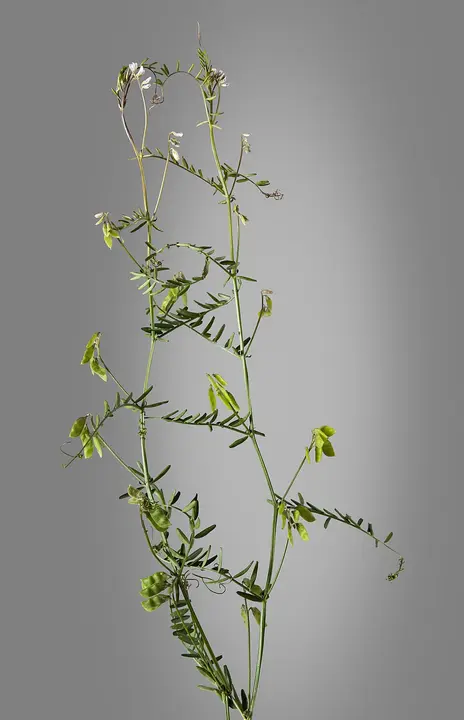
Hairy tare, Ervilia hirsuta

Wild flower

Hairy tare

Ervilia hirsuta

A scrambling annual whose leaves are made up of many pairs of small leaflets. The tiny flowers are whitish, tinged pale lilac, and are followed by short, hairy pods that each hold two seeds. It grows on rough grassland, road verges, hedgerows and field edges.

When it flowers

May to August

Formerly
Vicia hirsuta

Sources: NatureSpot

Photo: Didier Descouens, CC BY-SA 4.0, via Wikimedia Commons

Close

Hawkweed oxtongue, Picris hieracioides subsp. hieracioides

Wild flower

Hawkweed oxtongue

Picris hieracioides subsp. hieracioides

A stiffly hairy, branched plant with narrow leaves, the upper ones clasping the stem, and yellow, dandelion-like flower heads. The outer bracts beneath each flower head are shorter than the inner ones and spread outwards. It grows mainly on chalk and limestone, in grassland and quarries and along roadsides and railway banks.

When it flowers

July to September

Sources: NatureSpot, Wild Flower Finder, UK South West wild flowers

Photo: Jozefsu, CC BY-SA 4.0, via Wikimedia Commons

Close

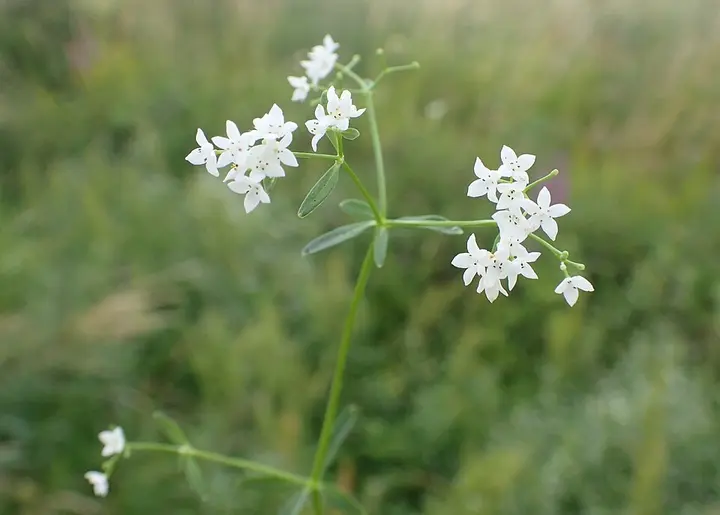
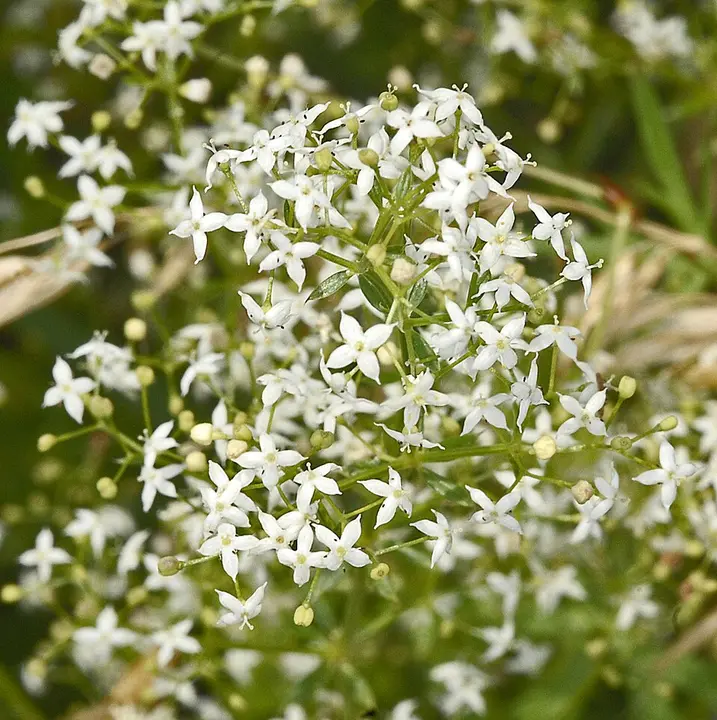
Hedge bedstraw, Galium album

Wild flower

Hedge bedstraw

Galium album

A perennial, usually hairless plant with smooth square stems and whorls of six to eight oblong leaves. In summer it carries loose, branching clusters of tiny four-petalled white flowers. It grows on hedgebanks, roadsides, scrub, woodland edges and rough grassland, mainly on chalky or other lime-rich soils.

When it flowers

June to September

Formerly
Galium mollugo

Sources: BSBI, NatureSpot

Photo: Hectonichus, CC BY-SA 3.0, via Wikimedia Commons

Close

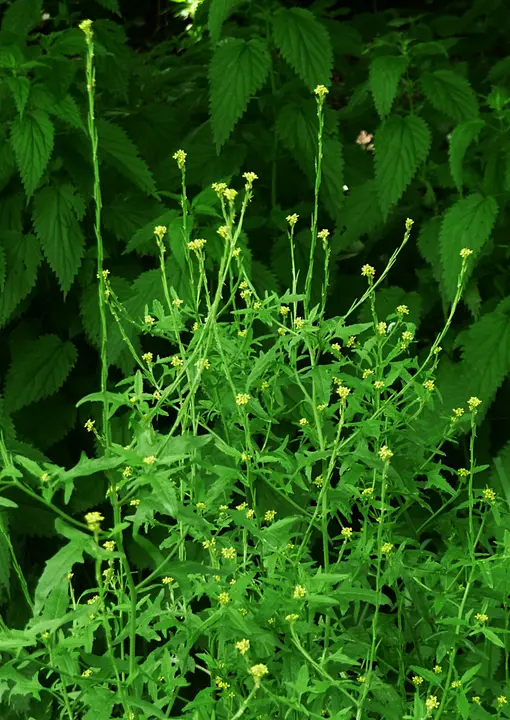
Hedge mustard, Sisymbrium officinale

Wild flower

Hedge mustard

Sisymbrium officinale

A stiff, branching plant with a candelabra-like shape and tiny pale yellow flowers at the tips of its stems. Its slender seed pods are pressed close against the stem, and its lower leaves are deeply lobed. It grows on roadsides, in hedgerows and on waste ground.

When it flowers

May to October

Sources: The Wildlife Trusts, NatureSpot, Wild Flower Finder, UK South West wild flowers

Photo: Konrad Lackerbeck, CC0, via Wikimedia Commons

Close

Hedge woundwort, Stachys sylvatica

Wild flower

Hedge woundwort

Stachys sylvatica

A hairy plant of woodland, hedgerows and roadside verges, with heart-shaped, toothed leaves on stalks. Its dark reddish-purple flowers, marked with white, grow in rings that form a loose spike, and bees visit them. The plant gives off a strong, unpleasant smell when crushed.

When it flowers

June to September

Sources: The Wildlife Trusts, NatureSpot

Photo: Andreas Trepte, CC BY-SA 2.5, via Wikimedia Commons

Close

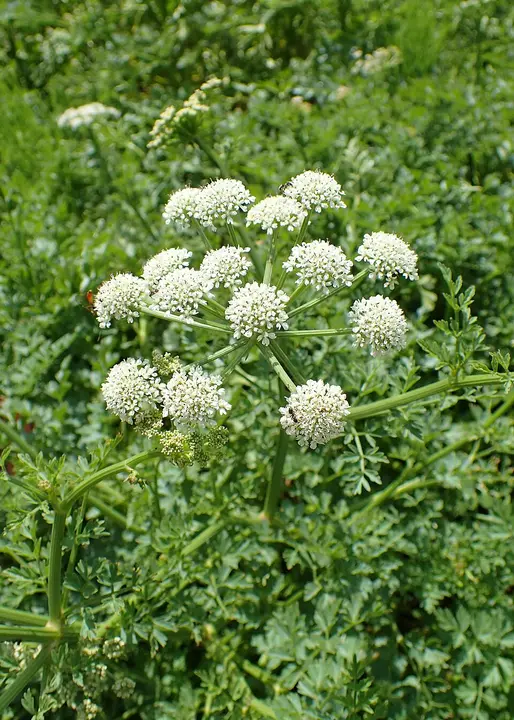
Hemlock water-dropwort, Oenanthe crocata

Wild flower

Hemlock water-dropwort

Oenanthe crocata

A tall, hairless umbellifer of ditches, stream banks, marshes and wet woodland, with heads of small white flowers in early summer. Its divided leaves smell of parsley or celery, and its roots form clusters of pale, fleshy tubers. Every part is highly poisonous to people and livestock, the tubers most of all.

When it flowers

June to August

Also called
dead man's fingers

Sources: BSBI, NatureSpot, Wild Flower Finder, Canal & River Trust

Photo: Krzysztof Ziarnek, Kenraiz, CC BY-SA 4.0, via Wikimedia Commons

Close

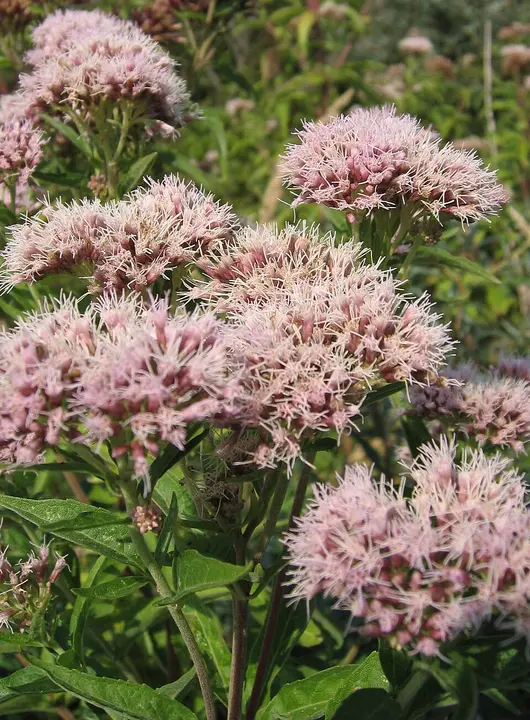
Hemp-agrimony, Eupatorium cannabinum

Wild flower

Hemp-agrimony

Eupatorium cannabinum

A tall plant of damp places such as riverbanks, marshes, fens and wet woods, with reddish stems and leaves divided into long, toothed leaflets. Domed, frothy clusters of small pink flowers attract many butterflies, including red admirals and small tortoiseshells. Its leaves look like those of hemp, but the two plants are not related.

When it flowers

July to September

Also called
raspberries and cream

Sources: The Wildlife Trusts

Photo: Svdmolen, CC BY-SA 3.0, via Wikimedia Commons

Close

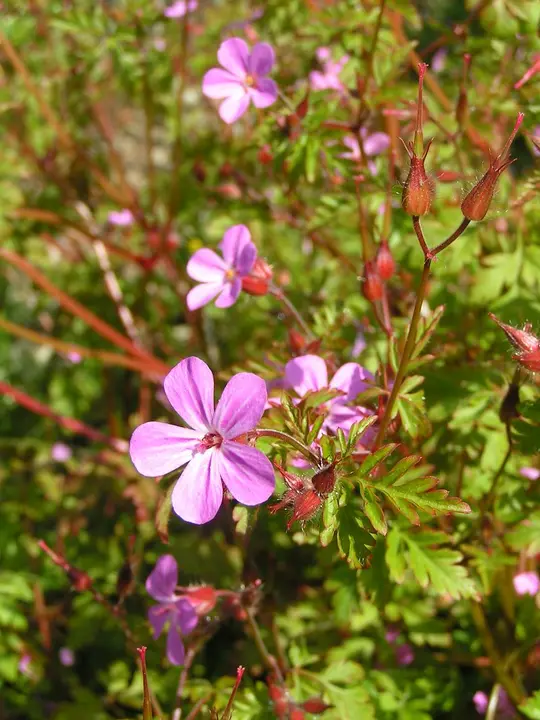
Herb-Robert, Geranium robertianum

Wild flower

Herb-Robert

Geranium robertianum

A low plant of woodland edges, hedge banks, walls and rocky places, with hairy reddish stems and fern-like leaves divided into three to five leaflets. Its small pink flowers have five rounded petals. The plant smells unpleasant when crushed, and its stems and leaves often turn deep red in sunny spots.

When it flowers

May to September

Sources: The Wildlife Trusts, Woodland Trust, NatureSpot, Wild Flower Finder

Photo: Sannse, CC BY-SA 3.0, via Wikimedia Commons

Close

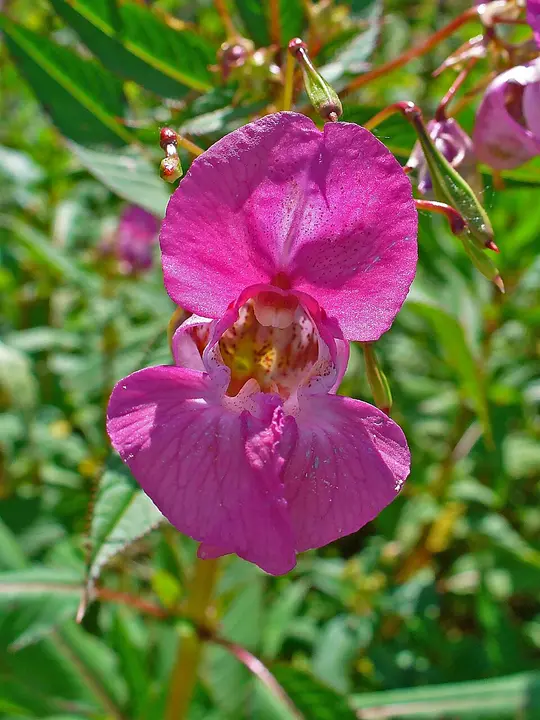
Himalayan balsam, Impatiens glandulifera

Wild flower

Himalayan balsam

Impatiens glandulifera

A tall, hairless annual with pink to purple, helmet-shaped flowers, found along rivers, streams and other damp ground. Its ripe seed pods burst open, flinging the seeds up to 7 metres. It was brought to Britain as a garden plant in 1839 and is now an invasive non-native that crowds out native plants along waterways.

When it flowers

July to October

Also called
Indian balsam, policeman's helmet

Sources: The Wildlife Trusts, RHS, NatureSpot

Photo: H. Zell, CC BY-SA 3.0, via Wikimedia Commons

Close

Hoary ragwort, Jacobaea erucifolia

Wild flower

Hoary ragwort

Jacobaea erucifolia

Similar to common ragwort, with flat-topped clusters of yellow, daisy-like flowers in late summer, but the whole plant is greyish and downy. Its leaves have narrow lobes and grey, cottony hairs underneath. It grows in rough grassland, pastures, hedge banks and roadsides.

When it flowers

July to September

Formerly
Senecio erucifolius

Sources: NatureSpot, NatureSpot (2)

Photo: AnRo0002, CC0, via Wikimedia Commons

Close

Hogweed, Heracleum sphondylium

Wild flower

Hogweed

Heracleum sphondylium

A tall, coarse umbellifer of hedgerows, road verges, rough grassland and waste ground, with hollow, ridged, bristly stems and broad, lobed leaves. Its large, flat heads of white or pinkish flowers, with uneven outer petals, attract many kinds of insect.

When it flowers

May to September

Also called
cow parsnip

Sources: The Wildlife Trusts, NatureSpot, Wild Flower Finder, First Nature

Photo: Robert Flogaus-Faust, CC BY 4.0, via Wikimedia Commons

Close

Hop trefoil, Trifolium campestre

Wild flower

Hop trefoil

Trifolium campestre

A small, hairy clover with round heads of pale yellow flowers. As the flowers fade they turn pale brown and fold down over the seed pods, so each head looks like a tiny hop. It grows in dry, short grassland, on road verges and on quarry spoil.

When it flowers

June to September

Sources: NatureSpot

Photo: Bernd Haynold, CC BY-SA 3.0, via Wikimedia Commons

Close

Hybrid campion, Silene × hampeana

Wild flower

Hybrid campion

Silene × hampeana

A cross between red campion and white campion, found where the two parents grow near each other, often on woodland edges, rides and hedgerows. The flowers are usually pale to mid pink. Because the hybrid is often fertile and crosses back with both parents, plants vary a lot and flower colour alone cannot confirm it.

When it flowers

May to October

Formerly
Silene alba × dioica

Sources: BSBI, NatureSpot

Photo: Rudolphous, CC BY-SA 4.0, via Wikimedia Commons

Close

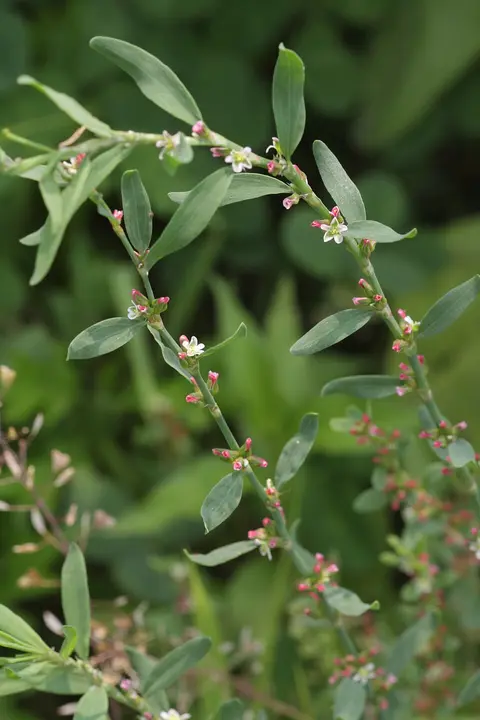
Knotgrass, Polygonum aviculare

Wild flower

Knotgrass

Polygonum aviculare

A low, often sprawling annual of paths, arable fields, gardens, waste ground and seashores. Its oval leaves are larger on the main stem than on the side branches, and silvery, papery sheaths surround each joint. Tiny greenish flowers with pink or white edges sit in small clusters along the stems.

When it flowers

June to November

Sources: BSBI, NatureSpot, Wild Flower Finder

Photo: Dalgial, CC BY-SA 3.0, via Wikimedia Commons

Close

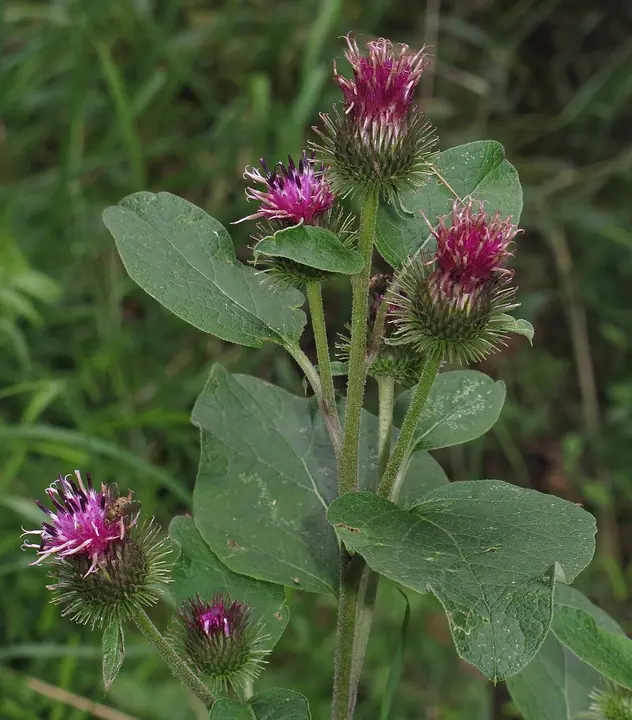
Lesser and wood burdock, Arctium minus s.l.

Wild flower

Lesser and wood burdock

Arctium minus s.l.

A tall plant whose large lower leaves have hollow stalks, with purple, thistle-like flower heads that ripen into hooked burs, which catch on the fur of passing animals. It grows on waysides, field edges, riverbanks, waste ground and in woods. The record covers both lesser burdock and the very similar wood burdock, which are often recorded together.

When it flowers

July to September

Sources: BSBI, The Wildlife Trusts, NatureSpot

Photo: Robert Flogaus-Faust, CC BY 4.0, via Wikimedia Commons

Close

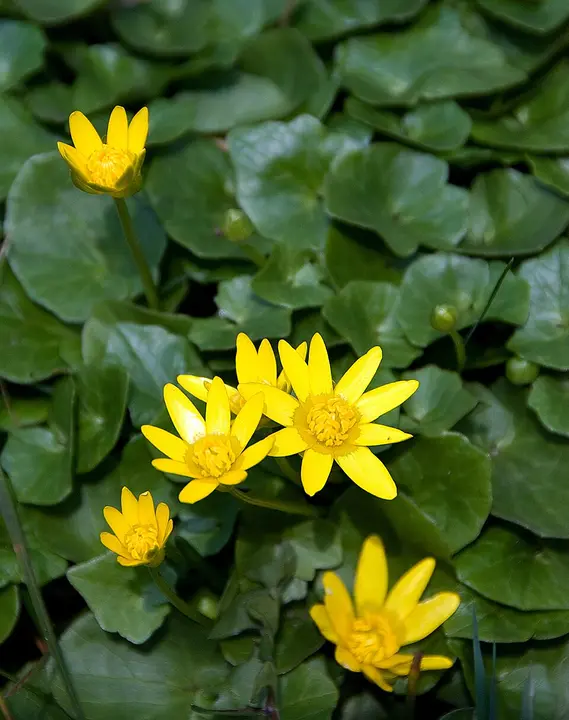
Lesser celandine, Ficaria verna

Wild flower

Lesser celandine

Ficaria verna

One of the first flowers of spring, found in damp woodland, along hedgerows and on stream banks. It has glossy, heart-shaped leaves and shiny yellow star-like flowers with eight to twelve petals, which open in sunshine and give early nectar to queen bumblebees.

When it flowers

March to May

Formerly
Ranunculus ficaria

Sources: BSBI, The Wildlife Trusts, Woodland Trust, Plantlife

Photo: Michal Osmenda from Brussels, Belgium, CC BY-SA 2.0, via Wikimedia Commons

Close

Lesser hawkbit, Leontodon saxatilis

Wild flower

Lesser hawkbit

Leontodon saxatilis

A small dandelion-like plant of dry, grazed grassland on chalky or sandy soils, heaths, dunes and stony banks. Its leaves form a low rosette and carry some forked hairs. Each unbranched stem has a few small scales and a single yellow flowerhead.

When it flowers

June to October

Formerly
Leontodon taraxacoides

Sources: BSBI, NatureSpot, Wild Flower Finder

Photo: Krzysztof Ziarnek, Kenraiz, CC BY-SA 4.0, via Wikimedia Commons

Close

Lesser stitchwort, Stellaria graminea

Wild flower

Lesser stitchwort

Stellaria graminea

A smaller relative of greater stitchwort, with white flowers about 0.5 to 1cm across, whose petals are split almost to the base. It sprawls through grass on smooth, angled stems with narrow, pointed leaves, in rough grassland, heaths, hedge banks and open woodland, usually on acid or neutral soils.

When it flowers

May to September

Sources: The Wildlife Trusts, NatureSpot

Photo: Kristian Peters, CC BY-SA 3.0, via Wikimedia Commons

Close

Lesser trefoil, Trifolium dubium

Wild flower

Lesser trefoil

Trifolium dubium

A low clover with tiny yellow flowers in small round heads that turn brown as they age, and leaves of three leaflets. Its flowers are smaller and brighter than those of hop trefoil. It grows in dry grassland, on road verges and waste ground, and in garden lawns.

When it flowers

May to October

Sources: NatureSpot

Photo: AnRo0002, CC0, via Wikimedia Commons

Close

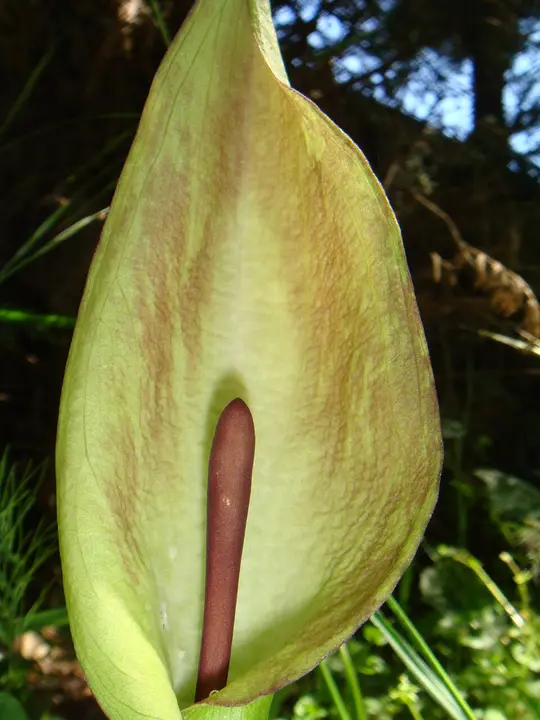
Lords-and-ladies, Arum maculatum

Wild flower

Lords-and-ladies

Arum maculatum

A shade-loving plant of woods and hedgerows with glossy, arrow-shaped leaves, often dark-spotted. In spring a pale green hood wraps around a purple or yellowish spike, and later in the year a short stalk of bright orange-red berries remains. The plant is poisonous to people, the berries especially, and it can irritate the skin.

When it flowers

April to May

Also called
cuckoo-pint

Sources: The Wildlife Trusts, Woodland Trust, Plantlife, NatureSpot, Wild Flower Finder

Photo: Francesco Scelsa, CC BY-SA 4.0, via Wikimedia Commons

Close

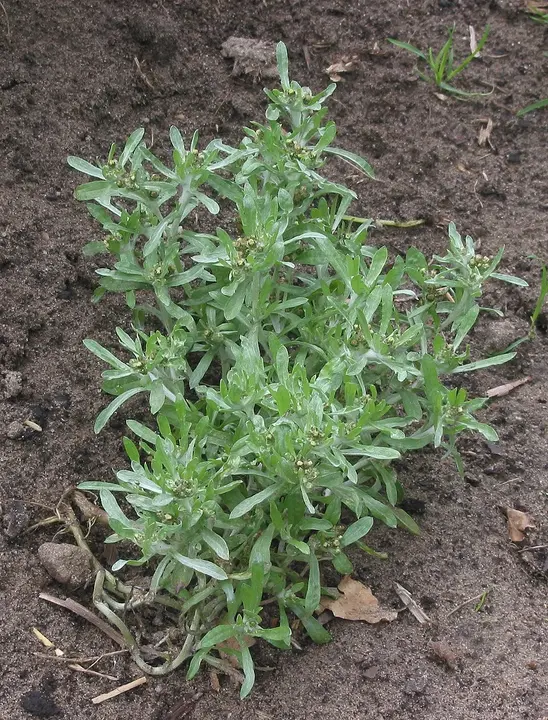
Marsh cudweed, Gnaphalium uliginosum

Wild flower

Marsh cudweed

Gnaphalium uliginosum

A small, much-branched annual covered in grey-white woolly hairs, with small clusters of yellowish-brown flowerheads. It grows on bare, muddy ground that is wet in winter, such as rutted tracks, trampled gateways and wet woodland rides.

When it flowers

July to September

Sources: BSBI, NatureSpot

Photo: Rasbak, CC BY-SA 3.0, via Wikimedia Commons

Close

Marsh thistle, Cirsium palustre

Wild flower

Marsh thistle

Cirsium palustre

A tall thistle whose stems carry spiny wings right up to the top, with small, usually purple flower heads in clusters. It grows in marshes, damp grassland, wet woods and woodland clearings. Its seeds can survive in the soil for many years, including through the shady years of a coppice cycle.

When it flowers

July to September

Sources: NatureSpot

Photo: Ivar Leidus, CC BY-SA 4.0, via Wikimedia Commons

Close

Marsh willowherb, Epilobium palustre

Wild flower

Marsh willowherb

Epilobium palustre

A slender willowherb of marshes and other wet places. Its small, pale pink or sometimes white flowers have a club-shaped stigma in the centre, and its narrow, untoothed leaves have no stalks. It spreads by thin underground runners, and its flowering spikes are often slightly bristly.

When it flowers

July to August

Sources: BSBI, NatureSpot

Photo: Kristian Peters, CC BY-SA 3.0, via Wikimedia Commons

Close

Marsh-bedstraw, Galium palustre

Wild flower

Marsh-bedstraw

Galium palustre

A hairless plant of ditches, marshes, wet meadows and pond edges, with square stems and leaves in whorls of four to six. Small white flowers with red anthers appear in summer. Fen bedstraw is very similar but has a small point at the tip of each leaf.

When it flowers

June to August

Also called
common marsh-bedstraw

Sources: BSBI, NatureSpot, BioImages

Photo: Kristian Peters, CC BY-SA 3.0, via Wikimedia Commons

Close

Meadow buttercup, Ranunculus acris

Wild flower

Meadow buttercup

Ranunculus acris

A tall buttercup, up to 1 m, with glossy yellow flowers about 2 cm across on smooth, unfurrowed stalks, and rounded leaves deeply divided into three to seven lobes. Unlike creeping buttercup it has no runners, and it grows in meadows and pastures, especially on slightly damp ground. Its sap is poisonous to people and livestock, and grazing animals avoid it because of its acrid taste.

When it flowers

April to October

Sources: The Wildlife Trusts, NatureSpot, First Nature

Photo: Michel Langeveld, CC BY-SA 4.0, via Wikimedia Commons

Close

Meadow vetchling, Lathyrus pratensis

Wild flower

Meadow vetchling

Lathyrus pratensis

A scrambling plant with angled stems and clusters of yellow pea flowers on long stalks. Each leaf has a single pair of narrow leaflets and a tendril. It grows in rough grassland, hedges and road verges, and bees visit the flowers.

When it flowers

May to August

Also called
meadow pea

Sources: The Wildlife Trusts, RHS, NatureSpot, NZ Flora

Photo: Didier Descouens, CC BY-SA 4.0, via Wikimedia Commons

Close

Meadowsweet, Filipendula ulmaria

Wild flower

Meadowsweet

Filipendula ulmaria

A tall plant of damp meadows, ditches, riverbanks and wet woodland, with frothy clusters of tiny creamy-white flowers on upright stems. The flowers smell sweet, but the crushed plant smells more like antiseptic. It was once used to flavour mead, which is probably where its name comes from.

When it flowers

June to September

Sources: The Wildlife Trusts, Woodland Trust, NatureSpot

Photo: AnRo0002, CC0, via Wikimedia Commons

Close

Moschatel, Adoxa moschatellina

Wild flowerAncient woodland

Moschatel

Adoxa moschatellina

A small, low plant of damp woods and shady hedgerows, with leaves divided into threes. Each short stem carries five small green flowers: four face outwards like the faces of a town clock and one faces upwards, which is why it is also called town-hall clock. The flowers give off a faint musky smell, especially on damp evenings.

When it flowers

April to May

Also called
town-hall clock

Sources: BSBI, NatureSpot, Wild Flower Finder, First Nature, GWCT

Photo: Robert Flogaus-Faust, CC BY 4.0, via Wikimedia Commons

Close

Mugwort, Artemisia vulgaris

Wild flower

Mugwort

Artemisia vulgaris

A tall, tufted plant with often reddish stems and deeply cut leaves that are dark green above and white with matted hairs underneath. Its tiny reddish-brown or yellowish flower heads grow in branched spikes. It is found on roadsides and waste ground, and is a long-established introduction rather than a native plant.

When it flowers

July to September

Sources: BSBI, NatureSpot, Wild Flower Finder

Photo: AnemoneProjectors, CC BY-SA 2.0, via Wikimedia Commons

Close

Musk-mallow, Malva moschata

Wild flower

Musk-mallow

Malva moschata

A perennial of dry grassy places, road verges, hedgebanks, field borders and woodland edges, with large pale pink, sometimes white, saucer-shaped flowers. Its leaves are deeply cut into narrow lobes, unlike the rounded leaves of common mallow. The flowers have a musky scent, which gives the plant its name.

When it flowers

July to August

Sources: BSBI, The Wildlife Trusts, NatureSpot, NatureSpot (2), Wild Flower Finder

Photo: Albert H, CC BY-SA 3.0, via Wikimedia Commons

Close

Opium poppy, Papaver somniferum

Wild flower

Opium poppy

Papaver somniferum

A tall, smooth, grey-green annual whose upper leaves clasp the stem. Its large flowers, pale lilac, purple or red and often with a dark blotch at the base of each petal, are followed by rounded seed capsules with a flat cap. Not native, it was brought to Britain long ago and grows wild on cultivated and waste ground, and it is harmful if eaten.

When it flowers

June to August

Sources: RHS, NatureSpot, UK South West wild flowers

Photo: Ann Harrison, CC BY-SA 2.0, via Wikimedia Commons

Close

Oxeye daisy, Leucanthemum vulgare

Wild flower

Oxeye daisy

Leucanthemum vulgare

A much larger relative of the daisy, with white-rayed flowerheads 3 to 5 cm across, held singly on tall stems. The lower leaves are spoon-shaped and the stem leaves narrower and toothed. It grows in meadows, rough grassland and on verges, and its nectar draws bees, butterflies and hoverflies.

When it flowers

May to September

Also called
moon daisy

Sources: The Wildlife Trusts, Woodland Trust, Plantlife, NatureSpot

Photo: Bourgeois.A, CC BY-SA 3.0, via Wikimedia Commons

Close

Oxford ragwort, Senecio squalidus

Wild flower

Oxford ragwort

Senecio squalidus

A much-branched plant with loose clusters of bright yellow, daisy-like flowers, each with black-tipped bracts beneath, and leaves that vary from lance-shaped to deeply lobed. It is not native: it escaped from Oxford Botanic Garden and spread along the railways. It grows on walls, railway land, roadsides and waste ground.

When it flowers

April to December

Sources: BSBI, NatureSpot

Photo: Snežana Trifunović, CC BY-SA 3.0, via Wikimedia Commons

Close

Perennial sow-thistle, Sonchus arvensis

Wild flower

Perennial sow-thistle

Sonchus arvensis

A tall plant that spreads underground, with large, deep golden-yellow, dandelion-like flowers, bigger than those of other sow-thistles. The bracts below each flower carry sticky yellowish glands, and the stems contain a milky sap. It grows on field margins, waste ground, roadsides and stream banks.

When it flowers

July to October

Also called
corn sow-thistle

Sources: NatureSpot, First Nature

Photo: 4028mdk09, CC BY-SA 3.0, via Wikimedia Commons

Close

Perforate St John's-wort, Hypericum perforatum

Wild flower

Perforate St John's-wort

Hypericum perforatum

An upright plant with star-shaped yellow flowers whose petals carry tiny black dots, mostly around the edges. Hold a leaf up to the light and it looks pierced by many clear dots, and the stem has two raised lines. It grows in rough grassland, hedgebanks, open woods and on roadsides.

When it flowers

June to September

Sources: BSBI Plant Atlas 2020, The Wildlife Trusts, NatureSpot

Photo: Didier Descouens, CC BY-SA 4.0, via Wikimedia Commons

Close

Pineappleweed, Matricaria discoidea

Wild flower

Pineappleweed

Matricaria discoidea

A low, branching plant with finely divided, feathery leaves and small, cone-shaped, greenish-yellow flower heads with no petals. The plant smells of pineapple when crushed. It grows on paths, pavements, verges and other trampled or disturbed ground, and is an introduced plant that is not native to Britain.

When it flowers

May to November

Also called
pineapple mayweed

Sources: The Wildlife Trusts, NatureSpot

Photo: Ivar Leidus, CC BY-SA 3.0, via Wikimedia Commons

Close

Prickly sow-thistle, Sonchus asper

Wild flower

Prickly sow-thistle

Sonchus asper

Its shiny green leaves are edged with sharp spines, and the upper ones clasp the stem with rounded lobes. Golden-yellow, dandelion-like flowers grow in loose clusters. It is an annual weed of cultivated ground, waste places and roadsides, and is told from smooth sow-thistle by those rounded lobes and its spinier leaves.

When it flowers

June to October

Also called
rough sow-thistle, spiny sow-thistle

Sources: NatureSpot, Wild Flower Finder, First Nature, Garden Organic

Photo: KENPEI, CC BY-SA 3.0, via Wikimedia Commons

Close

Primrose, Primula vulgaris

Wild flowerAncient woodland

Primrose

Primula vulgaris

Pale yellow flowers with a darker yellow centre, each on its own hairy stalk, rise from a low rosette of crinkled, tongue-shaped leaves. It grows in woodland clearings and on hedge banks and grassy banks, flowering through spring and from as early as December in mild years. It is a foodplant for caterpillars of the rare Duke of Burgundy butterfly.

When it flowers

December to May

Also called
common primrose

Sources: The Wildlife Trusts, Woodland Trust

Photo: Stefan Czapski, CC BY-SA 2.0, via Wikimedia Commons

Close

Procumbent pearlwort, Sagina procumbens

Wild flower

Procumbent pearlwort

Sagina procumbens

A small, hairless plant that forms low mats from a central rosette, with creeping stems that root as they spread and bristle-tipped leaves. Its tiny four-parted flowers usually have no petals, or very small ones. It grows on paths, lawns, ditch sides and other damp, bare ground.

When it flowers

May to September

Sources: NatureSpot, Wild Flower Finder, UK South West wild flowers

Photo: Sylvain Piry, CC BY-SA 2.0 fr, via Wikimedia Commons

Close

Red bartsia, Odontites vernus

Wild flower

Red bartsia

Odontites vernus

A straggly, downy plant whose stems, narrow toothed leaves and small pinkish-purple flowers all have a reddish tinge. It grows on roadside verges, waste ground and other disturbed places. It is partly parasitic, taking extra nutrients from the roots of nearby grasses.

When it flowers

June to September

Formerly
Odontites verna

Sources: The Wildlife Trusts

Photo: Sannse, CC BY-SA 3.0, via Wikimedia Commons

Close

Red campion, Silene dioica

Wild flower

Red campion

Silene dioica

A hairy plant up to 1 m tall with bright pink flowers, each of five petals so deeply notched they look almost split in two. Male and female flowers grow on separate plants. It is common in woods, hedges and on verges, and comes into flower as the bluebells are finishing.

When it flowers

May to September

Sources: The Wildlife Trusts, Woodland Trust, NatureSpot

Photo: J. Patrick Fischer, CC BY-SA 3.0, via Wikimedia Commons

Close

Redshank, Persicaria maculosa

Wild flower

Redshank

Persicaria maculosa

An annual of bare, disturbed and cultivated ground, often near water, with lance-shaped leaves that often carry a dark blotch, and dense spikes of small pink flowers. Its stems are often flushed red, especially above the joints, which gives it its English name.

When it flowers

June to October

Also called
redleg
Formerly
Polygonum persicaria

Sources: BSBI, NatureSpot, First Nature

Photo: Joanna Boisse, CC BY-SA 4.0, via Wikimedia Commons

Close

Ribbed melilot, Melilotus officinalis

Wild flower

Ribbed melilot

Melilotus officinalis

A tall plant with leaves in threes and long, slender spikes of small yellow pea-like flowers, found on waste ground and roadsides. Its ripe seed pods are brown and hairless, which tells it apart from tall melilot. It was introduced to Britain and is not a native plant.

When it flowers

June to September

Sources: NatureSpot, Wild Flower Finder, UK South West wild flowers

Photo: Ivar Leidus, CC BY-SA 4.0, via Wikimedia Commons

Close

Ribwort plantain, Plantago lanceolata

Wild flower

Ribwort plantain

Plantago lanceolata

Narrow, lance-shaped leaves with strong lengthwise ribs grow in a rosette, and wiry, ridged stalks carry short, dark brown flower heads ringed with pale stamens. It is common in grassland, lawns, verges and field edges. Its seed heads last into winter and feed goldfinches and other seed-eating birds.

When it flowers

April to October

Sources: The Wildlife Trusts, NatureSpot, Wikipedia

Photo: sannse, CC BY-SA 3.0, via Wikimedia Commons

Close

Rosebay willowherb, Chamaenerion angustifolium

Wild flower

Rosebay willowherb

Chamaenerion angustifolium

A tall plant that forms large stands on open, disturbed ground such as woodland clearings, roadside verges and waste ground. It has long, tapering spikes of rose-purple flowers and narrow leaves arranged in a spiral up the stem. It is also called fireweed because the heat of fires helps its seeds to germinate, so it often springs up on burnt ground.

When it flowers

June to September

Also called
fireweed
Formerly
Chamerion angustifolium, Epilobium angustifolium

Sources: The Wildlife Trusts, NatureSpot

Photo: kallerna, CC BY-SA 3.0, via Wikimedia Commons

Close

Rough hawkbit, Leontodon hispidus

Wild flower

Rough hawkbit

Leontodon hispidus

A hairy, dandelion-like plant of dry grassland, especially chalk and limestone downland, hay meadows and road verges. Each long, leafless, unbranched stem carries one yellow flowerhead, whose outer florets are often orange or reddish underneath. The leaves are rough with hairs, many of them forked at the tip.

When it flowers

June to October

Sources: BSBI, NatureSpot, Wild Flower Finder, Floodplain Meadows Partnership

Photo: Anne Burgess, CC BY-SA 2.0, via Wikimedia Commons

Close

Sanicle, Sanicula europaea

Wild flowerAncient woodland

Sanicle

Sanicula europaea

Shiny green leaves, divided like a hand into three to five toothed lobes, grow from the base, and taller stalks carry small rounded heads of pinkish or greenish-white flowers. It grows in shady deciduous woodland. Its fruits are covered in hooked bristles that catch on passing animals, which spreads the seeds.

When it flowers

May to August

Also called
wood sanicle

Sources: BSBI, NatureSpot, Woodlands.co.uk

Photo: Bernd Haynold, CC BY 2.5, via Wikimedia Commons

Close

Saw-wort, Serratula tinctoria

Wild flowerAncient woodland

Saw-wort

Serratula tinctoria

It looks like a small, slender knapweed, with thistle-like heads of purple flowers but no spines. Its leaves have finely toothed edges like a saw, which gives it its name. It grows in old grassland, meadows and along woodland edges, and a yellow dye was once made from its leaves.

When it flowers

July to September

Sources: The Wildlife Trusts, NatureSpot

Photo: Franz Xaver, CC BY-SA 3.0, via Wikimedia Commons

Close

Scarlet pimpernel, Lysimachia arvensis

Wild flower

Scarlet pimpernel

Lysimachia arvensis

A low, sprawling plant with square stems, pairs of oval, unstalked leaves dotted black underneath, and small five-petalled flowers, usually orange-red with a purple centre. It grows on cultivated and disturbed ground, paths and gardens. The flowers open only in sunshine, and the whole plant is poisonous.

When it flowers

May to October

Also called
poor man's weatherglass, shepherd's weatherglass
Formerly
Anagallis arvensis

Sources: The Wildlife Trusts, NatureSpot, Wild Flower Finder

Photo: Alvesgaspar, CC BY-SA 3.0, via Wikimedia Commons

Close

Scentless mayweed, Tripleurospermum inodorum

Wild flower

Scentless mayweed

Tripleurospermum inodorum

A branched annual of arable fields, field margins, farm tracks, verges and waste ground. It has white daisy-like flowers with yellow centres and finely divided, feathery leaves, but little or no scent. Slicing a flowerhead shows a solid centre, which separates it from scented mayweed, whose centre is hollow.

When it flowers

May to October

Sources: BSBI, NatureSpot, First Nature

Photo: Robert Flogaus-Faust, CC BY 4.0, via Wikimedia Commons

Close

Selfheal, Prunella vulgaris

Wild flower

Selfheal

Prunella vulgaris

A low, creeping plant with paired oval leaves and dense, oblong heads of violet-blue flowers, which leave purplish seed heads behind. It grows in short grassland, lawns, verges and woodland clearings. Its name comes from its long use in herbal medicine for healing wounds.

When it flowers

June to October

Also called
self-heal

Sources: The Wildlife Trusts, RHS, First Nature

Photo: Ivar Leidus, CC BY-SA 3.0, via Wikimedia Commons

Close

Silverweed, Potentilla anserina

Wild flower

Silverweed

Potentilla anserina

A low, creeping plant that spreads by thin red runners, with leaves divided into many toothed leaflets that are silvery and downy, especially underneath. Single yellow flowers with five petals appear in summer. It grows in rough grassland, on verges, paths and waste ground, and its flowers give nectar to bees.

When it flowers

May to August

Sources: The Wildlife Trusts, NatureSpot

Photo: Walter Siegmund, CC BY-SA 3.0, via Wikimedia Commons

Close

Slender St John's-wort, Hypericum pulchrum

Wild flowerAncient woodland

Slender St John's-wort

Hypericum pulchrum

A slender, hairless plant with round, often reddish stems and heart-shaped leaves that clasp the stem and show translucent dots against the light. The yellow flowers are tinged red, with black glands along the edges of the sepals. It grows in woods, heaths and dry grassland on acid soils.

When it flowers

June to August

Sources: NatureSpot

Photo: J.F. Gaffard Jeffdelonge at fr.wikipedia, CC BY-SA 3.0, via Wikimedia Commons

Close

Smooth hawk's-beard, Crepis capillaris

Wild flower

Smooth hawk's-beard

Crepis capillaris

A slender, branched plant, hairless or only sparsely hairy, of grassy places, lawns, verges, waste ground and gardens. Its small yellow flowerheads are often reddish under the outer florets, and its upper stem leaves are unstalked and clasp the stem. It often survives and flowers in mown grass.

When it flowers

June to November

Sources: BSBI, NatureSpot, Wild Flower Finder, Dorset Nature

Photo: Michael Becker, CC BY-SA 3.0, via Wikimedia Commons

Close

Smooth sow-thistle, Sonchus oleraceus

Wild flower

Smooth sow-thistle

Sonchus oleraceus

A common annual weed with soft, greyish-green, lobed leaves, the upper ones clasping the stem with pointed lobes. Pale yellow, dandelion-like flowers grow in loose clusters, and each seed carries a tuft of hairs that the wind blows away. It grows on bare and waste ground, roadsides, gardens and farmland.

When it flowers

May to November

Also called
common sow-thistle

Sources: RHS, NatureSpot, Wild Flower Finder, First Nature, Garden Organic

Photo: Wildfeuer, CC BY 2.5, via Wikimedia Commons

Close

Smooth tare, Ervum tetraspermum

Wild flower

Smooth tare

Ervum tetraspermum

A scrambling annual of hedgerows, scrub, woodland edges and rough grassland. Its pale purple flowers come singly or in pairs and are larger and more purple than those of hairy tare. The smooth, hairless pods usually hold four seeds.

When it flowers

May to August

Formerly
Vicia tetrasperma

Sources: NatureSpot

Photo: Fornax, CC BY-SA 3.0, via Wikimedia Commons

Close

Spear thistle, Cirsium vulgare

Wild flower

Spear thistle

Cirsium vulgare

A tall thistle with large purple flower heads, stems lined with spiny wings, and lobed leaves that are edged with sharp spines and prickly-hairy on top. It grows on rough grassland, verges, field edges and disturbed ground. Butterflies such as the small copper feed on its nectar, and goldfinches eat its seeds.

When it flowers

July to October

Sources: The Wildlife Trusts, NatureSpot

Photo: AnRo0002, CC0, via Wikimedia Commons

Close

Square-stalked St John's-wort, Hypericum tetrapterum

Wild flower

Square-stalked St John's-wort

Hypericum tetrapterum

An upright, hairless plant whose square stems have a wing along each of the four corners. The leaves grow in opposite pairs and show translucent dots against the light, and the small, pale yellow flowers grow in spreading heads. It grows in damp places such as marshes and the edges of ponds and rivers.

When it flowers

June to September

Sources: NatureSpot

Photo: Henry Miller, CC BY 4.0, via iNaturalist

Close

Square-stalked willowherb, Epilobium tetragonum

Wild flower

Square-stalked willowherb

Epilobium tetragonum

A medium to tall willowherb of damp or fairly dry ground, including woodland clearings, stream sides, roadsides and waste ground. Its stem is square in cross-section, its long, narrow leaves are edged with small teeth, and each small pink flower has four notched petals around a club-shaped stigma. Several willowherbs look alike, so check for the square stem and the lack of glandular hairs.

When it flowers

July to August

Sources: BSBI, NatureSpot

Photo: Rasbak, CC BY-SA 3.0, via Wikimedia Commons

Close

Stinking iris, Iris foetidissima

Wild flowerAncient woodland

Stinking iris

Iris foetidissima

An iris of woods, hedgebanks and scrub, mostly on chalky or limy soils, with dull bluish-mauve or pale yellow flowers. In autumn its seed pods split to show bright orange-red seeds that stay on the plant through winter, and the crushed leaves smell unpleasant. It is one of only two irises native to Britain.

When it flowers

May to July

Also called
gladdon, roast-beef plant

Sources: BSBI, NatureSpot, Wild Flower Finder, First Nature

Photo: Jymm, Public domain, via Wikimedia Commons

Close

Sweet violet, Viola odorata

Wild flower

Sweet violet

Viola odorata

A low plant that spreads by rooting runners, with heart-shaped leaves and fragrant flowers in early spring. The flowers are often dark violet but can be white. It grows in hedgerows, wood edges and shaded verges, often near houses and in churchyards, where many plants are garden escapes.

When it flowers

February to May

Sources: NatureSpot

Photo: Fritz Geller-Grimm, CC BY-SA 2.5, via Wikimedia Commons

Close

Tall melilot, Melilotus altissimus

Wild flower

Tall melilot

Melilotus altissimus

A tall, branching plant with leaves in threes and long spikes of small yellow pea-like flowers, found on roadsides, woodland edges and in damp places. Its ripe seed pods are black and hairy, which tells it apart from ribbed melilot. It is a long-established introduction rather than a native plant.

When it flowers

June to August

Also called
golden melilot

Sources: BSBI, NatureSpot, Wild Flower Finder, UK South West wild flowers

Photo: Hans Hillewaert, CC BY-SA 3.0, via Wikimedia Commons

Close

Three-nerved sandwort, Moehringia trinervia

Wild flowerAncient woodland

Three-nerved sandwort

Moehringia trinervia

A low, straggling plant of woods and other shady places, with hairy shoots and oval leaves that each show three to five clear veins. Its small white flowers have five unnotched petals, about half as long as the sepals behind them.

When it flowers

May to June

Sources: NatureSpot

Photo: Michael Becker, CC BY-SA 3.0, via Wikimedia Commons

Close

Thyme-leaved speedwell, Veronica serpyllifolia

Wild flower

Thyme-leaved speedwell

Veronica serpyllifolia

A low, creeping, almost hairless plant with small oval leaves and leafy spikes of small pale blue or whitish flowers marked with darker purplish-blue veins. It grows on bare and disturbed ground, in gardens and on cultivated land.

When it flowers

March to October

Sources: NatureSpot

Photo: Fornax, CC BY-SA 3.0, via Wikimedia Commons

Close

Tormentil, Potentilla erecta

Wild flower

Tormentil

Potentilla erecta

A low, creeping plant with small yellow flowers that usually have four petals, which sets it apart from buttercups with their five. Each leaf has three toothed leaflets, with two leaf-like stipules at its base. It grows on acid grassland, heaths, moors and in open woodland, and solitary bees visit it for nectar.

When it flowers

May to September

Sources: The Wildlife Trusts, NatureSpot

Photo: Joan Simon from Barcelona, España, CC BY-SA 2.0, via Wikimedia Commons

Close

Trailing St John's-wort, Hypericum humifusum

Wild flower

Trailing St John's-wort

Hypericum humifusum

A small St John's-wort whose stems usually lie flat along the ground. Its yellow flowers, about a centimetre across, open only in full sun, so the plant is easy to overlook. It grows on light, acid soils in heathland, acid grassland, open woodland and along tracks.

When it flowers

June to September

Sources: NatureSpot

Photo: Fornax, CC BY-SA 3.0, via Wikimedia Commons

Close

Upright hedge-parsley, Torilis japonica

Wild flower

Upright hedge-parsley

Torilis japonica

A slender plant with stiff stems, ferny leaves and small heads of white or pinkish flowers. It resembles cow parsley but flowers later, in mid to late summer, on hedge banks, in grassy places and along woodland edges. Its small fruits are covered in short, curved spines.

When it flowers

July to September

Sources: Woodland Trust, NatureSpot, Wild Flower Finder

Photo: Kristian Peters, CC BY-SA 3.0, via Wikimedia Commons

Close

Water-pepper, Persicaria hydropiper

Wild flower

Water-pepper

Persicaria hydropiper

An upright annual with narrow, pointed leaves and thin, drooping spikes of small greenish-white or pinkish flowers. It grows on wet mud at the edges of ponds and streams, and in damp woodland rides, often in wheel ruts and hoof prints. The plant has a hot, peppery taste, which gives it its name.

When it flowers

June to September

Sources: NatureSpot

Photo: AnRo0002, CC0, via Wikimedia Commons

Close

Wavy bitter-cress, Cardamine flexuosa

Wild flower

Wavy bitter-cress

Cardamine flexuosa

A small plant of damp, shady places such as ditches and ground that floods in winter, with tiny white flowers and a wavy, often branched stem. It looks very like hairy bitter-cress, but its flowers have six stamens rather than four and its seed pods do not usually rise above the flowers.

When it flowers

April to September

Sources: NatureSpot

Photo: Didier Descouens, CC BY-SA 4.0, via Wikimedia Commons

Close

Welted thistle, Carduus crispus

Wild flower

Welted thistle

Carduus crispus

A tall thistle with spiny wings running up its branched stems to just below the flower heads. The rounded heads of reddish-purple flowers are fairly small, and the leaves are only weakly spiny. It grows along woodland rides and edges, hedge bottoms, streamsides and field margins, and often increases after scrub is cleared or ground is disturbed.

When it flowers

June to August

Sources: RHS, NatureSpot, UK Wildflowers

Photo: Ivar Leidus, CC BY-SA 4.0, via Wikimedia Commons

Close

White campion, Silene latifolia

Wild flower

White campion

Silene latifolia

A hairy, slightly sticky plant up to 1 m tall with white flowers of five deeply notched petals. Male and female flowers grow on separate plants, and the flowers give off a scent at night that draws moths. It grows on field edges, verges and waste ground, and crosses with red campion to produce pink-flowered hybrids.

When it flowers

May to October

Formerly
Silene alba

Sources: BSBI, The Wildlife Trusts, NatureSpot, NatureSpot (2)

Photo: JackyM59, CC BY-SA 4.0, via Wikimedia Commons

Close

White clover, Trifolium repens

Wild flower

White clover

Trifolium repens

Creeping stems root as they spread through short grass, sending up leaves of three rounded leaflets, often with a pale mark, and round heads of white or pale pink flowers. It grows in lawns, pastures and on verges. Bumblebees visit the flowers, and it is a food plant of the common blue butterfly.

When it flowers

May to September

Sources: The Wildlife Trusts, Plantlife, NatureSpot

Photo: Vinayaraj, CC BY-SA 4.0, via Wikimedia Commons

Close

White dead-nettle, Lamium album

Wild flower

White dead-nettle

Lamium album

It looks like a stinging nettle, with heart-shaped, toothed leaves, but has no stinging hairs. White, hooded flowers grow in rings around the stem among the upper leaves. It is common on verges, hedge banks and waste ground, and bees such as the white-tailed bumblebee and red mason bee visit the flowers.

When it flowers

March to November

Sources: The Wildlife Trusts, NatureSpot, First Nature

Photo: Robert Flogaus-Faust, CC BY 4.0, via Wikimedia Commons

Close

White water-lily, Nymphaea alba

Wild flower

White water-lily

Nymphaea alba

A water plant with large, round floating leaves and big white flowers with many petals around a yellow centre, which open in sunshine. It roots in the mud of lakes, ponds and slow rivers, and has been widely planted in ornamental lakes and village ponds.

When it flowers

June to August

Sources: The Wildlife Trusts, NatureSpot

Photo: Jacek Halicki, CC BY-SA 4.0, via Wikimedia Commons

Close

White-flowered bugle, Ajuga reptans f. albiflora

Wild flower

White-flowered bugle

Ajuga reptans f. albiflora

A white-flowered form of bugle. Apart from the colour of its flowers it is the same plant: a low perennial of damp grassland and woodland clearings that spreads by rooting runners and has oval, often bronze-tinged leaves.

When it flowers

April to July

Sources: The Wildlife Trusts, NatureSpot

Photo: Patrick Roper, CC BY-SA 2.0, via Wikimedia Commons

Close

Wild angelica, Angelica sylvestris

Wild flower

Wild angelica

Angelica sylvestris

A tall member of the carrot family, found in damp places such as wet meadows, ditches and wet woods. It has hollow purple stems, divided leaves and large, rounded umbrellas of small flowers tinged with purple or red, which smell like garden angelica and attract a range of insects.

When it flowers

July to September

Sources: The Wildlife Trusts

Photo: W.carter, CC0, via Wikimedia Commons

Close

Wild basil, Clinopodium vulgare

Wild flower

Wild basil

Clinopodium vulgare

A softly hairy, faintly aromatic plant with pinkish-purple flowers in dense whorls spaced up the stem. It is found in scrub, rough grassland, hedgebanks and road verges, mostly where the soil is dry and lime-rich, such as on chalk.

When it flowers

July to September

Sources: NatureSpot, Dorset Nature

Photo: Doppelbrau, CC BY-SA 4.0, via Wikimedia Commons

Close

Wild carrot, Daucus carota

Wild flower

Wild carrot

Daucus carota

Look for umbrella-like heads of tiny white flowers, often with a single dark purple flower in the centre, above a ruff of divided bracts. As the seeds ripen, the head curls inwards into a cup like a bird's nest. It grows in dry grassland, especially on chalk, and near the coast, and the garden carrot is a cultivated form of the same species.

When it flowers

June to September

Sources: BSBI, The Wildlife Trusts, NatureSpot, First Nature

Photo: Anne Burgess, CC BY-SA 2.0, via Wikimedia Commons

Close

Wild strawberry, Fragaria vesca

Wild flower

Wild strawberry

Fragaria vesca

A low plant that spreads by rooting runners, with leaves of three toothed leaflets and white, five-petalled flowers with a yellow centre, followed by small red strawberries. The end tooth of each leaflet is about as long as those beside it, which separates it from barren strawberry. It grows in grassland, on chalk downland and in open woodland.

When it flowers

April to July

Sources: The Wildlife Trusts, NatureSpot

Photo: Ivar Leidus, CC BY-SA 4.0, via Wikimedia Commons

Close

Wild teasel, Dipsacus fullonum

Wild flower

Wild teasel

Dipsacus fullonum

A tall, prickly plant of rough grassland, woodland edges and roadsides that can reach 2 metres. Its spiny, cone-shaped heads of small purple flowers open first in a ring around the middle, and its paired leaves join around the stem to form cups that hold rainwater. Goldfinches pick seeds from the old brown heads in autumn.

When it flowers

July to August

Also called
teasel

Sources: The Wildlife Trusts, NatureSpot

Photo: MPF, CC BY-SA 3.0, via Wikimedia Commons

Close

Wood anemone, Anemone nemorosa

Wild flowerAncient woodland

Wood anemone

Anemone nemorosa

White flowers, sometimes tinged pink or streaked with purple, with a cluster of yellow anthers in the centre, appear on the woodland floor in spring. Each flower stands on a thin reddish stem above deeply lobed leaves. It spreads slowly, mostly by underground stems, and is one of the plants used as indicators of ancient woodland.

When it flowers

March to May

Also called
windflower

Sources: The Wildlife Trusts, Woodland Trust

Photo: Lilly M, CC BY-SA 3.0, via Wikimedia Commons

Close

Wood avens, Geum urbanum

Wild flower

Wood avens

Geum urbanum

A straggly, hairy plant of hedgerows, woods and gardens, with small yellow five-petalled flowers on slender stems. The flowers are followed by spiky seed heads covered in red hooks that catch on passing animals. Caterpillars of the grizzled skipper butterfly sometimes feed on it.

When it flowers

May to August

Also called
herb bennet

Sources: The Wildlife Trusts, NatureSpot, Butterfly Conservation

Photo: Krzysztof Ziarnek, Kenraiz, CC BY-SA 4.0, via Wikimedia Commons

Close

Wood dock, Rumex sanguineus

Wild flower

Wood dock

Rumex sanguineus

A slender dock of damp, shady places such as woodland rides, hedgerows and path edges. Its tiny reddish-green flowers grow in small, well-spaced whorls on branches held at a narrow angle to the stem, and each fruit carries one large wart. Its leaf veins are usually green and may redden as the leaves age, while a form with blood-red veins, var. sanguineus, is grown in gardens.

When it flowers

June to August

Sources: BSBI, NatureSpot, Wild Flower Finder, Dorset Nature

Photo: Agnieszka Kwiecień, Nova, CC BY-SA 4.0, via Wikimedia Commons

Close

Wood forget-me-not, Myosotis sylvatica

Wild flower

Wood forget-me-not

Myosotis sylvatica

A softly hairy plant of damp woods and shady hedgebanks, with loose sprays of sky-blue flowers, usually with a yellow or white eye. Its flowers are larger than those of field forget-me-not. It is native in woodland but is also grown in gardens, and it is far more often found as a garden escape.

When it flowers

April to July

Sources: BSBI, NatureSpot, Wild Flower Finder, Friends of Heene Cemetery

Photo: Kev22, CC BY-SA 4.0, via Wikimedia Commons

Close

Wood spurge, Euphorbia amygdaloides

Wild flowerAncient woodland

Wood spurge

Euphorbia amygdaloides

An evergreen woodland plant with upright stems and long, narrow, dark green leaves, sometimes tinged red. Its yellow-green flowers have no petals and sit in cup-shaped bracts. It grows in woods, especially damp and coppiced ones, mainly in southern England, and like other spurges it has a poisonous milky sap.

When it flowers

March to June

Sources: The Wildlife Trusts, NatureSpot

Photo: Rasbak, CC BY-SA 3.0, via Wikimedia Commons

Close

Woodruff, Galium odoratum

Wild flowerAncient woodland

Woodruff

Galium odoratum

A low, spreading plant of shady deciduous woodland, often on lime-rich soils, with square stems and narrow leaves in star-like rings of six to nine. Its small, white, four-petalled flowers grow in loose clusters at the top of the stem. The leaves smell of hay when dried.

When it flowers

May to June

Formerly
Asperula odorata

Sources: BSBI, BSBI (2), RHS, NatureSpot, First Nature, UK South West wild flowers

Photo: Hajotthu, CC BY-SA 3.0, via Wikimedia Commons

Close

Yarrow, Achillea millefolium

Wild flower

Yarrow

Achillea millefolium

A common, strong-smelling plant of lawns, meadows and roadside verges, with dark green, finely divided, feathery leaves. Its small white, sometimes pinkish, flower heads are packed into flat-topped clusters. The second part of its scientific name, millefolium, means 'a thousand leaves', after its finely divided foliage.

When it flowers

June to November

Sources: The Wildlife Trusts, First Nature

Photo: SAplants, CC BY-SA 4.0, via Wikimedia Commons

Close

Yellow archangel, Lamiastrum galeobdolon

Wild flowerAncient woodland

Yellow archangel

Lamiastrum galeobdolon

A hairy, nettle-like plant that does not sting, with whorls of hooded yellow flowers marked with brown up the stem. It grows in woods and hedgerows and is particularly associated with ancient woodland. A garden form with silver-marked leaves has escaped into the wild in many places and spreads invasively.

When it flowers

April to June

Sources: The Wildlife Trusts, NatureSpot, First Nature

Photo: Teun Spaans, CC BY 2.5, via Wikimedia Commons

Close

Yellow pimpernel, Lysimachia nemorum

Wild flowerAncient woodland

Yellow pimpernel

Lysimachia nemorum

A low, creeping evergreen of damp, shady woodland, with pairs of pointed oval leaves and bright yellow flowers held singly on long, slender stalks. It looks like its relative creeping-Jenny, but its petals are more pointed and spaced apart rather than forming a cup.

When it flowers

May to August

Sources: NatureSpot, Wild Flower Finder, First Nature

Photo: Robert Flogaus-Faust, CC BY 4.0, via Wikimedia Commons

Close

Annual meadow-grass, Poa annua

Grass

Annual meadow-grass

Poa annua

A low, light green grass that grows almost anywhere, including lawns, bare ground and waste places. It has blunt-tipped leaves and small, triangular flower heads, and can be found in flower in every month of the year. It can grow from seed to setting its own seed in about six weeks.

When it flowers

All year

Sources: BSBI, The Wildlife Trusts, NatureSpot

Photo: Rasbak, CC BY-SA 3.0, via Wikimedia Commons

Close

Barren brome, Anisantha sterilis

Grass

Barren brome

Anisantha sterilis

A common annual grass of hedge banks, roadsides and waste ground. Its loose flower head droops, with long, rough branches each carrying a single flattened spikelet with long bristles (awns), which usually turns purplish as it ripens. It is also a weed of arable crops.

When it flowers

May to July

Also called
sterile brome
Formerly
Bromus sterilis

Sources: BSBI, NatureSpot, AHDB

Photo: Kristian Peters, CC BY-SA 3.0, via Wikimedia Commons

Close

Black bent, Agrostis gigantea

Grass

Black bent

Agrostis gigantea

A tall bent grass, often close to a metre high, that spreads by creeping underground stems. Its open flower head of tiny spikelets stays spread out after flowering, unlike that of creeping bent. It grows in damp woodland and on arable land, where it can be a serious weed.

When it flowers

June to August

Sources: NatureSpot, Garden Organic

Photo: Kristian Peters, CC BY-SA 3.0, via Wikimedia Commons

Close

Black-grass, Alopecurus myosuroides

Grass

Black-grass

Alopecurus myosuroides

An annual grass with a slender, tapering flower spike, 2 to 12 cm long, that is yellowish-green to purplish. It is a serious weed of cereal fields, mainly in southern and eastern England, and is seldom found away from cultivated land.

When it flowers

May to August

Sources: BSBI, NatureSpot

Photo: Kurt Stüber [1], CC BY-SA 3.0, via Wikimedia Commons

Close

Cock's-foot, Dactylis glomerata

Grass

Cock's-foot

Dactylis glomerata

A coarse, tufted grass up to about a metre tall, with rough, grey-green leaves whose edges are sharp enough to cut skin. Its flower head has a few stiff branches ending in dense clusters of spikelets, said to resemble a bird's foot. It grows in meadows, on roadsides and along woodland rides.

When it flowers

May to September

Sources: BSBI, The Wildlife Trusts, NatureSpot, Wild Flowers of Ireland

Photo: Mike Pennington, CC BY-SA 2.0, via Wikimedia Commons

Close

Common bent, Agrostis capillaris

Grass

Common bent

Agrostis capillaris

A grass of drier, more acid grassland, usually 20 to 50 cm tall. Its open, purplish-brown flower head has whorls of thin branches carrying tiny spikelets and stays spread out. On non-flowering shoots the ligule (the small flap where leaf meets stem) is shorter than it is wide, which helps identify it.

When it flowers

June to August

Formerly
Agrostis tenuis

Sources: NatureSpot, Wild Flowers of Ireland

Photo: Kristian Peters, CC BY-SA 3.0, via Wikimedia Commons

Close

Creeping bent, Agrostis stolonifera

Grass

Creeping bent

Agrostis stolonifera

A common grass whose stems run across the ground as leafy runners that root at their joints. Its pale to purplish flower heads open out only while flowering and are otherwise held tight and narrow. It grows in grassland of all kinds, and cultivated forms are used on golf courses and putting greens.

When it flowers

June to August

Sources: The Wildlife Trusts, NatureSpot, Wild Flowers of Ireland

Photo: Stephen James McWilliam, CC0, via iNaturalist

Close

Creeping soft-grass, Holcus mollis

GrassAncient woodland

Creeping soft-grass

Holcus mollis

A soft-looking grass that spreads by creeping underground stems to form large patches, mostly on acid soils. It resembles Yorkshire-fog, but each joint of the stem has a tuft of long, downward-pointing hairs while the rest of the stem is almost hairless. It does well in woodland clearings and in the early years after coppicing.

When it flowers

June to August

Sources: BSBI, NatureSpot, Garden Organic, Wild Flowers of Ireland

Photo: Kenraiz, CC BY-SA 3.0, via Wikimedia Commons

Close

Crested dog's-tail, Cynosurus cristatus

Grass

Crested dog's-tail

Cynosurus cristatus

A wiry, tufted grass of meadows and other grassland, usually 15 to 60 cm tall. Its stiff, narrow flower spike looks flattened and one-sided, with its narrow florets fanned out stiffly. It grows on many kinds of soil but avoids waterlogged ground.

When it flowers

June to August

Sources: BSBI, The Wildlife Trusts, NatureSpot

Photo: Krzysztof Ziarnek, Kenraiz, CC BY-SA 4.0, via Wikimedia Commons

Close

False brome, Brachypodium sylvaticum

Grass

False brome

Brachypodium sylvaticum

A tufted grass of open woods and scrub, with broad, yellow-green leaves that droop and are softly hairy. Its flower head is a loose spike that often nods at the tip, with rounded spikelets set almost directly on the stem. The leaves and leaf sheaths carry long hairs.

When it flowers

June to July

Sources: BSBI, NatureSpot, Wild Flowers of Ireland

Photo: Krzysztof Ziarnek, Kenraiz, CC BY-SA 4.0, via Wikimedia Commons

Close

False oat-grass, Arrhenatherum elatius

Grass

False oat-grass

Arrhenatherum elatius

A tall grass, up to about 1.5 metres, of road verges, meadows, rough grassland and waste ground. Its loose flower head has two-flowered spikelets, the lower flower carrying a long, bent bristle, and the branches close up after flowering. It gives field voles shelter and nesting material, and barn owls hunt over grassland where native grasses like this grow.

When it flowers

June to August

Sources: BSBI, The Wildlife Trusts, NatureSpot, Wild Flowers of Ireland

Photo: Stefan.lefnaer, CC BY-SA 4.0, via Wikimedia Commons

Close

Giant fescue, Schedonorus giganteus

GrassAncient woodland

Giant fescue

Schedonorus giganteus

A tall, hairless grass of woods and other shady places. It has broad, glossy green leaves with reddish-purple 'ears' (auricles) that clasp the stem where the leaf joins it. Its large, loose flower head droops, and the spikelets carry long bristles (awns).

When it flowers

June to August

Formerly
Festuca gigantea

Sources: BSBI, NatureSpot

Photo: Krzysztof Ziarnek, Kenraiz, CC BY-SA 4.0, via Wikimedia Commons

Close

Hairy-brome, Bromopsis ramosa

GrassAncient woodland

Hairy-brome

Bromopsis ramosa

A tall grass, up to about 1.5 metres, of woods and shady places on richer soils. It has broad, drooping, hairy leaves and long, soft, downward-pointing hairs on the lower leaf sheaths. Its large, loose flower head nods, with drooping branches in pairs carrying long, narrow spikelets.

When it flowers

July to August

Formerly
Bromus ramosus

Sources: BSBI, NatureSpot

Photo: Leo Michels, CC0, via Wikimedia Commons

Close

Meadow foxtail, Alopecurus pratensis

Grass

Meadow foxtail

Alopecurus pratensis

An early-flowering grass of meadows and grassy verges. Its soft, blunt, cylindrical flower spike is green or purple-tinged, and a fine bristle sticks out from each tiny floret. It is often confused with Timothy, which has a similar spike but flowers later in the summer.

When it flowers

April to June

Sources: BSBI, NatureSpot, NatureSpot (2), Wikipedia

Photo: Krzysztof Ziarnek, Kenraiz, CC BY-SA 4.0, via Wikimedia Commons

Close

Perennial rye-grass, Lolium perenne

Grass

Perennial rye-grass

Lolium perenne

A vigorous, tufted grass of rough pastures, road verges and waste ground. Its flower head is a spike of stalkless, flattened spikelets set edgeways on to the stem and alternating up either side, and the flowers usually have no bristles. It has been grown as fodder for livestock since the early 17th century and is widely sown in fields and on lawns.

When it flowers

May to September

Sources: The Wildlife Trusts, NatureSpot, Wild Flowers of Ireland

Photo: Krzysztof Ziarnek, Kenraiz, CC BY-SA 4.0, via Wikimedia Commons

Close

Plicate sweet-grass, Glyceria notata

Grass

Plicate sweet-grass

Glyceria notata

A perennial grass of the edges of ponds and wet ditches. Its flower head is more branched and broader than those of some related sweet-grasses, and telling it apart from them depends on the size and tip shape of the tiny scales around each flower.

When it flowers

June to August

Formerly
Glyceria plicata

Sources: NatureSpot, NatureScene

Photo: Jean-Claude CALAIS, CC BY-SA 2.0 fr, via Wikimedia Commons

Close

Rough meadow-grass, Poa trivialis

Grass

Rough meadow-grass

Poa trivialis

A common grass of meadows, woods, roadside verges and waste ground that spreads by leafy runners above ground. Its ligule, the small flap where the leaf meets the stem, is longer than it is wide, and the lowest leaf sheath feels rough when rubbed. These features separate it from smooth meadow-grass.

When it flowers

May to July

Sources: BSBI, NatureSpot, NatureSpot (2)

Photo: Krzysztof Ziarnek, Kenraiz, CC BY-SA 4.0, via Wikimedia Commons

Close

Sheep's-fescue, Festuca ovina

Grass

Sheep's-fescue

Festuca ovina

A low, tufted grass with very fine, bristle-like leaves, found in dry grassland. It is hard to tell from red fescue without examining the leaf sheaths of young shoots closely. On short chalk grassland it is the food plant of the caterpillars of the rare silver-spotted skipper butterfly.

When it flowers

May to June

Sources: BSBI, NatureSpot, UK Butterfly Monitoring Scheme

Photo: Rasbak, CC BY-SA 3.0, via Wikimedia Commons

Close

Smooth meadow-grass, Poa pratensis

Grass

Smooth meadow-grass

Poa pratensis

A common grass of dry grassland, roadside verges and waste places that spreads by creeping underground stems. Its stems and leaf sheaths are smooth, and its spreading flower head is roughly pyramid-shaped. Its short ligule, where the leaf meets the stem, helps tell it from rough meadow-grass, which has a longer ligule and rough sheaths.

When it flowers

May to July

Sources: BSBI, NatureSpot, NatureSpot (2)

Photo: Krzysztof Ziarnek, Kenraiz, CC BY-SA 4.0, via Wikimedia Commons

Close

Sweet vernal-grass, Anthoxanthum odoratum

Grass

Sweet vernal-grass

Anthoxanthum odoratum

An early-flowering grass of meadows and grassy places of all kinds, with dense, spike-like flower heads in spring. White hairs at the base of the leaves help identify it. It contains coumarin, which gives the crushed plant a scent of new hay, and it is fragrant when dried.

When it flowers

April to July

Sources: BSBI, The Wildlife Trusts, NatureSpot, Floodplain Meadows Partnership

Photo: Krzysztof Ziarnek, Kenraiz, CC BY-SA 4.0, via Wikimedia Commons

Close

Tall fescue, Schedonorus arundinaceus

Grass

Tall fescue

Schedonorus arundinaceus

A tall grass, up to about 2 metres, with stiff, broad leaves that have rough edges, and tough whitish sheaths at the base of the stems. It grows on river and stream banks, in damp meadows and on damp or shaded verges. It is also sown in some seed mixtures for grazing.

When it flowers

June to August

Formerly
Festuca arundinacea

Sources: BSBI, NatureSpot, Cotswold Seeds

Photo: Matthew Flood, CC BY 4.0, via iNaturalist

Close

Timothy, Phleum pratense

Grass

Timothy

Phleum pratense

A grass of meadows, arable land, waste ground and road verges, with long, cylindrical flower spikes on slender stems. Each tiny spikelet ends in two short points and the spike feels rough, while the similar meadow foxtail flowers earlier and has a smooth, shiny head with protruding bristles. It is grown as fodder for livestock, and is a food plant of small skipper and Essex skipper caterpillars.

When it flowers

June to August

Sources: The Wildlife Trusts, NatureSpot, Wild Flowers of Ireland

Photo: Blokenearexeter, CC0, via Wikimedia Commons

Close

Tufted hair-grass, Deschampsia cespitosa

Grass

Tufted hair-grass

Deschampsia cespitosa

A large grass that forms dense tussocks in wet woodland, on marshy ground and on heavy soils. Its narrow leaves are very rough, with strong ridges and furrows on the upper side. In summer it has large, spreading flower heads of tiny silvery or purplish spikelets.

When it flowers

June to August

Sources: BSBI, NatureSpot, Wild Flowers of Ireland

Photo: Christian Fischer, CC BY-SA 3.0, via Wikimedia Commons

Close

Wild-oat, Avena fatua

Grass

Wild-oat

Avena fatua

An annual grass up to about a metre tall, with open, nodding flower heads. The outer scale of each flower has silky brown hairs at its base, and at least the lowest flower in each spikelet carries a strongly bent bristle called an awn. It is mainly a weed of arable land, especially among cereal crops, and also grows on waste ground.

When it flowers

June to September

Sources: NatureSpot, Wild Flowers of Ireland

Photo: Alvesgaspar, CC BY-SA 3.0, via Wikimedia Commons

Close

Wood meadow-grass, Poa nemoralis

GrassAncient woodland

Wood meadow-grass

Poa nemoralis

A perennial grass of deciduous woodland. It is one of the plants listed as indicators of ancient woodland in south-east England.

When it flowers

June to July

Sources: NatureSpot

Photo: Krzysztof Ziarnek, Kenraiz, CC BY-SA 4.0, via Wikimedia Commons

Close

Wood millet, Milium effusum

GrassAncient woodland

Wood millet

Milium effusum

A tall, tufted grass of damp woods and shady banks, up to about one and a half metres high, with broad, flat, hairless leaves. It carries an open flower head with spreading branches and small, single-flowered spikelets. It is one of the plants listed as indicators of ancient woodland in south-east England.

When it flowers

May to July

Sources: NatureSpot, NatureScene, Wild Flowers of Ireland

Photo: Krzysztof Ziarnek, Kenraiz, CC BY-SA 4.0, via Wikimedia Commons

Close

Yorkshire-fog, Holcus lanatus

Grass

Yorkshire-fog

Holcus lanatus

A tufted grass that is softly downy all over, with grey-green leaves. Its flower heads are often tinged pink or purple, and the sheaths at the base of the stems have reddish-purple stripes. It grows in all kinds of grassland, on road verges, woodland rides and waste ground, and is the main food plant of small skipper caterpillars.

When it flowers

May to August

Sources: The Wildlife Trusts, NatureSpot, Wild Flowers of Ireland

Photo: Rasbak, CC BY-SA 3.0, via Wikimedia Commons

Close

Carnation sedge, Carex panicea

Sedge

Carnation sedge

Carex panicea

A sedge of damp ground in heathy grassland, marshes, fens and bogs, on acid, neutral or lime-rich soils, with more or less flat, bluish grey-green leaves. Each stem has one purple-brown male spike at the top and one to three upright, stalked female spikes below. The similar glaucous sedge has leaves that are bluish only underneath, while carnation sedge leaves are bluish on both sides.

When it flowers

May to July

Sources: NatureSpot, NatureScene, UK Wildflowers, Wild Flowers of Ireland

Photo: BotaFlo, CC0, via Wikimedia Commons

Close

Glaucous sedge, Carex flacca

Sedge

Glaucous sedge

Carex flacca

A common sedge of grassland on chalk and limestone, and of fens, damp meadows and ditches. Its leaves are dull green above and bluish green beneath. The flowering stem carries one to three brownish male spikes at the top, with female spikes below, the lowest of which droops as it matures.

When it flowers

May to June

Sources: NatureSpot, Wild Flower Finder, UK Wildflowers

Photo: Kristian Peters, CC BY-SA 3.0, via Wikimedia Commons

Close

Grey sedge, Carex divulsa

Sedge

Grey sedge

Carex divulsa

A densely tufted sedge of hedge banks, scrub, woodland edges and paths, road verges and rough grassland, which will grow on fairly dry ground. Its slender flowering stems often droop and carry small, pale spikes in a long head, close together near the tip and widely spaced lower down.

When it flowers

June to August

Sources: NatureSpot, Wild Flower Finder, Wild Flowers of Ireland

Photo: Krzysztof Ziarnek, Kenraiz, CC BY-SA 4.0, via Wikimedia Commons

Close

Hairy sedge, Carex hirta

Sedge

Hairy sedge

Carex hirta

A sedge of meadows, rough grassland, hedge banks, open woods and pond margins. Its leaves, leaf sheaths and fruits are hairy, though plants on wet ground can be less hairy. Two or three male spikes sit at the top of the stem, with two or three well-spaced, upright female spikes below, each with a long, leaf-like bract.

When it flowers

May to June

Sources: NatureSpot, Wild Flower Finder, NatureScene, University of Reading, Wild Flowers of Ireland

Photo: Stemonitis, CC BY-SA 3.0, via Wikimedia Commons

Close

Lesser pond-sedge, Carex acutiformis

Sedge

Lesser pond-sedge

Carex acutiformis

A tall sedge of marshes, wet meadows, riversides, ditches and the edges and shallows of ponds. It has three-angled stems and long, greyish-green leaves that can reach well over a metre. Two or three purple-brown male spikes sit at the top of the stem, above three or four female spikes.

When it flowers

May to June

Sources: NatureSpot, Wild Flower Finder, Naturescape

Photo: Artem Topchiy, CC BY-SA 3.0, via Wikimedia Commons

Close

Remote sedge, Carex remota

SedgeAncient woodland

Remote sedge

Carex remota

A densely tufted sedge of damp, shady woodland, especially where water collects in winter, with narrow leaves. Its short flower spikes are spaced well apart up the stem, and the lowest has a leaf-like bract far longer than the whole flower head. It is one of the plants listed as indicators of ancient woodland in south-east England.

When it flowers

May to June

Sources: NatureSpot, Wild Flower Finder, NatureScene

Photo: E Wusk, CC BY-SA 4.0, via Wikimedia Commons

Close

Wood-sedge, Carex sylvatica

SedgeAncient woodland

Wood-sedge

Carex sylvatica

A slender, tufted sedge of woods, hedges and shady river banks, with short, shiny leaves. A single male spike tops the stem, with three to five narrow female spikes below on drooping stalks. It is one of the plants listed as indicators of ancient woodland in south-east England.

When it flowers

May to July

Sources: NatureSpot, Wild Flowers of Ireland

Photo: Franz Xaver, CC BY-SA 3.0, via Wikimedia Commons

Close

Bristle club-rush, Isolepis setacea

Rush

Bristle club-rush

Isolepis setacea

A member of the sedge family that grows on open, damp ground, often where it has been disturbed or floods in winter, such as sandy or gravelly tracks, the shores of ponds and lakes, short grassland and eroding stream banks. Its flower head sits near the top of the stem, and the bract above it is much longer than the flower head.

When it flowers

May to September

Formerly
Scirpus setaceus

Sources: NatureSpot, NatureScene

Photo: Krzysztof Ziarnek, Kenraiz, CC BY-SA 4.0, via Wikimedia Commons

Close

Compact rush, Juncus conglomeratus

Rush

Compact rush

Juncus conglomeratus

A tufted rush of damp grassland, marshes, bogs and wet open woods, mostly on acid soils. Its bluish-green stems are not glossy and have strong lengthways ridges, and the brown flowers are packed into a tight, often rounded cluster a short way below the stem tip. Soft-rush is similar but has smooth, glossy stems.

When it flowers

June to July

Sources: NatureSpot, NatureSpot (2), Wild Flower Finder, Wild Flowers of Ireland, Wild Flowers of Ireland (2)

Photo: Krzysztof Ziarnek, Kenraiz, CC BY-SA 4.0, via Wikimedia Commons

Close

Field wood-rush, Luzula campestris

Rush

Field wood-rush

Luzula campestris

A short rush that forms tufts in lawns, parks, downland and other short grassland, with grass-like leaves fringed with long, white hairs. In spring it carries rounded heads of dark brown flowers with conspicuous bright yellow anthers. Its spring flowering has earned it the name Good Friday grass, and the brush-like look of its flowers the name sweep's broom.

When it flowers

April to May

Also called
Good Friday grass, sweep's broom

Sources: The Wildlife Trusts, Wild Flower Finder, Wild Flowers of Ireland

Photo: Cwmhiraeth, CC BY-SA 4.0, via Wikimedia Commons

Close

Hairy wood-rush, Luzula pilosa

RushAncient woodland

Hairy wood-rush

Luzula pilosa

A tufted plant of woods, shady banks and hedgerows that flowers in spring, usually growing among moss or leaf litter. Its flowers are borne singly on slender stalks that turn downwards. It is one of the plants listed as indicators of ancient woodland in south-east England.

When it flowers

April to June

Sources: NatureSpot, Wild Flower Finder, Wild Flowers of Ireland

Photo: Krzysztof Ziarnek, Kenraiz, CC BY-SA 4.0, via Wikimedia Commons

Close

Hard rush, Juncus inflexus

Rush

Hard rush

Juncus inflexus

A rush of damp grassland and marshy ground, especially on clay or limy soils, forming clumps of stiff, grey-green, leafless stems with strong lengthways ridges. Loose clusters of brown flowers branch out from the side of the stem. Inside, the pith is broken into separate sections, while soft-rush has continuous pith.

When it flowers

May to July

Sources: The Wildlife Trusts, NatureSpot, Wild Flower Finder

Photo: HermannSchachner, CC0, via Wikimedia Commons

Close

Soft-rush, Juncus effusus

Rush

Soft-rush

Juncus effusus

A very common rush of wet grassland, marshes, ditches and wet woods, forming tufts of smooth, glossy, bright green stems without leaves. Pale brown flowers appear in a loose or compact cluster from the side of the stem. The spongy pith inside the stem was once soaked in fat and burned as a rushlight.

When it flowers

June to July

Sources: The Wildlife Trusts, NatureSpot, Wild Flower Finder, Wild Flowers of Ireland

Photo: Meggar, CC BY-SA 3.0, via Wikimedia Commons

Close

Toad rush, Juncus bufonius

Rush

Toad rush

Juncus bufonius

A short, much-branched rush, from about 3 to 25 centimetres tall, and unusual among rushes in being an annual. Its many slender stems branch repeatedly and carry small flowers with green, white-edged tepals (the petal-like parts). It grows on bare, damp or muddy ground, such as pond edges.

When it flowers

May to September

Sources: NatureSpot, NatureScene, Wild Flowers of Ireland

Photo: Kristian Peters, CC BY-SA 3.0, via Wikimedia Commons

Close

Bracken, Pteridium aquilinum

Fern

Bracken

Pteridium aquilinum

Britain's largest native fern, spreading by underground stems to form dense stands on heaths, moors, hillsides and in woods, mainly on dry, acid soils. Its large, branched fronds, which can reach two metres or more, unfurl in spring and die back to brown in autumn. Bracken is poisonous to grazing animals and is not safe for people to eat, as it contains cyanide-producing compounds and substances linked to cancer.

When it flowers

No flowering months listed.

Sources: The Wildlife Trusts, Woodland Trust, NatureSpot

Photo: Rasbak, CC BY-SA 3.0, via Wikimedia Commons

Close

Broad buckler-fern, Dryopteris dilatata

Fern

Broad buckler-fern

Dryopteris dilatata

A large fern, with fronds that can grow over a metre long, of damp woods, stream sides, hedge banks and pockets of deep leaf litter. Its spreading fronds are finely divided, up to three times. The scales on the frond stalks have a dark stripe down the centre, which helps tell it from narrow buckler-fern, whose scales are pale brown.

When it flowers

No flowering months listed.

Formerly
Dryopteris austriaca

Sources: NatureSpot, NatureSpot (2), Wild Flowers of Ireland

Photo: Southgeist, CC BY-SA 3.0, via Wikimedia Commons

Close

Lady-fern, Athyrium filix-femina

Fern

Lady-fern

Athyrium filix-femina

A deciduous fern of damp, shady woods, stream sides and hedge banks, forming clumps of finely divided, yellowish-green fronds that droop at the tips. It can look like male-fern, but the spore patches under its leaflets are curved like a J or a C rather than round.

When it flowers

No flowering months listed.

Sources: The Wildlife Trusts, NatureSpot, Wild Flowers of Ireland

Photo: Rosser1954, CC BY-SA 3.0, via Wikimedia Commons

Close

Male-fern, Dryopteris filix-mas

Fern

Male-fern

Dryopteris filix-mas

A large fern of woods, hedge banks and ditches, whose clumps of mid to dark green fronds grow from thick underground stems and die back in autumn and winter. The fronds are divided into tapering leaflets in opposite pairs, with large, round spore patches beneath.

When it flowers

No flowering months listed.

Sources: The Wildlife Trusts, NatureSpot, Wild Flowers of Ireland

Photo: Krzysztof Ziarnek, Kenraiz, CC BY-SA 4.0, via Wikimedia Commons

Close

Narrow buckler-fern, Dryopteris carthusiana

FernAncient woodland

Narrow buckler-fern

Dryopteris carthusiana

A fern of wet woodland and other damp places, often on rich soils with a high water table, whose fronds appear in spring and die back in autumn. The scales on its frond stalks are pale brown, without the dark stripe of broad buckler-fern. It is easily overlooked, and is one of the plants listed as indicators of ancient woodland in south-east England.

When it flowers

No flowering months listed.

Sources: NatureSpot

Photo: Wasp32, CC BY 4.0, via Wikimedia Commons

Close

Polypody, Polypodium vulgare

FernAncient woodland

Polypody

Polypodium vulgare

An evergreen fern of shady banks, rocks, walls and mossy branches, which in damp woods can grow on the trees themselves. Its leathery fronds are cut into a single row of narrow, finger-like leaflets on each side, and the round spore patches underneath are yellow to orange. It is one of the plants listed as indicators of ancient woodland in south-east England.

When it flowers

No flowering months listed.

Also called
common polypody

Sources: The Wildlife Trusts, NatureSpot, Wild Flowers of Ireland

Photo: Michael Linnenbach, CC BY-SA 4.0, via Wikimedia Commons

Close

About this list

The plants were recorded in the wood by the group's volunteers. The full survey is in our book The Flora of Tottington Wood.

Names
English and scientific names follow the BSBI checklist of the plants of Britain and Ireland, which follows Clive Stace's New Flora of the British Isles, 4th edition (2019). Older scientific names are shown as "Formerly".
Ancient woodland
Plants marked "Ancient woodland" are on the South East England list in Rose, F. (1999) "Indicators of ancient woodland: the use of vascular plants in evaluating ancient woodland for nature conservation", British Wildlife 10(4), pages 241 to 251, as reproduced in A revision of the Ancient Woodland Inventory for Mid Sussex District (Weald Ancient Woodland Survey, 2007, PDF). Four of them (crab apple, field maple, red currant and primrose) count only where they grow well inside a wood and do not look planted.
Flowering
The usual flowering period in Britain, not records from this wood.
Descriptions
Written for this page and checked against the sources listed under each plant.
Photos
Freely licensed photographs from Wikimedia Commons and iNaturalist. The photographer and licence are given under each plant.

Arrow keys step through plants · Esc closes

Spend a Sunday in the wood

No experience needed and no commitment expected. Bring a mug and wear old clothes. We supply the tea, the tools and the good company.